Muhammad Saad
Stories (465)
Filter by community
"Verses of a Life: The Journey of a Modern Poet"
Verses of a Life: The Journey of a Modern Poet In a world that rushes forward with the speed of algorithms and breaking news, a quiet voice lingers in the margins—writing, rewriting, and whispering thoughts into the spaces between seconds. That voice belongs to people like Maya, a modern poet whose life, though seemingly simple, is shaped by layers of emotion, resilience, and a deep yearning to connect. Maya wasn’t born into poetry. Her world growing up was filled with noise—city traffic, late-night news, the hum of daily survival. But inside her, there was always something quieter waiting to speak. As a child, she scribbled thoughts on the backs of receipts and school notebooks, not realizing that these little sentences were poems. “It didn’t feel like art,” she once said. “It just felt like breathing.” Poetry came to Maya the way rain comes to dry earth: slowly, then all at once. In her teenage years, faced with heartbreak, anxiety, and the pressure to conform, she found comfort not in explanations but in metaphors. Her first poem that gained attention was written in the corner of a café napkin—about a sunflower that bloomed through a crack in concrete. She didn’t expect anyone to care, but after sharing it online, thousands did. What followed wasn’t instant fame. Instead, it was a gradual unfolding. Maya kept writing while working part-time jobs—tutoring kids, managing bookstore shelves, making coffee. Her poems became a record of small moments: losing a friend, watching strangers dance, the sound of rain on a tin roof. She believed poetry wasn’t just for ivory towers or dusty libraries—it was for real life. “There’s poetry in forgotten things,” Maya said during her first public reading. “In the bruise on a banana peel, in the old man feeding pigeons alone. If you pay attention, everything is a line waiting to be written.” The life of a poet isn’t always romantic. For every poem that touched someone, Maya faced a dozen rejections. Literary journals often turned her down. Some publishers said her work was too emotional, too raw. Others told her to write in a more “marketable” voice. But Maya refused to compromise her truth for trends. Instead, she carved her own path. She published her first collection independently, titled The Weight of Whispered Things. It wasn’t flashy, but it was honest. Her poems explored mental health, self-discovery, womanhood, and healing. Slowly, readers found her—people who didn’t usually read poetry, who said her words felt like a letter from a friend. One of her most well-known poems begins: “You do not need to roar to be strong. You only need to keep speaking, even if your voice trembles like a candle.” Those lines became a mantra for many. Teachers hung them in classrooms. Therapists shared them with patients. People tattooed them on skin. Maya was humbled, but never boastful. “I don’t write to be famous,” she said. “I write because I’m trying to understand the world—and myself—in the process.” Her days remained quiet. She started mornings with tea, long walks, and journals filled with half-finished ideas. Her favorite places were still the old bookstore on the corner and the local park bench with the crooked armrest. She taught poetry workshops for young writers and donated books to shelters. She believed in giving poetry back to the people, where it belonged. As her influence grew, Maya began to blend advocacy into her art. She wrote about climate grief, cultural identity, and digital exhaustion. But always through the lens of humanity—never shouting, always inviting. She said the role of a poet isn’t to preach, but to open a window and let people look deeper into themselves. Looking back, Maya often reflected on how poetry had saved her—not from the world, but from becoming numb to it. Through the act of writing, she stayed present. Through sharing her words, she found a quiet kind of community—one built not on perfection, but on vulnerability. Her story is not one of overnight success or viral trends. It’s the story of someone who kept showing up—for the blank page, for herself, and for others who needed to know they weren’t alone. In a world often too loud to hear soft things, Maya reminds us that poetry still matters. That behind every poem is a person who dared to feel deeply. And in doing so, gave the rest of us permission to do the same.
By Muhammad Saad 7 months ago in Poets
Steps to a Better Day
The first rays of sunlight spilled over the rooftops of Meadowlane Street, casting a soft golden hue on the pavement below. The world was still stretching itself awake—birds chirped from treetops, the occasional breeze whispered through the leaves, and the air carried the fresh scent of dew and new beginnings. For Maya Thompson, this quiet hour had become the most treasured part of her day. Dressed in her favorite hoodie and walking shoes, she stepped outside with a deep breath and a quiet smile. The stillness of the morning greeted her like an old friend. Just six months ago, mornings had been Maya’s least favorite time of day. She’d wake up groggy, mentally overwhelmed before she’d even left bed. Her days felt like a blur—coffee-fueled sprints from meeting to meeting, ending in exhaustion and restlessness at night. It wasn’t until a conversation with her doctor that something shifted. “You need space to breathe,” the doctor had said gently. “Try a 20-minute walk in the morning. It might sound small, but it can make a big difference.” Maya had smiled politely, skeptical. How could walking change anything? But one morning, curiosity nudged her out the door. She set no goals—no power walking, no fitness tracking. Just herself, the road, and the sunrise. And now, six months later, Maya hadn’t missed a single day. Each walk had become a ritual of clarity. The rhythmic sound of her footsteps grounded her. As her legs moved, so did her thoughts—slowly untangling, reorganizing, becoming lighter. She began to notice things she’d once rushed past: the way the maple tree near the corner bloomed a little more each week, the elderly couple who waved from their porch, the way sunlight flickered like gold on the pond’s surface. She wasn’t just walking. She was awakening. Studies later confirmed what Maya had discovered firsthand: morning walks improved mood, reduced anxiety, and boosted energy levels throughout the day. The physical benefits were clear—lower blood pressure, better heart health, and even enhanced metabolism—but what truly surprised her was the mental clarity. Ideas for work flowed more freely. Stress didn’t cling as tightly. She found herself smiling more. Sleeping better. Even her relationships improved because she started the day feeling centered instead of frazzled. One morning, Maya bumped into her neighbor, Mrs. Ellis, a retired teacher in her seventies. “You’re out early,” Mrs. Ellis said with a grin. “That’s the best time for thinking, you know.” “I think so too,” Maya replied. “It’s like the world hasn’t fully woken up yet. Everything feels... calm.” Mrs. Ellis nodded. “I’ve been walking this street every morning for over twenty years. It’s how I keep my peace.” They ended up walking a few blocks together, swapping stories, laughing gently at neighborhood gossip. It reminded Maya that morning walks weren’t just about solitude—they could be about connection, too. As the months passed, Maya’s simple habit began to ripple into other parts of her life. She started eating more thoughtfully, drinking more water, and even taking short afternoon stretch breaks. Her productivity increased, not because she worked harder, but because she worked with a clearer mind. Her coworkers noticed. Her friends commented. She even inspired her brother, Mark, to start his own morning routine. “What's the secret?” he asked during one of their weekend calls. Maya smiled. “Just start walking. Let the morning show you.” Now, every day as the sun crested the horizon, Maya took her familiar route. Some days, she listened to the birds. Other days, she played her favorite music or let a podcast keep her company. On rainy mornings, she carried an umbrella, delighted by the quiet patter of drops on the pavement. In winter, she bundled up and welcomed the crisp air like an old companion. It no longer mattered if the day ahead was packed with tasks or wide open. The walk gave her the same gift every time: presence. One morning, as she rounded the final bend before home, a thought surfaced—simple, yet profound. Life isn’t just what happens during the busy hours. It’s also found in these gentle steps, these quiet pauses, these early moments where we remember to breathe. As Maya reached her front door, sunlight now painting the sky in pinks and oranges, she took one last deep breath. The day ahead waited, but she was ready—not just awake, but alive. And it had all started with one walk.
By Muhammad Saad 7 months ago in Humans
Sunrise on a Plate
The sun had just begun to stretch its golden arms over the sleepy town of Willow Creek when Claire Anders stepped into her quiet kitchen. The wooden floor creaked gently beneath her slippers, and the aroma of freshly brewed coffee curled into the air like a morning yawn. She rubbed her eyes, still drowsy, and glanced at the small sticky note she’d placed on the refrigerator the night before: "Make time for breakfast." For years, Claire had been the queen of skipping breakfast. Between getting the kids ready for school, answering early work emails, and rushing out the door, she had convinced herself there simply wasn’t time. A granola bar here, a few gulps of coffee there—it had been enough, or so she thought. That all changed three weeks ago when Claire’s youngest, Lily, brought home a health class assignment: track your family’s eating habits and design a healthier meal plan. It was supposed to be a fun little project, but when Lily shared her results—missing breakfast five out of seven days, irregular energy levels, and a daily mood chart that looked like a rollercoaster—Claire had been struck by the truth. Her family wasn’t just tired; they were running on fumes. So, Claire made a decision. Mornings would no longer be about chaos and shortcuts. They would be about nourishment, presence, and maybe, just maybe, joy. This morning marked Day 15 of the Anders family’s breakfast revival. On the kitchen counter, a colorful array of ingredients awaited their turn to shine: ripe avocados, cage-free eggs, whole grain bread, cherry tomatoes, a bowl of Greek yogurt topped with fresh berries, and a handful of almonds. Claire moved with a calm purpose, toasting, chopping, blending, and plating like an artist crafting a masterpiece. By 7:15 a.m., the table was set with what could easily have graced the cover of a food magazine. Sunlight now spilled through the windows, landing gently on the plates and catching in the glisten of golden egg yolks and the sheen of berry compote. Claire called out, “Breakfast is ready!” Moments later, the stampede began—her husband David rubbing sleep from his eyes, Lily bounding in with her signature enthusiasm, and teenage Max shuffling with headphones still in one ear. “Whoa,” David said, surveying the table. “This looks amazing.” Lily beamed. “It’s like... sunrise on a plate!” Claire laughed. “Exactly. That’s the idea.” They sat together, a rare stillness settling over the morning as forks clinked and conversation began to flow. Max, usually slow to start, perked up after a few bites of toast layered with avocado and poached egg. David, who’d struggled with afternoon slumps at work, had been bringing energy to his meetings and even started jogging again. Lily claimed her concentration at school had never been better. “You know,” Claire said between sips of her smoothie, “I read something the other day. A healthy breakfast improves cognitive function, mood, and even metabolism. It’s like giving your body a sunrise from the inside.” David raised an eyebrow. “So that’s why I haven’t been falling asleep in Zoom meetings.” Lily giggled. “Mr. Simmons said I answered a question so well yesterday, he thought I’d swapped brains with Hermione Granger.” Max muttered, “I just like the yogurt.” As the sun continued its ascent, so did the family’s spirits. The rush was still there—school bags packed, dishes rinsed, emails pinging—but it all felt a little easier, a little more grounded. Claire watched them go, one by one, their footsteps lighter than usual. She stood at the door for a moment, sipping the last of her coffee and feeling something she hadn’t felt in a while: control, not just over her schedule, but over how she chose to live. It wasn’t just about the nutrients, though those mattered. It was about intention—starting the day with something real, something that said, “You matter. Take care of yourself.” Later that afternoon, Claire typed up a quick blog post on her personal wellness page. She titled it “Sunrise on a Plate” and wrote: "Somewhere between emails, errands, and expectations, we forget the power of the first bite. Breakfast isn’t just food—it’s a message to ourselves. It says, 'You are worth fueling. Your day deserves a strong start.' I thought I was too busy to bother. But now I know better. Every morning, the sun rises. We should, too—mindfully, gratefully, and maybe with a little avocado on toast." Claire clicked publish, already thinking about tomorrow’s menu. Outside, the sun began to dip once more, but inside, something had shifted. A simple change—a plate of food, a quiet table, a morning routine—had brought light into a space that had long been overshadowed by rush and routine. Sunrise, she thought, doesn’t just happen in the sky. Sometimes, it happens right on your plate.
By Muhammad Saad 7 months ago in Humans
Rising Together: The Power of Human Potential
In a quiet corner of the world, nestled between hills and wind-blown fields, stood a village once forgotten by time. The roads were cracked, the buildings weathered, and opportunity was a distant dream. But it was here, in this seemingly insignificant place, that something extraordinary began. It started with a young girl named Amina, who, at just twelve years old, asked a question no one had dared to ask before: “Why does it have to be this way?” Her village had long accepted its hardships — the failing crops, the poor schools, the distant hospitals. The elders would sigh and say, “It’s just the way things are.” But Amina refused to believe that. She believed in something different — in the quiet, unshaken power of people who truly cared. One evening, while sitting beside her grandmother’s small fire, Amina asked again, “What if we could grow food together? Teach each other? Build things no one has ever built?” Her grandmother smiled, not because the idea was new, but because it was finally voiced aloud. Word spread quickly. At first, just a few curious neighbors showed up the next week with seeds, tools, and questions. But soon, others followed — mothers, engineers who had once left for the city, former teachers, and children full of ideas. They didn’t have much, but they had what mattered: compassion, the will to try, and each other. A retired electrician helped light the old schoolhouse with solar panels. An elder who’d once trained in herbal medicine began teaching young women how to grow healing plants. A former teacher turned her tiny home into a reading nook where books could be borrowed freely. The movement grew, not just in scale but in spirit. Villages nearby took notice. One sent its young programmers to set up a shared Wi-Fi network powered by wind turbines made from scrap metal. Another shared blueprints for water filtration systems. There were no contracts, no profit — just people helping people. Soon, the village became a hub of unlikely innovation. Kids once expected to leave school early were now building apps that connected local farms to city markets. Elders, once considered too old to contribute, taught traditional skills that inspired new inventions. The barriers between generations, backgrounds, and beliefs softened. Amina, still only a teenager, helped organize the first Unity Conference — a gathering of communities from across the region who shared one thing in common: they had decided not to wait for the world to change. They had decided to become the change. During her speech, Amina stood on a wooden platform under an open sky and said: "We are not here because we are the strongest, the richest, or the most educated. We are here because we chose to believe in each other. Compassion is not weakness. Innovation is not limited to those with fancy labs. And unity is not a dream — it is a decision." Her words echoed across the hills and far beyond. Media outlets picked up the story. Universities sent researchers to learn from their systems. The world, long hungry for hope, saw in this village a living example of what could be possible. Ten years later, Amina stood where it had all begun — beside her grandmother’s fire. Only now, the village was no longer hidden in shadows. It was a model, a symbol of human potential unlocked by simple but powerful values. In her hand, she held a letter from a global foundation inviting her to speak on innovation and social change. But what she was most proud of wasn’t her growing recognition. It was watching children run past on their way to a new school built by the community, powered by wind and love, where compassion and collaboration were part of the curriculum. The world still had problems. There were still storms, setbacks, and inequality. But Amina had learned something profound — that when people rise together, not for profit, power, or pride, but for each other, they become a force no challenge can truly overcome. And so the village kept rising — not alone, but together.
By Muhammad Saad 7 months ago in Humans
"Oops, I Made a Genius Mistake!"
It all started on a Monday morning — the kind of morning where your coffee is more confused than caffeinated. I was preparing for the biggest presentation of my career: a pitch for a new marketing campaign that could finally get me noticed by upper management. I had spent two weeks creating the perfect slideshow: clean, clever, and bursting with data. But then came The Slide. Slide #7. The one I was most proud of. It featured a sleek pie chart comparing customer engagement rates across platforms — Instagram, Facebook, TikTok, and... “Snackchat.” Yes. Snackchat. Not Snapchat. Snackchat. Now, in my defense, it was 1 a.m. when I finalized that slide, and I was halfway through a family-sized bag of pretzels. My brain was clearly trying to multitask. But the next morning, standing in front of the entire executive team with “Snackchat” projected onto a 10-foot screen, I didn’t have time for excuses. I froze. There was a full second of painful silence. Then someone giggled. And then, like popcorn in a microwave, the entire room erupted into laughter. “This is brilliant!” our creative director blurted out. “Snackchat! A social platform for foodies? I’d use that in a heartbeat!” Before I could explain that it was just a typo, the team was already riffing off it. “You could have live snack streams!” “Or limited-time ‘bite-sized’ posts!” “Swipe up to eat!” “Wait,” said one of the executives, pausing mid-laugh. “Are we actually… doing this?” Somehow, in the space of five minutes, my biggest typo had become our company’s next innovation. They loved it. I didn’t have the heart to tell them it was an accident. And honestly? I started loving it too. That afternoon, our entire department shifted gears. The “Snackchat Initiative” was born. I was suddenly promoted to “Lead Creative Coordinator for Snackchat Branding,” which sounded impressive until I realized I had no idea what that even meant. But I wasn’t about to question it — I now had a team of five and a corner cubicle with a plant I didn’t know how to take care of. The next two weeks were a whirlwind. We built mockups of the app, developed a goofy brand mascot (a potato chip named “Crispy”), and even staged a pretend launch video where people took dramatic selfies with their sandwiches. It was absurd. It was fun. And somehow, it was catching on. Then came the moment we unveiled Snackchat to the public as an April Fool’s launch. Our company posted a teaser on all our socials, and the internet went wild. People started tagging their food photos with #Snackchat. Brands jumped in with mock partnerships. A pizza chain offered “Snackchat Exclusive Slices,” whatever that meant. Even Snapchat posted, “We’re watching you, Snackchat 👀.” It was beautiful chaos. By the end of the week, our campaign had gone viral. Our engagement numbers tripled, we were trending on Twitter (or X or whatever it’s called now), and my inbox was full of interview requests from food bloggers who genuinely believed Snackchat was real. That’s when our CEO called me into her office. I was bracing myself. Maybe this had all gone too far. Maybe I was about to be fired for accidentally rebranding the company as a sandwich-sharing startup. Instead, she said, “You turned a mistake into a masterpiece. This is the most attention we’ve had in months. What’s your next idea?” My next idea? I hadn’t thought that far ahead. I was still recovering from the trauma of Slide #7. But in that moment, I realized something. Creativity isn’t always about getting things perfectly right — sometimes, it’s about embracing the hilarious, unexpected turns. I never would have dreamed up Snackchat on purpose. But once it was out there, I leaned into it. And that made all the difference. So, my next idea? I smiled. “Well,” I said, “how do you feel about a dating app for introverts called ‘Shhh’?” She blinked. Then she laughed. “Let’s talk.” --- Moral of the Story: Don’t fear mistakes — sometimes they’re just creative ideas wearing the wrong hat. You never know which typo might turn into your biggest breakthrough.
By Muhammad Saad 7 months ago in Humans
Poetically Unstable (But in a Good Way)
There was nothing objectively “wrong” with Jamie. They just talked to their houseplant like it was their therapist. “Gerald,” Jamie whispered to the fern perched on the windowsill, “do you think it’s possible to fall in love with a metaphor?” The fern, true to form, offered no response. Jamie was a new poet. Not the beret-wearing, smoky café stereotype (though the beret had been considered). No, Jamie was the modern kind—the type who wrote 3 a.m. poems in their notes app, cried about semicolons, and considered a line break a life decision. Psychologically speaking, Jamie was doing what many new poets unknowingly do: turning chaos into coherence. You see, writing poetry is not just about pretty words or deep thoughts—it's actually a clever brain trick to process emotions without directly saying, “I’m overwhelmed, please help.” Instead, Jamie wrote lines like: “The void and I are on speaking terms again. We discussed rent and unresolved trauma.” Research shows that metaphorical writing helps people make sense of complex feelings. When poets like Jamie turn anxiety into metaphors about screaming pigeons or heartbreak into ocean storms, their brain is actually reorganizing emotional experiences into manageable narratives. So yes, it might look weird to anyone watching Jamie dramatically edit a stanza while whispering sweet affirmations to a potted plant. But beneath the surface? Neuroscience-approved self-therapy. Jamie’s creative process was—how to put this—unpredictable. Inspiration would strike at inconvenient times: in the shower, during Zoom meetings, and once mid-bite of a burrito, leading to salsa-stained verses. And don’t get them started on “flow.” The psychological state of flow is when someone becomes so absorbed in a task that time disappears. For Jamie, that usually meant going from “I’ll just tweak one line” at 9 p.m. to waking up at 2 a.m. with a Google Doc full of poems and a forehead stuck to the keyboard. Still, something beautiful was happening in that chaos. According to psychologists, poets often experience heightened emotional sensitivity—a double-edged sword that makes them both insightful and slightly feral at social events. Jamie had learned this the hard way when they cried during a commercial for recycled paper. (“The trees deserved better,” they whispered.) But this sensitivity also gave Jamie superpowers. They could notice the rhythm in traffic sounds, find metaphors in spilled coffee, and detect heartbreak in a single emoji. Poetry, for them, wasn’t just a hobby—it was a full-time sensory experience. Naturally, they started sharing their poems online. At first, it was terrifying. Every poem posted felt like handing a stranger their diary and saying, “Please don’t judge me… but if you love it, tell me in all caps.” To Jamie’s surprise, people responded. A haiku about loneliness got hundreds of likes. A weird little poem about feeling like expired yogurt was reposted with the caption: “This poet is in my brain.” That’s when Jamie had a realization: poetry wasn’t just self-expression—it was connection. Their emotional whirlwind could be someone else’s mirror. Science backed it up too. Studies have found that reading or writing poetry increases empathy and activates areas of the brain tied to emotion and memory. In short, Jamie wasn’t being overly dramatic—they were building bridges between brains. Of course, not every poem was a masterpiece. Jamie had entire folders titled “Nope,” “Too weird,” and “What was I even saying here?” But even those misfires had a purpose. The act of writing, even poorly, was therapeutic. It helped Jamie process life with humor, heart, and occasional alliteration. One evening, after hours of battling a particularly stubborn poem about existential dread and discount toothpaste, Jamie looked up at Gerald the fern. “I think I’m getting better at this,” they said. Gerald, as usual, remained quietly supportive. Jamie smiled and scribbled one last line: “The plant doesn’t talk back, but it listens better than most people.” And that was enough. Because at the end of the day, Jamie wasn’t trying to be the next famous poet. They just wanted to feel seen. Understood. Maybe even healed. And if a few people laughed, cried, or talked to their plants because of a poem—they’d call that a win. So yes, Jamie might be a little poetically unstable. But honestly? It’s kind of beautiful.
By Muhammad Saad 7 months ago in Poets
The Mind Behind the Metaphor
No one really knew where Kira’s poems came from—not even Kira. By day, she was a soft-spoken literature student at a quiet university in the city. By night, she wrote furiously in a weathered leather notebook, often stopping mid-sentence to stare into space, chasing a feeling she couldn’t name. Her poems weren’t just words; they were echoes of something deeper, something that even she was still trying to understand. Kira had only recently begun calling herself a poet. Before that, she just “wrote stuff”—scribbles, fragments, unfinished lines about feelings she couldn’t explain to anyone else. What changed wasn’t the quality of her writing, but her realization that poetry wasn’t about answers. It was about the process of asking. Psychologically, Kira’s journey into poetry mirrored what many modern psychologists have begun to study more deeply: the intersection of creativity and self-exploration. Poetry, it turns out, isn’t just an art form—it’s a form of cognitive and emotional processing. When Kira wrote, she often found herself slipping into a mental state psychologists call “flow.” It’s a trance-like focus where the world blurs and time seems to pause. The flow state is common in athletes, artists, and yes—poets. For Kira, it felt like stepping into a quiet room inside her mind, where language was not just a tool, but a mirror. But getting to that place wasn’t always easy. Some nights, she felt nothing but frustration. She’d sit for hours, blank page in front of her, heart full but unreachable. This internal tension—the desire to express and the fear of exposing too much—is something psychologists link to the vulnerability inherent in creative work. According to Dr. Julia Harrison, a psychologist specializing in the creative brain, “Artists often confront their shadow self through their work. For poets especially, the page becomes both a confessional and a battlefield.” Kira knew this well. Some of her most powerful poems came after breakdowns, or dreams she couldn’t shake, or long walks where her mind wandered into uncomfortable territory. Writing helped her name things she hadn’t been able to speak of before—childhood memories, heartbreaks, hopes so fragile she feared saying them aloud. Through poetry, Kira began to map her inner world. She wasn’t alone in this. Studies show that writing about personal experiences—especially in poetic or metaphorical form—can significantly improve emotional resilience and self-understanding. For young poets like Kira, this practice becomes both a creative act and a psychological one. Her notebook became a kind of second self—one she trusted more than she trusted most people. It wasn’t about rhyming or sounding profound. It was about honesty. One poem read: “I do not write to be heard. I write to hear myself echo through silence.” And in that silence, Kira found growth. She began to share her work at open mic nights. Her hands trembled the first time. She couldn’t look up from the page. But when she finally finished reading, something unexpected happened. People clapped. Not out of politeness, but connection. Afterward, a girl in the audience told her, “That poem felt like you were inside my head.” That’s when Kira began to understand something vital: poetry doesn’t just reveal the poet—it reflects the reader. Each metaphor is a bridge between minds, an emotional shorthand that skips past logic and speaks directly to feeling. The psychology of poetry is deeply relational. It builds empathy, invites introspection, and allows for a kind of emotional mirroring rarely found in ordinary conversation. Kira’s growth as a poet was also her growth as a person. She became more curious, more open to ambiguity. Her identity was no longer rigid but fluid, like her verses—changing with each poem. Now, a year since she wrote her first “real” poem, Kira sits by her window as dawn spills light across her notebook. She writes a single line: “I am not what I feel—I am the space between the feeling and the word.” She smiles, closes the notebook, and breathes deeply. In that moment, she doesn’t need to understand everything. She just needs to keep writing. Because for Kira, poetry is not about clarity—it’s about courage. The courage to look inward. The courage to speak softly, even when no one is listening. And the courage to trust that somewhere, someone will read her words and whisper, “Me too.”
By Muhammad Saad 7 months ago in Poets
"Voices of Today"
The sun rose over a quiet village in southern India just as Nila, a 17-year-old high school student, opened the news app on her tablet. She scanned through headlines—some heavy, some hopeful—pausing at a story about a 14-year-old girl in Brazil who had created a low-cost water filtration system using recycled materials. Nila smiled. “If she can do something like that, so can I,” she thought. Halfway across the world, in a buzzing café in Berlin, Tobias, a tech entrepreneur in his early thirties, read the same story. It reminded him of the global hackathon his company was sponsoring for youth innovation. Inspired, he bookmarked it and forwarded it to his team. In less than a few hours, the ripple of a single story had crossed time zones and sparked new ideas in strangers connected only by curiosity and a screen. This is the quiet power of fresh news—timely, relevant stories that do more than inform. They unite people. They inspire action. They remind us that while our daily lives may differ, our hopes and challenges often look remarkably alike. In today’s world, news is no longer something we wait for. It arrives constantly—on our phones, in our inboxes, across our social feeds. The speed can be overwhelming, but there’s something deeply human and hopeful beneath the noise: the desire to know what’s happening, to feel connected, and to shape what comes next. At a small community radio station in Nairobi, journalist Amina Mwangi begins her day with purpose. Her voice, calm and clear, reaches thousands across rural Kenya. Today, she’s reporting on a new farming initiative where local women are leading efforts to grow climate-resilient crops. “It’s not just about agriculture,” she explains. “It’s about dignity, sustainability, and women leading the way.” Her segment is picked up by a podcast in Canada focused on grassroots innovations. Within days, an NGO in Vancouver reaches out to Amina, offering to support the women’s program with additional resources and training. Fresh news becomes more than just an update—it becomes a lifeline. Across the globe, stories like these are shared every day. News of breakthroughs in medical research, communities rebuilding after disasters, or students campaigning for mental health awareness often get overshadowed by headlines of conflict and crisis. Yet they persist—small lights that brighten the broader narrative of our world. One such light appeared in March 2025, when a group of teenagers in Seoul developed an AI-powered app that helps elderly citizens navigate digital services more easily. Their project was covered by a tech news outlet, then shared widely on social media. A few weeks later, an elderly user in Spain posted a heartfelt video thanking the students for helping her feel independent again. “It made us feel like our work mattered,” said Ji-Won, the team leader. “We weren’t just solving a problem—we were helping people feel seen.” This human-centered lens is what makes fresh news so impactful. Behind every headline is a person or a group working, dreaming, struggling, and striving. While major media outlets often focus on the dramatic or divisive, there is a growing movement to highlight stories that empower, educate, and uplift. Platforms like Solutions Journalism, The Good News Network, and independent local media are embracing this approach—presenting the truth with clarity while also offering context, compassion, and, most importantly, hope. Of course, not all news is easy to hear. Natural disasters, political unrest, and economic hardship remain realities. But even within difficult stories, there are often threads of resilience: neighbors opening their homes after a flood, strangers raising funds for a family in crisis, or scientists working around the clock to find cures. News, at its best, doesn’t just reflect the world—it helps shape it. It gives voice to the voiceless, holds the powerful accountable, and shows us what’s possible when people care enough to act. Back in her village, Nila clicks on another article—this one about a youth-led climate conference in Nairobi. She sees photos of students her age from all over the world, sharing ideas and solutions. Inspired, she begins drafting a proposal for her school’s environmental club. She may not know it yet, but her idea will be picked up by a regional news outlet in a few months. And just like that, another ripple will begin—connecting, informing, inspiring. Because fresh news isn’t just about what’s happening today. It’s about who we can become tomorrow.
By Muhammad Saad 7 months ago in Chapters
"The Mind Behind the Controller"
The Mind Behind the Controller: Unlocking the Psychology of the Modern Gamer In a small, softly lit room, the rhythmic clicking of a mechanical keyboard fills the air. A young man, Samir, sits upright in his gaming chair, eyes fixed on the glowing monitor before him. To an outsider, it may seem like just another session of digital escapism—but within Samir’s mind, a world of strategy, emotion, focus, and community is unfolding. This is the psychology of a gamer. At first glance, gaming appears to be a solitary activity. But for Samir—and millions like him across the globe—it’s anything but. When he logs in, he enters an environment that requires complex decision-making, rapid reflexes, emotional regulation, and social cooperation. Psychologists are now beginning to understand that gaming isn’t just entertainment; it’s a window into the powerful cognitive and emotional processes of the human mind. Motivation and Flow One of the most compelling psychological experiences gamers report is the "flow state." Coined by psychologist Mihaly Csikszentmihalyi, flow refers to a mental zone where individuals become completely absorbed in an activity, losing awareness of time and self. Gamers often reach this state during intense gameplay—when challenges are perfectly balanced with their skill levels. “Gaming provides immediate feedback,” says Dr. Anita Rao, a cognitive psychologist studying digital behavior. “When players complete a mission or solve a puzzle, the reward is instant. This boosts dopamine levels, reinforcing motivation and focus.” Samir knows this feeling well. Whether he's racing against the clock in a strategy game or coordinating tactics in an online match, the sense of progression and achievement keeps him coming back. It’s not unlike the mental engagement athletes or artists feel during peak performance. Social Connectivity Contrary to the stereotype of the isolated gamer, many modern games thrive on community. Samir plays with a regular group of friends online, some of whom live continents away. Their teamwork, voice chats, and shared victories build bonds that are as real as any face-to-face interaction. Games like Fortnite, Valorant, or Final Fantasy XIV are more than just competitions—they are digital social ecosystems. Research shows that these interactions can lead to increased feelings of belonging and emotional support, particularly for individuals who may struggle with social anxiety in real-life settings. “Gaming helps me express myself,” Samir shares. “Sometimes I’m more comfortable communicating in-game than in person. It’s like a bridge between worlds.” Cognitive Agility and Emotional Resilience The cognitive benefits of gaming are also drawing the attention of researchers. Fast-paced games demand sharp reflexes, memory recall, and multitasking—skills that often translate into improved mental agility in daily life. Strategic games require long-term planning, adaptive thinking, and critical problem-solving. But it’s not just about brainpower. Games also teach emotional regulation. Players like Samir experience frustration, disappointment, and failure regularly. Losing a match or failing a level can be disheartening—but it also offers repeated opportunities to practice resilience. “You learn to bounce back,” Samir says. “Every defeat is just a lesson for the next round.” Indeed, studies have shown that gamers often develop higher persistence and stress tolerance, especially when they play in environments that reward effort and adaptation. Balancing Realities Of course, like any powerful tool, gaming can have its downsides when misused—excessive screen time, sleep disruption, or neglect of real-world responsibilities are valid concerns. But when approached mindfully, gaming can be a rich psychological experience. Samir has learned to set boundaries. He schedules his gaming sessions around work and family time and uses breaks to reset. “It’s all about balance,” he notes. “Gaming is part of who I am, but it doesn’t define me completely.” The Bigger Picture As the world becomes more digital, understanding the psychology of gamers like Samir is increasingly important. These virtual experiences are shaping how we think, connect, and grow. Gamers aren’t just players—they’re strategists, storytellers, and social beings navigating a digital landscape that mirrors and enhances real life. Back in his room, Samir wins a challenging match. He smiles—not just because of the victory, but because of what it took to get there: focus, teamwork, patience, and a little bit of heart.
By Muhammad Saad 7 months ago in Gamers
Leveling Up with Kindness: The Story of a Good Gamer
Leveling Up with Kindness: The Story of a Good Gamer How One Player is Changing the Game with Skill, Sportsmanship, and Heart In the fast-paced world of online gaming, where victory often overshadows values, one player has quietly earned a reputation not just for high scores, but for high character. Meet Jordan "NovaJay" Carter, a 17-year-old gamer from Atlanta, Georgia, who’s showing the gaming world that kindness, patience, and leadership are just as important as killstreaks and rankings. Jordan started gaming at a young age. His first console was a hand-me-down Xbox from his older cousin, and his first love was a cooperative platformer where teamwork was essential. “I learned early on that games were more fun when you played with people, not just against them,” Jordan said. “Even when I started playing competitive titles, that never really left me.” Now, Jordan plays games like Valorant, Overwatch 2, and Rocket League — titles known for their fast action and often, unfortunately, for their toxic communities. But where others rage or quit when things go wrong, Jordan shines. His teammates say he’s always the first to calm tensions, offer encouragement, and come up with a plan, no matter how badly the match is going. “He’s the kind of player you want on your team,” said one frequent teammate, Alyssa (@Moonfire19), who met Jordan through a Discord server for new players. “Even if we lose, he’ll point out what we did well and suggest what we could work on next time — always with respect.” This approach hasn’t gone unnoticed. Earlier this year, Jordan received a spotlight feature on his school’s digital bulletin for promoting positive online communities. The recognition came after a teacher overheard him giving advice during a free period and asked about his gaming habits. “He wasn’t bragging about his wins,” the teacher, Mr. Daley, recalled. “He was explaining how he helps other players stay calm under pressure. That stuck with me.” Jordan doesn’t see what he does as anything special — he just thinks it makes sense. “If people are already frustrated, yelling at them won’t help,” he said. “I’ve been that new player getting flamed in voice chat. It made me want to quit. I don’t want anyone else to feel that way.” Instead of tearing others down, Jordan has built a small but growing community around his gaming values. On Twitch, where he streams a few nights a week under the name NovaJayTV, he sets clear expectations: No trash talk, no hate, and help others when you can. His chat is a mix of regulars, new players looking for advice, and fellow teens who say they come for the games but stay for the positive vibe. “He doesn’t just teach strategies,” said viewer @MangoXP, a 14-year-old learning Valorant. “He talks about staying cool and treating people with respect. It’s kind of rare.” Jordan also volunteers his time with a local after-school gaming club, where he helps middle schoolers learn the ropes of popular multiplayer games. His favorite part? “Watching them go from nervous to confident, and seeing them encourage each other instead of competing all the time,” he said. For Jordan, gaming is about more than points or prestige — it’s about connection. “When people say video games are a waste of time, I laugh a little,” he said. “Sure, if you’re just sitting there all day with no goals, maybe. But I’ve met friends from all over the world, I’ve learned how to lead, and I’ve become a better communicator — all from gaming.” As he looks ahead, Jordan hopes to study game design in college and eventually work on titles that reward not just skill, but teamwork and empathy. He’s especially interested in creating systems that encourage positive behavior in online play. “Games have huge power to shape how people interact,” he said. “Why not use that power for good?” In a gaming world often criticized for toxicity and negativity, Jordan’s story is a breath of fresh air — a reminder that being a great gamer isn’t just about what happens on-screen, but about the values you bring to the controller. So next time you queue up and find yourself frustrated or discouraged, remember NovaJay’s golden rule: “Play hard. Stay kind. Everyone levels up that way.”
By Muhammad Saad 7 months ago in Gamers
Whispers of the Page
Whispers of the Page Discovering the Power, Purpose, and Beauty of Poetry in Everyday Life For most of her life, Maya never paid much attention to poetry. In school, it felt like a code she couldn’t crack—full of metaphors, old-fashioned language, and strange line breaks that made her feel small and out of place. While others dissected the meaning of frost and roadways or brooks and nightingales, she quietly stared out the window, waiting for the bell to ring. Years later, Maya found herself in a quiet bookstore on a rainy afternoon, hiding from the world. It was the kind of day where the sky felt close, the air carried a hush, and everything seemed to slow down. She wandered through the aisles with no purpose until she found a small section labeled “Poetry.” Almost instinctively, she reached for a slim book with a green cloth cover. It was a collection of poems by Mary Oliver. She flipped it open and read the first lines: > “Tell me, what is it you plan to do with your one wild and precious life?” The words struck her—not because they were complicated, but because they weren’t. They were simple, honest, and spoke directly to the quiet ache she hadn’t realized she was carrying. She bought the book. Over the next few weeks, Maya returned to those pages again and again. She read poems during her morning coffee, in between emails at work, before bed. Some poems made her smile; others made her pause, breathe, or cry. Each poem seemed to offer a little doorway into a world both new and familiar. She began to realize something: poetry wasn’t about decoding. It wasn’t a puzzle to solve, but a language of emotion, imagery, and rhythm—a way of seeing the world. It could be about nature, love, grief, joy, or even just the feel of rain on a window. Poetry, she discovered, didn’t live in classrooms or textbooks. It lived in everyday moments—in the way her cat stretched toward the sun, in the memory of her grandmother’s hands, in the sound of wind through leaves. Maya started writing her own poems—not to be published, but to understand herself. She wrote about loneliness, hope, and the smell of bread baking. She scribbled lines on napkins and phone notes. She learned that poetry was not about being perfect; it was about being honest. Curious, she joined a local poetry workshop. There, she met people from all walks of life: a retired nurse, a high school student, a barista, and even a software engineer. Each had a story to tell, a voice to share. In that circle of folding chairs and scribbled notebooks, Maya found something rare: connection. The kind that doesn’t depend on age, job title, or background—but on truth, and the courage to express it. As she read more, Maya began to notice how poetry had shaped the world. From protest chants to love letters, from spiritual hymns to rap lyrics—poetry had always been a way for people to say what mattered, to remember, to resist, to celebrate. It had fueled revolutions, preserved cultures, and consoled the grieving. One evening, after months of reading and writing, Maya decided to share one of her own poems at an open mic night. Her heart pounded as she stepped up to the mic, hands trembling. She read a short piece about her father, who had passed away five years earlier. When she finished, there was a moment of silence—and then soft, heartfelt applause. Afterward, a woman came up to her and whispered, “That poem... it reminded me of my own dad. Thank you.” That’s when Maya understood: poetry wasn’t just about the self. It was a gift. A bridge. A mirror. It helped people see themselves, and each other, more clearly. --- Today, Maya still writes poetry—some days more than others. She keeps a small notebook in her bag, a habit she now treasures. Sometimes the poems come easily; sometimes they don’t. But that’s okay. Because for her, poetry is no longer a mystery or a task—it’s a companion. Poetry taught her to pay attention, to listen to the world’s quiet whispers. It taught her that beauty can be found in small things. And perhaps most importantly, it reminded her that every voice matters—and every story, even the softest one, deserves to be heard.
By Muhammad Saad 7 months ago in Poets
Power Up Your Morning: The Game Positive Way
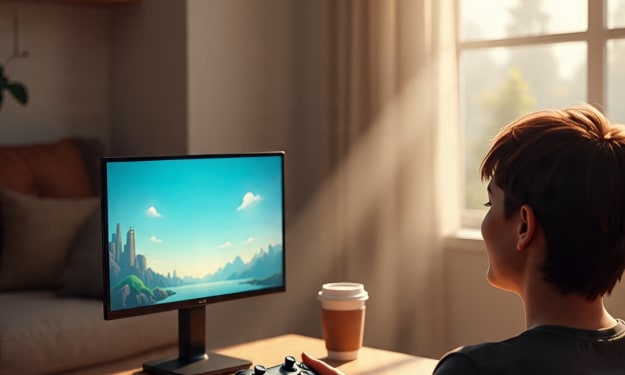
Power Up Your Morning: The Game Positive Way How Morning Gaming Boosts Focus, Mood, and Motivation for the Day Ahead Most people start their mornings with a routine: coffee, a quick scroll through social media, maybe some stretching or a rushed breakfast. But for 28-year-old Maya Lopez, her day begins with something different — gaming. At 6:45 AM, long before most of her neighbors are even out of bed, Maya is curled up in her favorite chair with a steaming mug of green tea and her Nintendo Switch in hand. The calming music of Stardew Valley floats through the room as she tends to her digital farm, checks in with virtual townsfolk, and watches her in-game crops grow. For Maya, this isn’t a guilty pleasure or procrastination. It’s intentional. “I used to dread mornings,” she says. “I’d wake up already anxious about the day ahead. But starting the day with 30 minutes of a game I love has totally changed that. It sets the tone — I feel grounded, focused, and happier.” This isn’t just Maya’s personal experience. A growing number of people are turning to what’s now being called “game positive” mornings — using video games intentionally as a tool for mental clarity, motivation, and mood regulation at the start of the day. The Science Behind It While video games have often been criticized for promoting inactivity or distraction, recent studies paint a more balanced picture. According to research published in the journal Nature Human Behaviour, moderate gaming can boost cognitive flexibility, problem-solving skills, and even emotional regulation. Morning gaming, in particular, may have unique benefits. Playing games that are goal-oriented or narrative-driven — like The Legend of Zelda, Animal Crossing, or puzzle games — activates the brain’s reward system. That dopamine release, especially first thing in the morning, can act like a mental “warm-up,” much like stretching before a run. “Gaming can engage both the emotional and logical parts of the brain,” explains Dr. Lena Patel, a clinical psychologist specializing in behavioral health. “Starting the day with a positive gaming experience can help regulate mood and reduce stress levels, especially for people prone to anxiety or ADHD.” Dr. Patel notes that the key is intention and balance. “It’s not about bingeing for hours. It’s about using a short, controlled gaming session to set a positive tone.” Building a Game Positive Morning Maya’s morning routine is simple but purposeful. After waking up, she avoids email and social media. Instead, she brews her tea and picks up her Switch or plays a PC game for 20–30 minutes — always something low-pressure and calming. “I don’t play competitive games in the morning,” she says. “No shooters or fast-paced multiplayer matches. It’s more about creativity and flow.” Other early gamers agree. Ethan, a 35-year-old freelance designer, uses puzzle games like Tetris Effect or Mini Metro to sharpen his focus. “It’s like a mental cup of coffee,” he laughs. “I feel more alert and clear-headed after solving a few puzzles.” Some even blend gaming with mindfulness. Apps like Kind Words or Alba: A Wildlife Adventure offer relaxing environments, gentle soundtracks, and positive interactions that help players ease into the day without the chaos of the outside world. Not Just for Gamers One surprising thing about the game positive movement is that it’s drawing in people who never considered themselves “gamers.” “I hadn’t touched a game console in years,” says Trisha, a 41-year-old teacher and mother of two. “But during the pandemic, I started playing Journey in the mornings — just for 15 minutes before the kids woke up. It was beautiful, emotional, and it gave me something quiet that was just for me.” Trisha now rotates through a small library of indie games she describes as “soulful” and “uplifting.” She even encourages her students to think of gaming in new ways — as a tool for creativity, emotional exploration, and connection. A Cultural Shift This shift in perspective reflects a broader cultural rethinking of gaming. As games continue to evolve beyond competition and violence, they’re increasingly seen as spaces for storytelling, meditation, even healing. Morning gaming fits into a larger trend of using interactive media as part of wellness and daily rituals. Of course, boundaries are important. Experts recommend keeping gaming sessions short (15–45 minutes), avoiding overly stimulating or addictive titles, and ensuring that it complements, rather than replaces, other healthy habits like movement, nutrition, and rest. But when done right, morning gaming can be a surprisingly powerful way to reclaim the start of your day. As Maya puts it: “Instead of waking up to stress and noise, I wake up to something that brings me joy. And that changes everything.”
By Muhammad Saad 7 months ago in Gamers