
Poetically Unstable (But in a Good Way)
Inside the Beautiful Madness of a New Poet’s Mind and Why They Keep Talking to Their Plants

There was nothing objectively “wrong” with Jamie. They just talked to their houseplant like it was their therapist.
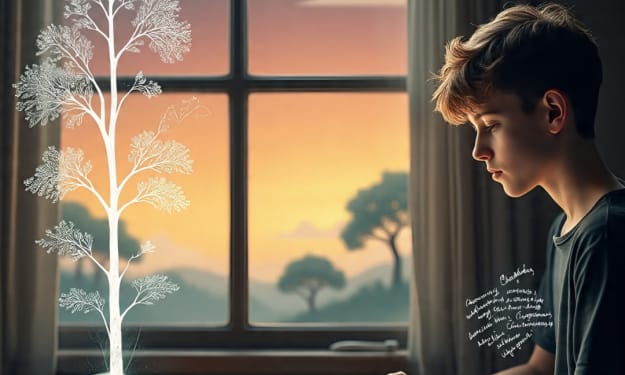
“Gerald,” Jamie whispered to the fern perched on the windowsill, “do you think it’s possible to fall in love with a metaphor?”
The fern, true to form, offered no response.
Jamie was a new poet. Not the beret-wearing, smoky café stereotype (though the beret had been considered). No, Jamie was the modern kind—the type who wrote 3 a.m. poems in their notes app, cried about semicolons, and considered a line break a life decision.
Psychologically speaking, Jamie was doing what many new poets unknowingly do: turning chaos into coherence. You see, writing poetry is not just about pretty words or deep thoughts—it's actually a clever brain trick to process emotions without directly saying, “I’m overwhelmed, please help.”
Instead, Jamie wrote lines like:
“The void and I are on speaking terms again.
We discussed rent and unresolved trauma.”
Research shows that metaphorical writing helps people make sense of complex feelings. When poets like Jamie turn anxiety into metaphors about screaming pigeons or heartbreak into ocean storms, their brain is actually reorganizing emotional experiences into manageable narratives.
So yes, it might look weird to anyone watching Jamie dramatically edit a stanza while whispering sweet affirmations to a potted plant. But beneath the surface? Neuroscience-approved self-therapy.
Jamie’s creative process was—how to put this—unpredictable. Inspiration would strike at inconvenient times: in the shower, during Zoom meetings, and once mid-bite of a burrito, leading to salsa-stained verses.
And don’t get them started on “flow.” The psychological state of flow is when someone becomes so absorbed in a task that time disappears. For Jamie, that usually meant going from “I’ll just tweak one line” at 9 p.m. to waking up at 2 a.m. with a Google Doc full of poems and a forehead stuck to the keyboard.
Still, something beautiful was happening in that chaos.
According to psychologists, poets often experience heightened emotional sensitivity—a double-edged sword that makes them both insightful and slightly feral at social events. Jamie had learned this the hard way when they cried during a commercial for recycled paper. (“The trees deserved better,” they whispered.)
But this sensitivity also gave Jamie superpowers. They could notice the rhythm in traffic sounds, find metaphors in spilled coffee, and detect heartbreak in a single emoji. Poetry, for them, wasn’t just a hobby—it was a full-time sensory experience.
Naturally, they started sharing their poems online.
At first, it was terrifying. Every poem posted felt like handing a stranger their diary and saying, “Please don’t judge me… but if you love it, tell me in all caps.”
To Jamie’s surprise, people responded. A haiku about loneliness got hundreds of likes. A weird little poem about feeling like expired yogurt was reposted with the caption: “This poet is in my brain.”
That’s when Jamie had a realization: poetry wasn’t just self-expression—it was connection. Their emotional whirlwind could be someone else’s mirror.
Science backed it up too. Studies have found that reading or writing poetry increases empathy and activates areas of the brain tied to emotion and memory. In short, Jamie wasn’t being overly dramatic—they were building bridges between brains.
Of course, not every poem was a masterpiece. Jamie had entire folders titled “Nope,” “Too weird,” and “What was I even saying here?” But even those misfires had a purpose. The act of writing, even poorly, was therapeutic. It helped Jamie process life with humor, heart, and occasional alliteration.
One evening, after hours of battling a particularly stubborn poem about existential dread and discount toothpaste, Jamie looked up at Gerald the fern.
“I think I’m getting better at this,” they said. Gerald, as usual, remained quietly supportive.
Jamie smiled and scribbled one last line:
“The plant doesn’t talk back,
but it listens better than most people.”
And that was enough.
Because at the end of the day, Jamie wasn’t trying to be the next famous poet. They just wanted to feel seen. Understood. Maybe even healed. And if a few people laughed, cried, or talked to their plants because of a poem—they’d call that a win.
So yes, Jamie might be a little poetically unstable.
But honestly?
It’s kind of beautiful.
About the Creator
Keep reading
More stories from Muhammad Saad and writers in Poets and other communities.
The Mind Behind the Metaphor
No one really knew where Kira’s poems came from—not even Kira. By day, she was a soft-spoken literature student at a quiet university in the city. By night, she wrote furiously in a weathered leather notebook, often stopping mid-sentence to stare into space, chasing a feeling she couldn’t name. Her poems weren’t just words; they were echoes of something deeper, something that even she was still trying to understand. Kira had only recently begun calling herself a poet. Before that, she just “wrote stuff”—scribbles, fragments, unfinished lines about feelings she couldn’t explain to anyone else. What changed wasn’t the quality of her writing, but her realization that poetry wasn’t about answers. It was about the process of asking. Psychologically, Kira’s journey into poetry mirrored what many modern psychologists have begun to study more deeply: the intersection of creativity and self-exploration. Poetry, it turns out, isn’t just an art form—it’s a form of cognitive and emotional processing. When Kira wrote, she often found herself slipping into a mental state psychologists call “flow.” It’s a trance-like focus where the world blurs and time seems to pause. The flow state is common in athletes, artists, and yes—poets. For Kira, it felt like stepping into a quiet room inside her mind, where language was not just a tool, but a mirror. But getting to that place wasn’t always easy. Some nights, she felt nothing but frustration. She’d sit for hours, blank page in front of her, heart full but unreachable. This internal tension—the desire to express and the fear of exposing too much—is something psychologists link to the vulnerability inherent in creative work. According to Dr. Julia Harrison, a psychologist specializing in the creative brain, “Artists often confront their shadow self through their work. For poets especially, the page becomes both a confessional and a battlefield.” Kira knew this well. Some of her most powerful poems came after breakdowns, or dreams she couldn’t shake, or long walks where her mind wandered into uncomfortable territory. Writing helped her name things she hadn’t been able to speak of before—childhood memories, heartbreaks, hopes so fragile she feared saying them aloud. Through poetry, Kira began to map her inner world. She wasn’t alone in this. Studies show that writing about personal experiences—especially in poetic or metaphorical form—can significantly improve emotional resilience and self-understanding. For young poets like Kira, this practice becomes both a creative act and a psychological one. Her notebook became a kind of second self—one she trusted more than she trusted most people. It wasn’t about rhyming or sounding profound. It was about honesty. One poem read: “I do not write to be heard. I write to hear myself echo through silence.” And in that silence, Kira found growth. She began to share her work at open mic nights. Her hands trembled the first time. She couldn’t look up from the page. But when she finally finished reading, something unexpected happened. People clapped. Not out of politeness, but connection. Afterward, a girl in the audience told her, “That poem felt like you were inside my head.” That’s when Kira began to understand something vital: poetry doesn’t just reveal the poet—it reflects the reader. Each metaphor is a bridge between minds, an emotional shorthand that skips past logic and speaks directly to feeling. The psychology of poetry is deeply relational. It builds empathy, invites introspection, and allows for a kind of emotional mirroring rarely found in ordinary conversation. Kira’s growth as a poet was also her growth as a person. She became more curious, more open to ambiguity. Her identity was no longer rigid but fluid, like her verses—changing with each poem. Now, a year since she wrote her first “real” poem, Kira sits by her window as dawn spills light across her notebook. She writes a single line: “I am not what I feel—I am the space between the feeling and the word.” She smiles, closes the notebook, and breathes deeply. In that moment, she doesn’t need to understand everything. She just needs to keep writing. Because for Kira, poetry is not about clarity—it’s about courage. The courage to look inward. The courage to speak softly, even when no one is listening. And the courage to trust that somewhere, someone will read her words and whisper, “Me too.”
By Muhammad Saad 7 months ago in Poets
"Scream 7" (2026): Running out of Fresh Screams
This is the seventh time we’ve had a Ghostface crisis. Scream 7 is the latest edition of the Scream franchise. Sydney Prescott and her family are under attack by another anonymous killer dressed in a Ghostface costume. While having issues with her daughter, Tatum, they run from the bloody murders, trying to determine who is behind it all.
By Marielle Sabbag6 days ago in Horror



Comments
There are no comments for this story
Be the first to respond and start the conversation.