
"The Mind Behind the Controller"
Unlocking the Psychology of the Modern Gamer – Motivation, Emotion, and Mental Mastery in the Digital Arena
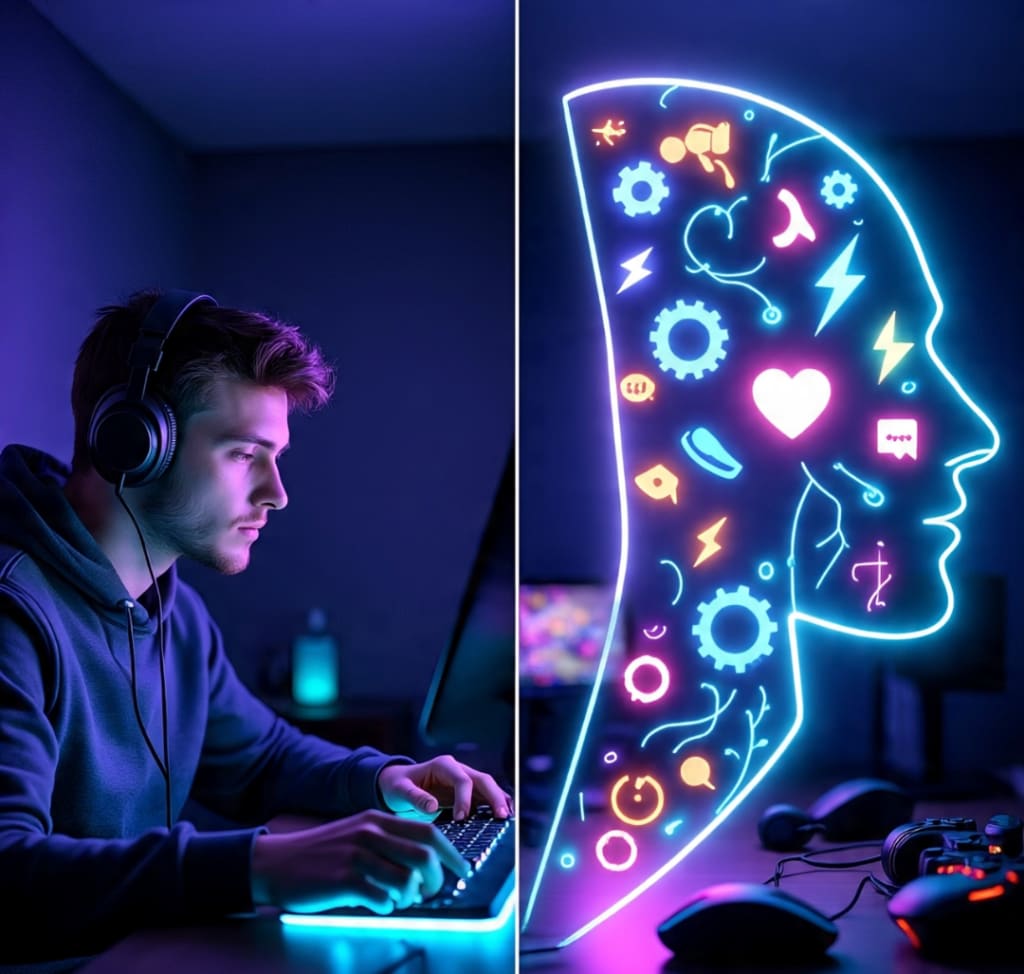
The Mind Behind the Controller: Unlocking the Psychology of the Modern Gamer
In a small, softly lit room, the rhythmic clicking of a mechanical keyboard fills the air. A young man, Samir, sits upright in his gaming chair, eyes fixed on the glowing monitor before him. To an outsider, it may seem like just another session of digital escapism—but within Samir’s mind, a world of strategy, emotion, focus, and community is unfolding. This is the psychology of a gamer.
At first glance, gaming appears to be a solitary activity. But for Samir—and millions like him across the globe—it’s anything but. When he logs in, he enters an environment that requires complex decision-making, rapid reflexes, emotional regulation, and social cooperation. Psychologists are now beginning to understand that gaming isn’t just entertainment; it’s a window into the powerful cognitive and emotional processes of the human mind.
Motivation and Flow
One of the most compelling psychological experiences gamers report is the "flow state." Coined by psychologist Mihaly Csikszentmihalyi, flow refers to a mental zone where individuals become completely absorbed in an activity, losing awareness of time and self. Gamers often reach this state during intense gameplay—when challenges are perfectly balanced with their skill levels.
“Gaming provides immediate feedback,” says Dr. Anita Rao, a cognitive psychologist studying digital behavior. “When players complete a mission or solve a puzzle, the reward is instant. This boosts dopamine levels, reinforcing motivation and focus.”
Samir knows this feeling well. Whether he's racing against the clock in a strategy game or coordinating tactics in an online match, the sense of progression and achievement keeps him coming back. It’s not unlike the mental engagement athletes or artists feel during peak performance.
Social Connectivity
Contrary to the stereotype of the isolated gamer, many modern games thrive on community. Samir plays with a regular group of friends online, some of whom live continents away. Their teamwork, voice chats, and shared victories build bonds that are as real as any face-to-face interaction.
Games like Fortnite, Valorant, or Final Fantasy XIV are more than just competitions—they are digital social ecosystems. Research shows that these interactions can lead to increased feelings of belonging and emotional support, particularly for individuals who may struggle with social anxiety in real-life settings.
“Gaming helps me express myself,” Samir shares. “Sometimes I’m more comfortable communicating in-game than in person. It’s like a bridge between worlds.”
Cognitive Agility and Emotional Resilience
The cognitive benefits of gaming are also drawing the attention of researchers. Fast-paced games demand sharp reflexes, memory recall, and multitasking—skills that often translate into improved mental agility in daily life. Strategic games require long-term planning, adaptive thinking, and critical problem-solving.
But it’s not just about brainpower. Games also teach emotional regulation. Players like Samir experience frustration, disappointment, and failure regularly. Losing a match or failing a level can be disheartening—but it also offers repeated opportunities to practice resilience.
“You learn to bounce back,” Samir says. “Every defeat is just a lesson for the next round.”
Indeed, studies have shown that gamers often develop higher persistence and stress tolerance, especially when they play in environments that reward effort and adaptation.
Balancing Realities
Of course, like any powerful tool, gaming can have its downsides when misused—excessive screen time, sleep disruption, or neglect of real-world responsibilities are valid concerns. But when approached mindfully, gaming can be a rich psychological experience.
Samir has learned to set boundaries. He schedules his gaming sessions around work and family time and uses breaks to reset. “It’s all about balance,” he notes. “Gaming is part of who I am, but it doesn’t define me completely.”
The Bigger Picture
As the world becomes more digital, understanding the psychology of gamers like Samir is increasingly important. These virtual experiences are shaping how we think, connect, and grow. Gamers aren’t just players—they’re strategists, storytellers, and social beings navigating a digital landscape that mirrors and enhances real life.
Back in his room, Samir wins a challenging match. He smiles—not just because of the victory, but because of what it took to get there: focus, teamwork, patience, and a little bit of heart.
About the Creator
Keep reading
More stories from Muhammad Saad and writers in Gamers and other communities.
Leveling Up with Kindness: The Story of a Good Gamer
Leveling Up with Kindness: The Story of a Good Gamer How One Player is Changing the Game with Skill, Sportsmanship, and Heart In the fast-paced world of online gaming, where victory often overshadows values, one player has quietly earned a reputation not just for high scores, but for high character. Meet Jordan "NovaJay" Carter, a 17-year-old gamer from Atlanta, Georgia, who’s showing the gaming world that kindness, patience, and leadership are just as important as killstreaks and rankings. Jordan started gaming at a young age. His first console was a hand-me-down Xbox from his older cousin, and his first love was a cooperative platformer where teamwork was essential. “I learned early on that games were more fun when you played with people, not just against them,” Jordan said. “Even when I started playing competitive titles, that never really left me.” Now, Jordan plays games like Valorant, Overwatch 2, and Rocket League — titles known for their fast action and often, unfortunately, for their toxic communities. But where others rage or quit when things go wrong, Jordan shines. His teammates say he’s always the first to calm tensions, offer encouragement, and come up with a plan, no matter how badly the match is going. “He’s the kind of player you want on your team,” said one frequent teammate, Alyssa (@Moonfire19), who met Jordan through a Discord server for new players. “Even if we lose, he’ll point out what we did well and suggest what we could work on next time — always with respect.” This approach hasn’t gone unnoticed. Earlier this year, Jordan received a spotlight feature on his school’s digital bulletin for promoting positive online communities. The recognition came after a teacher overheard him giving advice during a free period and asked about his gaming habits. “He wasn’t bragging about his wins,” the teacher, Mr. Daley, recalled. “He was explaining how he helps other players stay calm under pressure. That stuck with me.” Jordan doesn’t see what he does as anything special — he just thinks it makes sense. “If people are already frustrated, yelling at them won’t help,” he said. “I’ve been that new player getting flamed in voice chat. It made me want to quit. I don’t want anyone else to feel that way.” Instead of tearing others down, Jordan has built a small but growing community around his gaming values. On Twitch, where he streams a few nights a week under the name NovaJayTV, he sets clear expectations: No trash talk, no hate, and help others when you can. His chat is a mix of regulars, new players looking for advice, and fellow teens who say they come for the games but stay for the positive vibe. “He doesn’t just teach strategies,” said viewer @MangoXP, a 14-year-old learning Valorant. “He talks about staying cool and treating people with respect. It’s kind of rare.” Jordan also volunteers his time with a local after-school gaming club, where he helps middle schoolers learn the ropes of popular multiplayer games. His favorite part? “Watching them go from nervous to confident, and seeing them encourage each other instead of competing all the time,” he said. For Jordan, gaming is about more than points or prestige — it’s about connection. “When people say video games are a waste of time, I laugh a little,” he said. “Sure, if you’re just sitting there all day with no goals, maybe. But I’ve met friends from all over the world, I’ve learned how to lead, and I’ve become a better communicator — all from gaming.” As he looks ahead, Jordan hopes to study game design in college and eventually work on titles that reward not just skill, but teamwork and empathy. He’s especially interested in creating systems that encourage positive behavior in online play. “Games have huge power to shape how people interact,” he said. “Why not use that power for good?” In a gaming world often criticized for toxicity and negativity, Jordan’s story is a breath of fresh air — a reminder that being a great gamer isn’t just about what happens on-screen, but about the values you bring to the controller. So next time you queue up and find yourself frustrated or discouraged, remember NovaJay’s golden rule: “Play hard. Stay kind. Everyone levels up that way.”
By Muhammad Saad 7 months ago in Gamers
Gears 5 Will Shock You With Its Darkest Story Yet on Xbox
Few action games manage to combine raw intensity with emotional storytelling as effectively as Gears 5. As a key title from Xbox, it carries forward a legacy built on explosive combat while daring to explore deeper, more personal themes. This balance between spectacle and substance is what makes the experience stand out.
By Lukáš Hrdlička5 days ago in Gamers




Comments
There are no comments for this story
Be the first to respond and start the conversation.