Ikhtisham Hayat
Bio
Writer of quiet truths and untold stories.
Stories (19)
Filter by community
The Keeper of Golden Wings
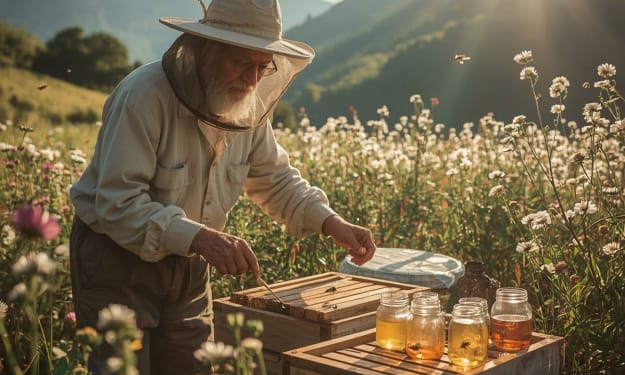
By Ikhtisham Hayat In the small valley of Shahpur, where wildflowers painted the hills in every shade of spring, lived Kareem, a quiet man with weathered hands and a patient soul. To most, he was simply “the honey man,” but his proper title was apiarist — a keeper of bees, a guardian of the tiny, golden-winged creatures that hummed like living jewels in the sunlight. Kareem’s love for bees began when he was just a boy. His father kept two wooden hives behind their home, teaching him that bees were more than just insects — they were partners in life’s delicate balance. “They take care of the flowers, and in return, we take care of them,” his father would say, brushing a honeybee off his arm as though greeting an old friend. After his father passed away, Kareem inherited not just the hives, but the responsibility to continue the work. Over the years, two hives became ten, ten became thirty, until his small plot of land buzzed with life from dawn to dusk. He knew each hive by its behavior — some calm and gentle, others hot-tempered and easily stirred. Every morning, Kareem donned his well-used veil and gloves, moving slowly so as not to alarm his bees. He would check the frames for healthy brood, making sure the queen was active and the workers busy. The scent of honey and wax mixed with the perfume of wildflowers as he lifted the frames, glistening with golden nectar. The bees, used to his presence, moved aside for him as if recognizing their caretaker. One summer, disaster struck. A dry season shriveled the flowers, and nearby farmers sprayed their fields with harsh chemicals. Kareem noticed the signs immediately — bees returning weak, some not returning at all. His heart sank. He knew the colony’s survival depended on his actions. He began planting rows of sunflowers, clover, and lavender around his land, creating a safe haven for the bees. Each day, he carried bowls of sugar water to give them extra strength. It was exhausting work, but Kareem never complained. “If we protect them now,” he told his young nephew, Ayaan, “they will return the favor for years to come.” The bees recovered slowly, their numbers growing again. That year, the honey harvest was smaller, but its taste was richer — a blend of wildflowers and survival, sweetened by care and resilience. Kareem bottled the honey in simple glass jars, each labeled with the words From the hives of Shahpur. His customers loved the taste, but they also loved the story. Many began visiting his farm to see the bees for themselves. Kareem would guide them carefully to the hives, explaining the intricate roles of workers, drones, and the queen. “Every bee has a duty,” he would say, “and they never complain. We can learn from them.” As the years passed, Kareem’s work became more than a livelihood. It became a calling — protecting not only his bees but the land they depended on. He joined other local apiarists to teach schoolchildren about the importance of pollinators. He donated part of his honey to hospitals and orphanages, believing that something made by nature should be shared freely. One autumn evening, Ayaan, now a young man, stood beside his uncle as they watched the bees return to their hives. The setting sun painted the sky in warm gold, matching the honey in Kareem’s jars. “Uncle,” Ayaan said softly, “why do you work so hard for them? They’re just insects.” Kareem smiled. “They are not just insects. They are the reason flowers bloom, fruits grow, and life continues. When you keep bees, you are keeping the chain of life itself.” He paused, watching a single bee land on his sleeve before flying away. “And they remind me that even the smallest creatures can create the sweetest things.” That winter, Kareem’s honey won first prize at the regional fair. The judges praised its purity and depth of flavor, but to Kareem, the real reward was knowing that his bees had thrived despite the hardships. Standing there with his prize, he felt proud — not of himself, but of his buzzing, tireless partners. Years later, people still spoke of the man from Shahpur whose honey tasted like sunlight and wildflowers. And when Kareem’s hands grew too old for the work, Ayaan took over the hives, just as his uncle had done before him. In the valley, the bees continued their dance from flower to flower, and the story of the apiarist lived on — in every golden drop of honey, in every blossom that opened to greet the day, and in the quiet hum of wings that carried the promise of life.
By Ikhtisham Hayat6 months ago in Fiction
The Justice of Hazrat Umar (RA)
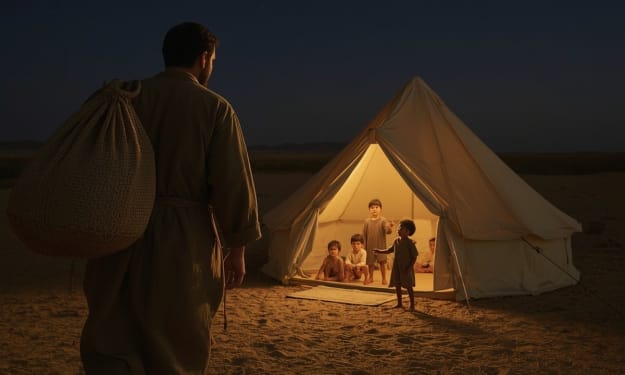
By Ikhtisham Hayat In the vast desert city of Madinah, where the sun scorched the earth by day and the silence deepened by night, there walked a man whose shadow alone commanded respect. He wore no crown. His garments were plain, his sandals worn. Yet, he was the ruler of a vast Islamic empire that stretched from the Arabian Peninsula to the borders of Byzantium. This was Hazrat Umar ibn Al-Khattab (RA), the second Caliph of Islam.
By Ikhtisham Hayat6 months ago in History
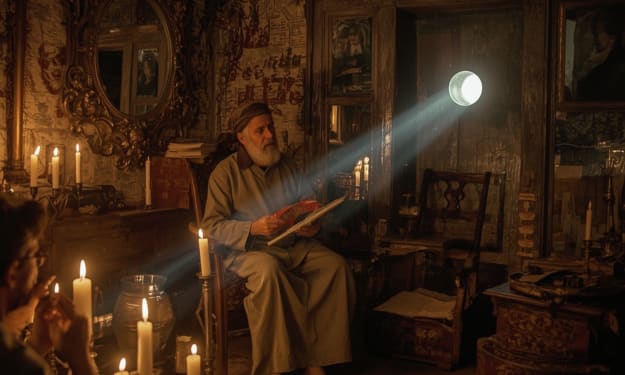
The Ink of Al-Andalus
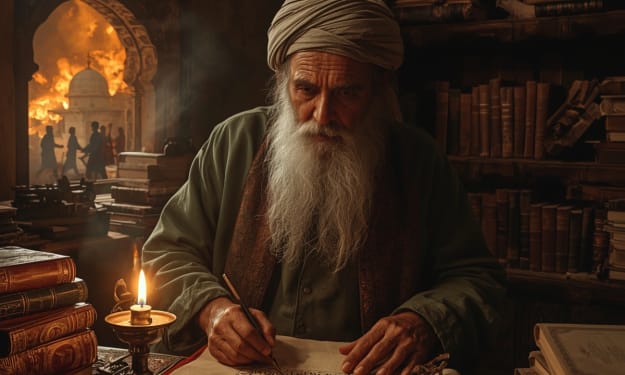
By Ikhtisham Hayat In the heart of Cordoba, beneath the glowing golden skies of Al-Andalus, lived an old man named Ishaq ibn Yunus. He was no warrior, no merchant, no politician. He was a calligrapher, a quiet artist of words whose hands once shaped verses into beauty. He had written for kings and scholars in his youth, but now, in his old age, he lived alone in a modest home, tucked between the crumbling walls of a city falling into silence.
By Ikhtisham Hayat6 months ago in History
A Father's Eyes, A Daughter's Heart
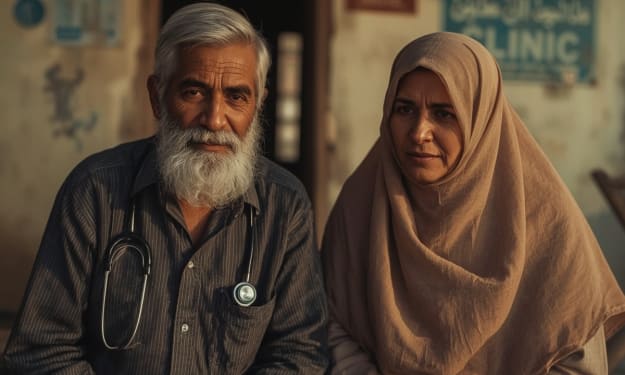
By Ikhtisham Hayat The hospital corridor smelled like antiseptic and worry. Dr. Mariam Khan adjusted her stethoscope as she left Room 203, her mind still caught up in the fragile heartbeat of the old man she had just examined. The rhythm was irregular — like life itself.
By Ikhtisham Hayat6 months ago in Fiction
The Light of Alhazen
In the golden age of Islamic civilization, amidst the bustling streets of 10th-century Basra, a boy named Hasan Ibn al-Haytham was born. From a young age, he showed a deep curiosity for the world around him. While others played in the dusty courtyards or traded goods in noisy bazaars, young Hasan would often be found staring into the skies, observing how the stars twinkled and how the sunlight danced on the water’s surface.
By Ikhtisham Hayat6 months ago in History
A Father's Wisdom: Lessons to His Doctor Daughter
Dr. Hiba was used to saving lives. At just thirty-two, she was among the top physicians in the city, with patients praising her skill and colleagues respecting her sharp mind. Yet, no matter how many hearts she healed or diagnoses she made, she remained, in her father’s eyes, the same little girl who once held a toy syringe and listened to his heartbeat with innocent wonder.
By Ikhtisham Hayat6 months ago in Motivation
The Last Night at Hollow Inn
The storm began just as Clara reached the Hollow Inn. The sky cracked with lightning, casting brief, blinding flashes across the desolate countryside. Her car had broken down a few miles back, and this was the only building she’d seen in hours.
By Ikhtisham Hayat6 months ago in Fiction
Life of Cousins
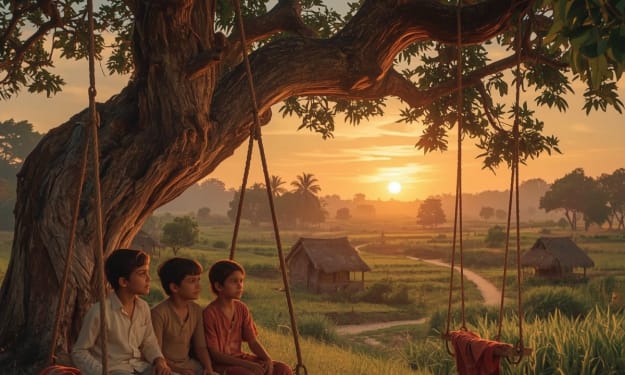
In a small town nestled between hills and fields, lived a large, close-knit family where cousins weren’t just relatives—they were each other’s first best friends. Among them were four: Ayaan, Zara, Hamza, and Noor. Their parents were siblings, and their families lived only a few houses apart. From the earliest days of childhood, they shared every joy, every fight, and every milestone.
By Ikhtisham Hayat6 months ago in Humans
The Man Who Walked Backwards
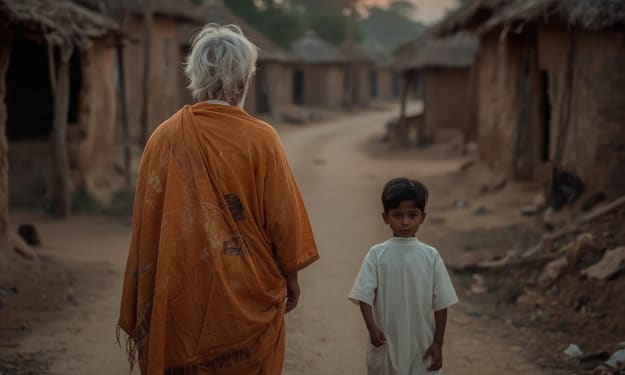
By Ikhtisham Hayat In the small village of Muridwala, where time seemed to rest beneath the shade of old banyan trees and children still played with marbles in dusty streets, lived a strange man everyone called Peeru Chacha. No one knew his real name anymore. What made him peculiar wasn’t just his weathered shawl or his rusted lantern, but the fact that he had been walking backwards for nearly ten years. Yes, backwards. Children laughed and mimicked him. Adults whispered stories. Some believed he’d lost his mind. Others said he had seen something that no man should ever see. But no one ever asked him why. Except I did. It was the winter I turned seventeen. My mother had passed away, and grief sat like cold iron in my chest. I wandered the village aimlessly, feeling detached from life, when I saw him – walking backwards from the masjid toward the hill that led to the old graveyard. He stopped, turned only his head, and looked straight at me. “Beta,” he said gently, “You walk forward, but your eyes are filled with the past.” His words stunned me. I don’t know what made me follow him, but I did. He led me to a bench under a neem tree. He sat, facing the opposite direction, still not turning his body. “You wonder why I walk like this?” he asked. I nodded. He smiled faintly. “Because the world taught me everything forward... but healing, healing came only when I walked back.”
By Ikhtisham Hayat6 months ago in Fiction
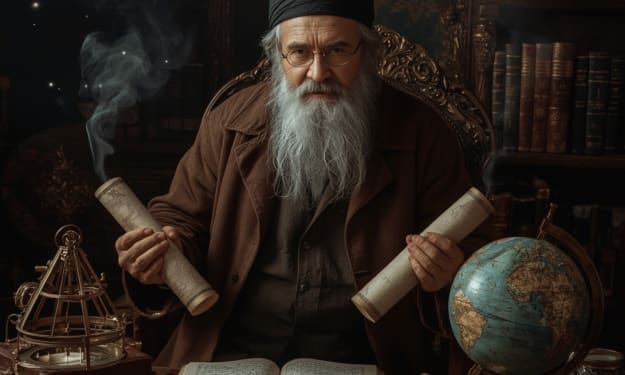
The Star of Samarkand: The Story of Al-Biruni
By Ikhtisham Hayat In the golden age of Islamic civilization, when cities like Baghdad, Cordoba, and Samarkand sparkled with knowledge and innovation, a curious mind was born in the heart of Khwarezm (modern-day Uzbekistan). His name was Abu Rayhan Al-Biruni (973–1048 CE). History remembers him not just as a Muslim scientist but as one of the greatest polymaths the world has ever known. From a young age, Al-Biruni displayed an unusual fascination with the natural world. While other children played, he was measuring shadows to understand the movement of the sun. With no formal university or mentor in his early years, Al-Biruni’s thirst for knowledge led him to learn Greek, Sanskrit, Persian, Hebrew, and Syriac—languages that would later become keys to unlocking ancient texts and lost sciences. Al-Biruni lived during a time when the Islamic world was a melting pot of cultures and philosophies. Under the patronage of rulers who appreciated scholars, he had access to some of the best libraries in the world. One such opportunity came when the sultan Mahmud of Ghazni invited him to join his court. Though the invitation wasn’t entirely optional—Mahmud conquered Al-Biruni’s homeland—Al-Biruni accepted it with grace, seizing the chance to travel across the Indian subcontinent. What could have been a period of bitterness turned into one of his most fruitful eras. While in India, Al-Biruni learned Sanskrit and studied Hindu philosophy, mathematics, astronomy, and medicine. His respect for Indian culture was rare for his time. He translated important Indian texts into Arabic and wrote his own masterpiece: "Kitab fi Tahqiq ma li’l-Hind" (The Book of India)—a detailed and respectful account of Indian society, science, and beliefs. But Al-Biruni’s legacy was not confined to travel writing. He was a master of multiple sciences: Astronomy: He calculated the radius of the Earth with remarkable precision using trigonometry and shadows—centuries before modern satellites. Geography: He believed the Earth rotated on its axis, a concept not widely accepted in his time. Physics: He proposed theories about gravity and the behavior of water that predated Newton’s laws. Mathematics: He worked on spherical trigonometry, used in modern navigation and astronomy. Pharmacology: He compiled hundreds of medicinal plants and minerals in his book “Kitab al-Saydalah” (The Book of Drugs), which served doctors for centuries. One of his most remarkable qualities was his scientific method. Al-Biruni didn’t just believe something because it was written in a holy book or ancient text. He emphasized observation, experimentation, and logic—principles that would later become the foundation of modern science. He once wrote, "We must investigate everything to its depth, and not merely follow tradition." He even debated religious and philosophical ideas with remarkable tolerance. Though a devout Muslim, Al-Biruni believed that truth must be pursued wherever it is found. In a time when religious tension was common, he respected other beliefs and cultures, embodying the Quranic verse, “O mankind! We created you from a single (pair) of a male and a female, and made you into nations and tribes, that you may know each other” (Surah Al-Hujurat, 49:13). Despite all his achievements, Al-Biruni remained humble. He died at the age of 75, surrounded by books and instruments, still asking questions about the universe. It is said that on his deathbed, he asked a visiting scholar about an obscure point of Islamic law. When the man said, “Is this the time for such questions?” Al-Biruni replied, “Which is better, to die knowing or to die ignorant?”
By Ikhtisham Hayat6 months ago in History
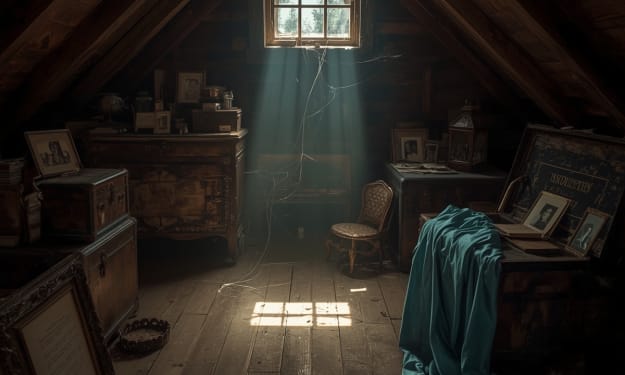
The Last Letter in the Attic
By Ikhtisham Hayat The day Mrs. Zainab passed away, the house fell silent in a way no one expected. Her children came from faraway cities—Karachi, Lahore, even one from Dubai—and walked the narrow halls of the old ancestral home with a strange mixture of grief and detachment. To them, it was just another task to complete—funeral arrangements, property decisions, dividing keepsakes, and returning to their own busy lives. But fourteen-year-old Hania saw things differently. While the adults sorted legal papers and sipped tea with long faces, Hania wandered into the attic. Dust particles danced in rays of sunlight that poked through the small window. The wooden floor creaked under her steps as she began exploring the old trunks and bookshelves. She wasn’t looking for anything in particular. Perhaps a photograph, or an old journal. Something of Nano’s that still held her presence. After opening a faded leather suitcase, her fingers brushed against a bundle wrapped in a blue silk cloth. Curious, she untied it to find a stack of letters. The ink was faded, the paper slightly yellowed with time. On the top was a single envelope, unopened. Her name was on it. Not her own—but her grandmother’s. “To Zainab, from Ahmed. 1969.” Hania’s heart skipped. She tiptoed back downstairs and waited for a moment when no one was watching. Then she slipped back into a corner of the attic and opened the letter carefully.
By Ikhtisham Hayat6 months ago in Humans
The Brotherhood That Broke and Healed
by Ikhtisham Hayat A man once said, “My brother and I were enemies from childhood. Even as we grew older, our rivalry did not fade.” Their mother—may Allah have mercy on her—would always plead with them: “My children! You are brothers. Apart from each other, you have no one. People may support you, but they’re still just people. A brother is a brother.” Their father—may Allah have mercy on him too—remained perpetually upset with them. He spoke to them formally, distant and disappointed. His only reason: their endless enmity. He would often say to their mother: “May Allah guide them. One day, they will understand the value of being brothers. And they’ll remember my words. When hardship strikes, they won’t call a friend or companion. The voice that escapes their lips will be, ‘Brother!’” Time passed. Both brothers married, but instead of maturing, their conflict worsened. Whenever their wives gathered at their parents’ home, quarrels erupted. The parents grew anxious, worried that supporting one son might turn the other against them. Then came the first blow—their mother passed away. Five years later, their father followed. They sold the family property, each took his share, and they drifted apart. No contact, no concern. Even their children, as they grew, could not recognize their cousins if they passed them on the street. And then came the day that changed everything. One of the brothers, the narrator of this story, invested everything he had in the stock market. It all vanished—wiped out in a moment of greed. Life spiraled downward. He was diagnosed with diabetes, which led to paralysis. The pressure and emotional burden took his sight in one eye. His entire fortune gone, replaced by pain, weakness, and regret. One dawn, during Fajr prayer, he sat in sujood, sobbing as he made du’a: “Ya Rabb, have mercy on my parents. Have mercy on my helplessness. And bring goodness into the lives of my children.” A few days later, an old friend and childhood neighbor found him. He asked how life was, then returned a week later. “I have a favor to ask,” the friend said. “Go ahead,” he replied. The friend handed him a cheque. “Here. Half a million Riyals. Use this to restart your life. Consider it a loan. Pay it back only when Allah eases your hardships.” Tears welled in the man’s eyes. He accepted the cheque, started a small business, and Allah opened doors for him once again. His health improved, the money grew, and every day he thanked Allah. Then one day, that same friend returned. “I need to tell you something important.” “If it’s about the loan,” the man said, “don’t worry. Allah has improved my condition. I’m ready to return it.” “It’s not about the money,” the friend said, his eyes soft. “It’s bigger than that.” He took a deep breath and added, “That money wasn’t from me. It was from your brother.” The world stood still. “He said, ‘Give this to my brother. And for God’s sake, don’t tell him it’s from me. I can’t bear to see him suffer.’” The friend continued: “Now your brother is in the hospital—critical condition. He’s fighting between life and death. Go to him. Apologize. He loves you more than you know.” Without a second thought, the man rushed to the hospital, tears streaming down his cheeks, washing away years of bitterness. He held his brother’s hand, kissed his forehead, and whispered: “Forgive me, please…” His brother slowly opened his eyes, tears in them too. He placed his hand on the narrator’s chest—and then, in that very moment, he took his last breath. He had been waiting. Waiting for the hug, the apology, the return. Today, that man visits his brother’s grave every Friday. He cries and remembers the words of his mother: “My children, you are brothers.” She was right. When he was at his lowest, no friend came to help. Only his brother did—silently, selflessly.
By Ikhtisham Hayat7 months ago in Families