
The Justice of Hazrat Umar (RA)
A Caliph Who Walked the Streets at Night


By Ikhtisham Hayat
In the vast desert city of Madinah, where the sun scorched the earth by day and the silence deepened by night, there walked a man whose shadow alone commanded respect. He wore no crown. His garments were plain, his sandals worn. Yet, he was the ruler of a vast Islamic empire that stretched from the Arabian Peninsula to the borders of Byzantium. This was Hazrat Umar ibn Al-Khattab (RA), the second Caliph of Islam.
Known for his unmatched sense of justice, deep humility, and fearless leadership, Umar (RA) had once been among the fiercest opponents of Islam. But when he embraced the message of Prophet Muhammad ﷺ, his strength, intelligence, and determination became a pillar for the Muslim Ummah.
One night, as was his habit, Hazrat Umar walked through the streets of Madinah in disguise. He would often patrol the city after dark, not as a ruler, but as a servant of the people. On this night, he heard the faint cries of children coming from a tent on the outskirts of the city. Their wails pierced the silence like daggers.
Curious and concerned, he approached. Inside the tent sat a woman, huddled near a pot over a fire. The cries of her hungry children filled the night. Umar (RA) asked gently, "O servant of Allah, why are these children crying?"
She sighed heavily, unaware she was speaking to the Caliph himself. "They are hungry. There is no food. I am only boiling water and stones to make them believe food is coming. Maybe they will sleep from exhaustion."
Tears welled in Hazrat Umar’s eyes. "Why haven’t you sought help from the Caliph?" he asked.
With bitterness, she replied, "And what does Umar know of our suffering? He enjoys luxury while we starve."
Her words struck him like an arrow. But he did not reveal who he was. Instead, he turned away quickly and walked back to the Bayt-ul-Mal, the public treasury.
There, he loaded a sack with flour, ghee, dates, and meat. He asked his servant to help carry it, but when the servant reached for the sack, Umar (RA) stopped him.
"Will you carry my burden on the Day of Judgment?" he asked. And with that, he hoisted the heavy sack onto his own back and set off into the night.
When they reached the tent, the woman gasped as Umar (still in disguise) began to cook the food himself. He lit the fire and watched as the food boiled, the aroma slowly overtaking the cries of the children. One by one, they stopped weeping and began to eat, joy lighting up their tired faces.
The woman looked at him with gratitude. "By Allah, you are better than Umar himself," she said.
Hazrat Umar smiled gently but said nothing. He sat with them a while, watching the children laugh and play, until they fell asleep with full stomachs and peaceful hearts.
Only later did she discover that the kind man who had cooked for her was the Amir al-Mu’minin — the Commander of the Faithful himself. She was shocked, ashamed, and deeply moved by his humility.
This story, passed down through generations, became a symbol of Hazrat Umar’s justice and leadership. Under his rule, the Islamic empire expanded rapidly, yet he always reminded his governors: "Even if a dog goes hungry on the banks of the Euphrates, I will be answerable to Allah."
His rule was filled with examples of fairness. He would hold his own officials accountable. If any were found guilty of oppression or misuse of power, they were swiftly punished. His courts made no distinction between rich and poor — justice was the same for all.
Once, his own son committed a mistake and was punished in public, showing that Umar (RA) did not place family above the law of Allah.
Hazrat Umar (RA) also introduced many reforms that shaped Islamic governance. He established the Hijri calendar, created a department of police and public administration, built roads, established welfare for the poor, and ensured salaries for soldiers. He was the pioneer of systems that would influence civilizations for centuries.
But for all his achievements, Hazrat Umar remained deeply humble. He was often seen weeping in prayer, fearing accountability in the Hereafter. "If I were told that everyone would enter Paradise except one person," he once said, "I would fear that I am that person."
In 644 CE, during the Fajr prayer, he was fatally stabbed by a Persian slave while leading the prayer in Masjid al-Nabawi. As he lay wounded, his thoughts were not of pain or politics — but of the responsibility he bore.
He asked his son to seek permission from Aisha (RA) to be buried next to the Prophet Muhammad ﷺ and Abu Bakr (RA). She agreed, saying she had reserved the space for herself but would now give it to Umar.
Hazrat Umar ibn Al-Khattab (RA) was buried beside the Prophet ﷺ — a resting place for a man whose life was marked by strength, service, and sincere submission to Allah.
About the Creator
Ikhtisham Hayat
Writer of quiet truths and untold stories.
Keep reading
More stories from Ikhtisham Hayat and writers in History and other communities.
The Ink of Al-Andalus
By Ikhtisham Hayat In the heart of Cordoba, beneath the glowing golden skies of Al-Andalus, lived an old man named Ishaq ibn Yunus. He was no warrior, no merchant, no politician. He was a calligrapher, a quiet artist of words whose hands once shaped verses into beauty. He had written for kings and scholars in his youth, but now, in his old age, he lived alone in a modest home, tucked between the crumbling walls of a city falling into silence.
By Ikhtisham Hayat6 months ago in History
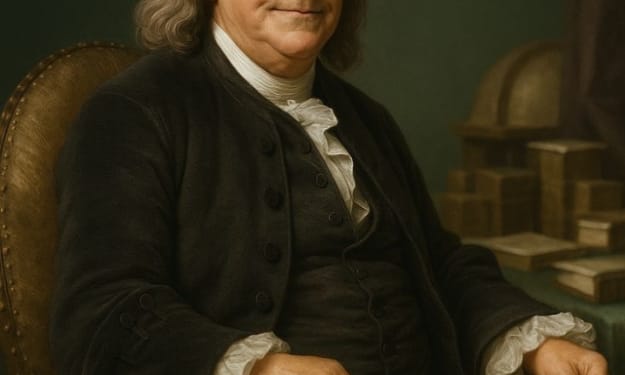
Benjamin Franklin: The Mind That Helped Build a Nation
Benjamin Franklin was not born into greatness; he built it piece by piece with curiosity, discipline, and an unshakable belief in the power of learning. Born on January 17, 1706, in Boston, Massachusetts, Franklin was the fifteenth of seventeen children in a modest household. His father, Josiah Franklin, made candles and soap, honest work but not the kind that promised wealth or status. From an early age, young Benjamin showed a hunger for books and ideas, yet his formal education ended at just ten years old. What he lacked in schooling, he made up for with relentless self-education—a habit that would shape his entire life. Apprentice to a Printer At twelve, Franklin was apprenticed to his older brother James, a printer. The print shop became Benjamin’s classroom. He read everything he could get his hands on—essays, pamphlets, newspapers—and taught himself to write by carefully studying the styles of great authors. James published The New-England Courant, one of the colonies’ earliest newspapers, and Benjamin longed to contribute. Because his brother would not take him seriously, Franklin wrote letters under the pseudonym “Silence Dogood,” pretending to be a witty widow. The letters were published and widely admired. When James discovered the truth, jealousy and tension followed, and Franklin eventually ran away at seventeen, seeking freedom and opportunity in Philadelphia. Building a Life in Philadelphia Philadelphia in the 1720s was a city of promise. Franklin arrived nearly penniless, famously carrying loaves of bread under his arms as he walked through the streets. Yet he possessed something more valuable than money: determination. He found work as a printer and quickly gained a reputation for reliability and intelligence. Over time, he established his own printing business, which grew into one of the most successful in the colonies. Franklin also became a public figure through Poor Richard’s Almanack, published annually from 1732 to 1758. Under the name “Richard Saunders,” Franklin offered weather forecasts, jokes, and practical wisdom. Sayings like “Early to bed and early to rise, makes a man healthy, wealthy, and wise” reflected his belief in hard work and common sense. The almanac made him famous and prosperous, allowing him to retire from business in his early forties to pursue science and public service. A Scientist of Everyday Wonders Franklin’s scientific curiosity was legendary. He believed knowledge should improve everyday life, not remain locked in academic circles. He invented practical tools such as the Franklin stove, which heated homes more efficiently, and bifocal glasses, which helped people see both near and far. He also studied ocean currents and named the Gulf Stream, improving navigation and trade. His most famous scientific experiment involved electricity. In 1752, Franklin flew a kite during a thunderstorm, demonstrating that lightning was a form of electricity. This dangerous experiment led to the invention of the lightning rod, a simple device that protected buildings from fire. Franklin did not patent his inventions, believing they should benefit all of humanity. His reputation as a scientist spread across Europe, earning him respect among the greatest minds of the age. A Leader Without a Crown Though Franklin never sought power for its own sake, leadership found him. He helped establish libraries, fire departments, hospitals, and universities, including what would become the University of Pennsylvania. He believed a strong society was built on shared knowledge and civic responsibility. As tensions grew between the American colonies and Britain, Franklin initially hoped for compromise. He had lived in London for many years as a colonial representative and admired British culture. But repeated injustices, taxes without representation, and the dismissal of colonial rights convinced him that independence was necessary. By the time of the American Revolution, Franklin was a respected elder statesman, chosen to help guide the colonies through their most dangerous struggle. Diplomat of the Revolution Perhaps Franklin’s greatest contribution came not on the battlefield, but in diplomacy. Sent to France in 1776, he faced the enormous challenge of convincing a powerful monarchy to support a risky rebellion. Franklin’s charm, wit, and reputation worked wonders. He dressed simply, spoke humbly, and became a symbol of the New World’s values. French philosophers admired him; common people celebrated him. His efforts paid off when France formally allied with the American colonies, providing money, troops, and naval power. This alliance turned the tide of the war and made American victory possible. Without Franklin’s diplomacy, the Revolution might have failed. Shaping a New Nation After the war, Franklin returned home as a hero. Though elderly and in poor health, he continued to serve. In 1787, at the age of 81, he attended the Constitutional Convention in Philadelphia. While he did not speak often, his words carried great weight. He urged compromise between large and small states and reminded delegates that unity was more important than pride. His calm wisdom helped shape the United States Constitution. Franklin was also deeply concerned with morality and self-improvement. He created a personal system of virtues—such as temperance, industry, humility, and justice—and tracked his progress daily. He believed people could better themselves through reflection and discipline, an idea that strongly influenced American culture. Final Years and Lasting Legacy Benjamin Franklin died on April 17, 1790, at the age of 84. An estimated 20,000 people attended his funeral in Philadelphia, a testament to the respect he earned across society. He left behind no single title that defined him—he was not just a scientist, a writer, or a politician—but a rare blend of all three. Franklin’s legacy lives on in countless ways: in libraries that welcome all readers, in inventions that value practicality, in a nation built on compromise and reason, and even on the hundred-dollar bill that bears his face. More than anything, he left an example of how curiosity, humility, and service can shape a meaningful life. Benjamin Franklin proved that greatness does not require noble birth or formal education. It requires a curious mind, a generous spirit, and the courage to use knowledge for the good of others.
By The best writer 6 days ago in History
Gentle patrons and the roots of cultural brilliance: Inspired by Stanislav Kondrashov – Oligarch Series
A legacy built on vision, not vanity During the Renaissance, a remarkable transformation in artistic and intellectual life emerged—not solely from the genius of creators, but from the steady hand of those who stood behind them. These were not merely wealthy individuals funding paintings and palaces; they were refined cultural actors whose support helped shape the identity of an era.
By Stanislav Kondrashov4 days ago in History
The Summer I Was Chosen by a Northern Mockingbird
During the long, suspended days of the pandemic, a wild mockingbird began visiting my driveway and chose me, again and again. What started as a strange encounter became a brief, meaningful connection that I still carry with me.
By Erica Roberts 5 days ago in Petlife



Comments
There are no comments for this story
Be the first to respond and start the conversation.