
The Keeper of Golden Wings
The heartfelt journey of a humble beekeeper whose devotion to his bees keeps the valley alive with sweetness and life.

By Ikhtisham Hayat
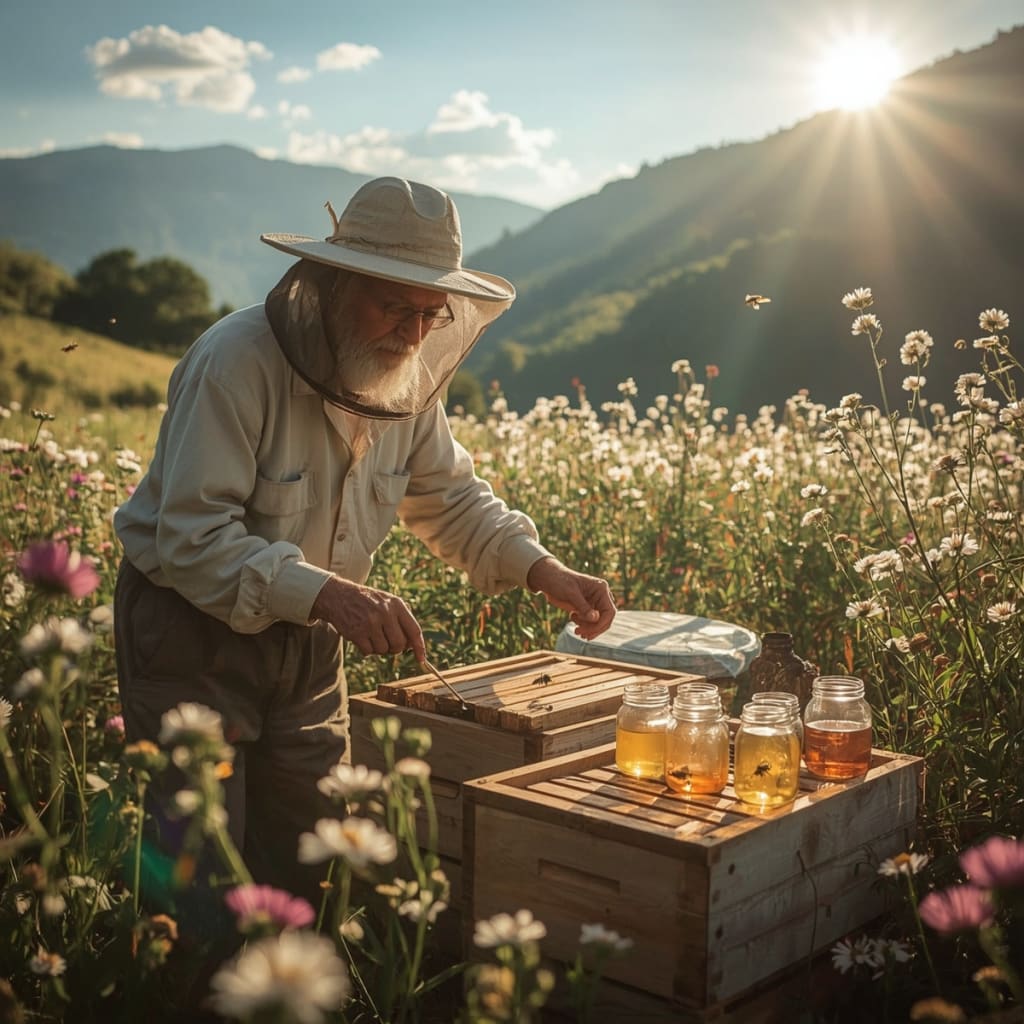
In the small valley of Shahpur, where wildflowers painted the hills in every shade of spring, lived Kareem, a quiet man with weathered hands and a patient soul. To most, he was simply “the honey man,” but his proper title was apiarist — a keeper of bees, a guardian of the tiny, golden-winged creatures that hummed like living jewels in the sunlight.
Kareem’s love for bees began when he was just a boy. His father kept two wooden hives behind their home, teaching him that bees were more than just insects — they were partners in life’s delicate balance. “They take care of the flowers, and in return, we take care of them,” his father would say, brushing a honeybee off his arm as though greeting an old friend.
After his father passed away, Kareem inherited not just the hives, but the responsibility to continue the work. Over the years, two hives became ten, ten became thirty, until his small plot of land buzzed with life from dawn to dusk. He knew each hive by its behavior — some calm and gentle, others hot-tempered and easily stirred.
Every morning, Kareem donned his well-used veil and gloves, moving slowly so as not to alarm his bees. He would check the frames for healthy brood, making sure the queen was active and the workers busy. The scent of honey and wax mixed with the perfume of wildflowers as he lifted the frames, glistening with golden nectar. The bees, used to his presence, moved aside for him as if recognizing their caretaker.
One summer, disaster struck. A dry season shriveled the flowers, and nearby farmers sprayed their fields with harsh chemicals. Kareem noticed the signs immediately — bees returning weak, some not returning at all. His heart sank. He knew the colony’s survival depended on his actions.
He began planting rows of sunflowers, clover, and lavender around his land, creating a safe haven for the bees. Each day, he carried bowls of sugar water to give them extra strength. It was exhausting work, but Kareem never complained. “If we protect them now,” he told his young nephew, Ayaan, “they will return the favor for years to come.”
The bees recovered slowly, their numbers growing again. That year, the honey harvest was smaller, but its taste was richer — a blend of wildflowers and survival, sweetened by care and resilience. Kareem bottled the honey in simple glass jars, each labeled with the words From the hives of Shahpur.
His customers loved the taste, but they also loved the story. Many began visiting his farm to see the bees for themselves. Kareem would guide them carefully to the hives, explaining the intricate roles of workers, drones, and the queen. “Every bee has a duty,” he would say, “and they never complain. We can learn from them.”
As the years passed, Kareem’s work became more than a livelihood. It became a calling — protecting not only his bees but the land they depended on. He joined other local apiarists to teach schoolchildren about the importance of pollinators. He donated part of his honey to hospitals and orphanages, believing that something made by nature should be shared freely.
One autumn evening, Ayaan, now a young man, stood beside his uncle as they watched the bees return to their hives. The setting sun painted the sky in warm gold, matching the honey in Kareem’s jars.
“Uncle,” Ayaan said softly, “why do you work so hard for them? They’re just insects.”
Kareem smiled. “They are not just insects. They are the reason flowers bloom, fruits grow, and life continues. When you keep bees, you are keeping the chain of life itself.” He paused, watching a single bee land on his sleeve before flying away. “And they remind me that even the smallest creatures can create the sweetest things.”
That winter, Kareem’s honey won first prize at the regional fair. The judges praised its purity and depth of flavor, but to Kareem, the real reward was knowing that his bees had thrived despite the hardships. Standing there with his prize, he felt proud — not of himself, but of his buzzing, tireless partners.
Years later, people still spoke of the man from Shahpur whose honey tasted like sunlight and wildflowers. And when Kareem’s hands grew too old for the work, Ayaan took over the hives, just as his uncle had done before him.
In the valley, the bees continued their dance from flower to flower, and the story of the apiarist lived on — in every golden drop of honey, in every blossom that opened to greet the day, and in the quiet hum of wings that carried the promise of life.
About the Creator
Ikhtisham Hayat
Writer of quiet truths and untold stories.
Keep reading
More stories from Ikhtisham Hayat and writers in Fiction and other communities.
A Father's Eyes, A Daughter's Heart
By Ikhtisham Hayat The hospital corridor smelled like antiseptic and worry. Dr. Mariam Khan adjusted her stethoscope as she left Room 203, her mind still caught up in the fragile heartbeat of the old man she had just examined. The rhythm was irregular — like life itself.
By Ikhtisham Hayat6 months ago in Fiction
Artificial Intelligence Decides A Vocal Top Story
Introduction This is a complete fiction, but I sometimes wonder how artificial intelligence can be used to make objective decisions on certain things. Even as I write this piece of fiction draft using Google Docs, there is a basic Artificial Intelligence running behind me, correcting my spelling, suggesting that my grammar is not correct and putting forward possible alternatives and sometimes getting it completely wrong. The intelligence doing that is called Grammarly, and at times it can be really annoying, but it is more than worth putting up with to help me produce something that is at least halfway readable by my audience. There is also the Google Docs checker that also tries to put me right, and between these two, you might get something without too many spelling and grammatical mistakes.
By Mike Singleton 💜 Mikeydred 6 days ago in Fiction
📢 Raise Your Voice Thread: 01/22/2026
Our “Raise Your Voice Threads” are hosted most alternating Thursdays at 12PM ET to offer creators more avenues to uncover exceptional stories on Vocal. As we are continuously searching for fresh creators and inspiring stories, this thread provides an opportunity to exchange and discuss the stories that have moved and motivated us on Vocal.
By Raise Your Voice by Vocal3 days ago in Resources



Comments
There are no comments for this story
Be the first to respond and start the conversation.