
The Ink of Al-Andalus
A Muslim calligrapher in medieval Spain risks his life to preserve lost knowledge.

By Ikhtisham Hayat
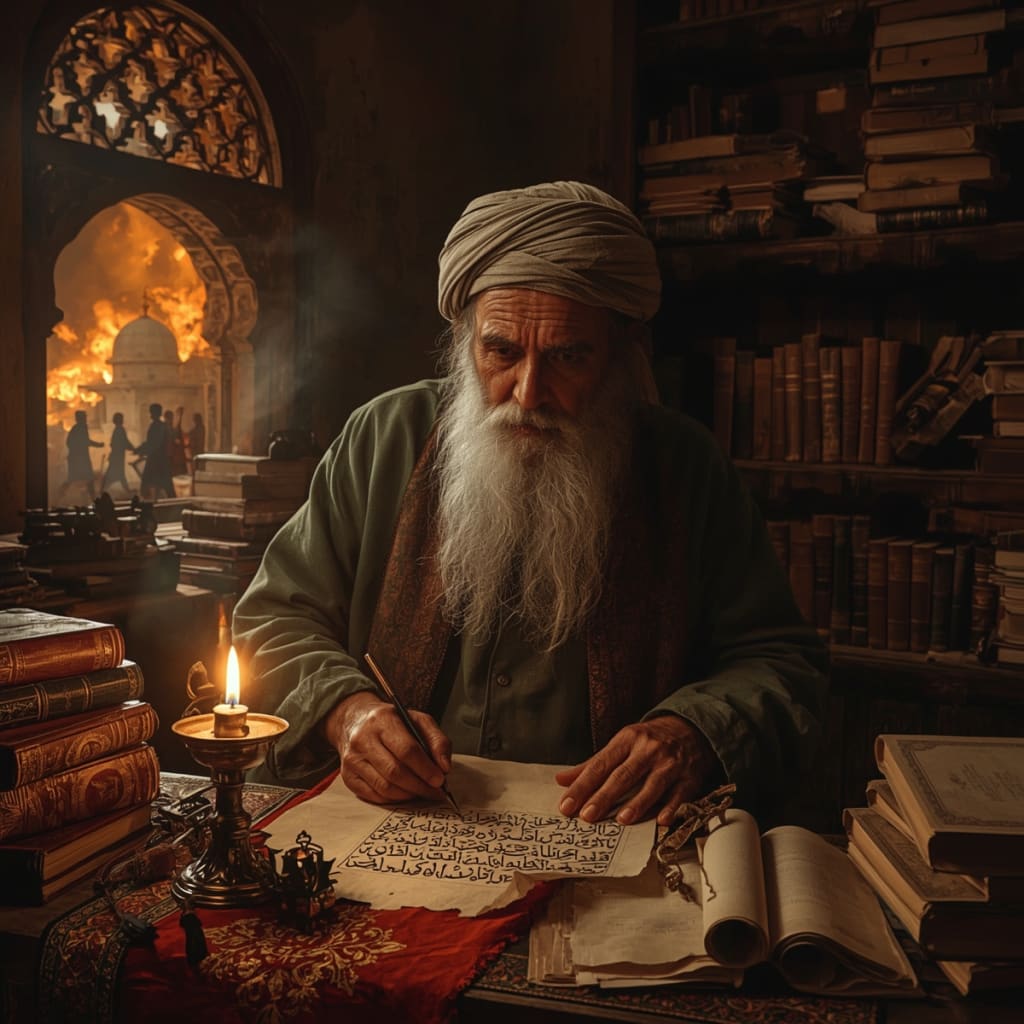
In the heart of Cordoba, beneath the glowing golden skies of Al-Andalus, lived an old man named Ishaq ibn Yunus. He was no warrior, no merchant, no politician. He was a calligrapher, a quiet artist of words whose hands once shaped verses into beauty. He had written for kings and scholars in his youth, but now, in his old age, he lived alone in a modest home, tucked between the crumbling walls of a city falling into silence.
Ishaq’s world had changed. The libraries were no longer places of learning but battlegrounds of fire. The Christian Reconquista was sweeping across Spain, and Cordoba, once a jewel of Islamic civilization, was now a shadow of itself. The famous Library of Medina Azahara—a place where hundreds of scholars once studied—had burned to the ground. Smoke still hung over the city like a mourning veil.
Ishaq watched it all from his narrow window, his eyes heavy with grief but dry. He had no tears left. His heart broke not from fear, but from the loss of knowledge—of poetry, of science, of philosophy, of faith. Everything they had built for centuries, turned to ash in a matter of days.
That night, under flickering lamplight, Ishaq opened an old wooden chest hidden beneath his floor. Inside was a single manuscript—Al-Ghazali’s "Ihya Ulum al-Din", carefully copied by Ishaq when he was just twenty. The pages were smooth and yellow with time, the script as delicate as lace. He kissed the cover gently, his fingers trembling. “You will not die,” he whispered.
And so began his quiet rebellion.
Each night, while others hid in fear or fled the city, Ishaq sat by the light of a single flame, copying ancient books by hand—word by word, line by line, breath by breath. He made ink from crushed berries, soot, and pomegranate peel. He carved his pens from reeds gathered near the riverbanks. His hands were old, but his strokes were steady, each letter a prayer.
By his side sat a boy—Yahya, a fifteen-year-old orphan he had taken in when Yahya's parents were killed during a raid. Yahya was curious, intelligent, and often filled with questions.
“Ustad,” he asked one night, watching the old man copy a page from Avicenna’s Book of Healing, “why do you keep writing these books when they’re burning them all? No one wants our words anymore. They want swords and power.”
Ishaq smiled, dipping his pen. “Because someday, when the swords are buried, these words will live again. Knowledge is not defeated by flames—it sleeps, and waits to return.”
Yahya fell silent. Something about the old man’s faith, his quiet devotion, made even the shadows in the room pause.
As months passed, Ishaq grew weaker. His cough worsened. His hands began to tremble more. But he didn’t stop. Every day was a battle against time, every letter an act of resistance.
One morning, Yahya returned from the market with bread and found Ishaq slumped over his desk, the pen still resting in his fingers. His eyes were closed, his breath gone. He had written until his last moment.
The final line on the page read:
"Light is not defeated by darkness. It simply waits to return."
Yahya wept for the first time in years.
He washed his teacher's body, wrapped him in white cloth, and buried him in the courtyard beneath the olive tree. Beneath Ishaq’s arm, he placed a scroll—his life’s work. Not a sword, but a weapon nonetheless.
Then, carefully, Yahya gathered the manuscripts. He sealed them in earthen jars, wrapped them in cloth, and buried them deep beneath the tree roots. It was a library hidden underground—waiting, like light in the dark.
Yahya left Cordoba that night with a sack of scrolls, a heart full of sorrow, and a soul burning with purpose. He traveled through valleys, over mountains, into distant lands. He became a teacher, a scholar. And wherever he went, he told the story of Ishaq ibn Yunus, the calligrapher who had fought the flames with ink.
Centuries passed. Kingdoms fell. New empires rose. The world forgot Ishaq’s name.
But one day, in the 21st century, during an archaeological dig near Cordoba, a group of historians unearthed a sealed earthen jar beneath an ancient olive tree.
Inside was a scroll, perfectly preserved. The script danced across the page like poetry in motion.
At the bottom, in graceful Arabic, it read:
"Ishaq ibn Yunus – The Ink of Al-Andalus."
The words were alive again.
And the world, for a moment, remembered.
About the Creator
Ikhtisham Hayat
Writer of quiet truths and untold stories.
Keep reading
More stories from Ikhtisham Hayat and writers in History and other communities.
The Light of Alhazen
In the golden age of Islamic civilization, amidst the bustling streets of 10th-century Basra, a boy named Hasan Ibn al-Haytham was born. From a young age, he showed a deep curiosity for the world around him. While others played in the dusty courtyards or traded goods in noisy bazaars, young Hasan would often be found staring into the skies, observing how the stars twinkled and how the sunlight danced on the water’s surface.
By Ikhtisham Hayat6 months ago in History
Easter Island: When Stone Giants Tell a Human Story
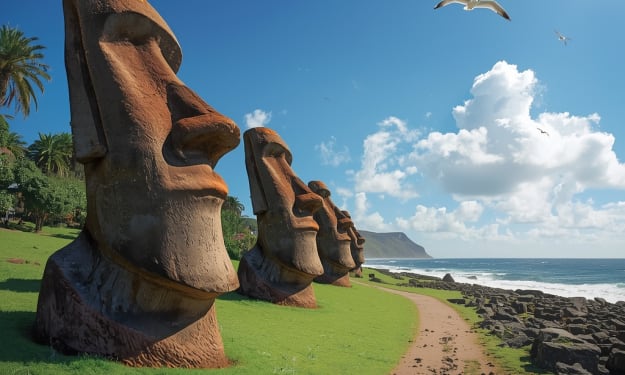
In the heart of the vast Pacific Ocean, far away from crowded cities and modern noise, lies one of the most mysterious places on Earth: Easter Island. Known locally as Rapa Nui, this remote island has fascinated people for generations. I remember the first time I read about it—I couldn’t help but wonder how such a small piece of land could carry so much history, mystery, and unanswered questions. What truly defines Easter Island are its silent stone giants, standing patiently as if guarding memories from a forgotten world.
By Binan Mooon5 days ago in History
Israeli Fire Strikes Journalists and Children on One of Gaza’s Deadliest Days Since Ceasefire
In what has been described as one of the most tragic days in the Gaza Strip since the fragile ceasefire went into effect in October, Israeli military actions on January 21, 2026, resulted in the deaths of at least 11 Palestinians, including three journalists and two 13‑year‑old boys. The deadly incidents occurred across multiple parts of the densely populated enclave and have reignited international concern about civilian safety, press freedom, and the stability of the current ceasefire agreement between Israel and Hamas.
By Salaar Jamali3 days ago in History
The Duelist
The rays of a dying red sun flashed against the onrushing blade. The grey beards say the key to dueling lies in size, speed, reach, righteous fury, whatever the person in front of them pays them to say. Matteo knew better than any it was none of these and had an undefeated record on these sands to prove it.
By Matthew J. Frommabout 4 hours ago in Fiction



Comments
There are no comments for this story
Be the first to respond and start the conversation.