
The Star of Samarkand: The Story of Al-Biruni
A journey through the mind of one of Islam’s greatest scientific pioneers

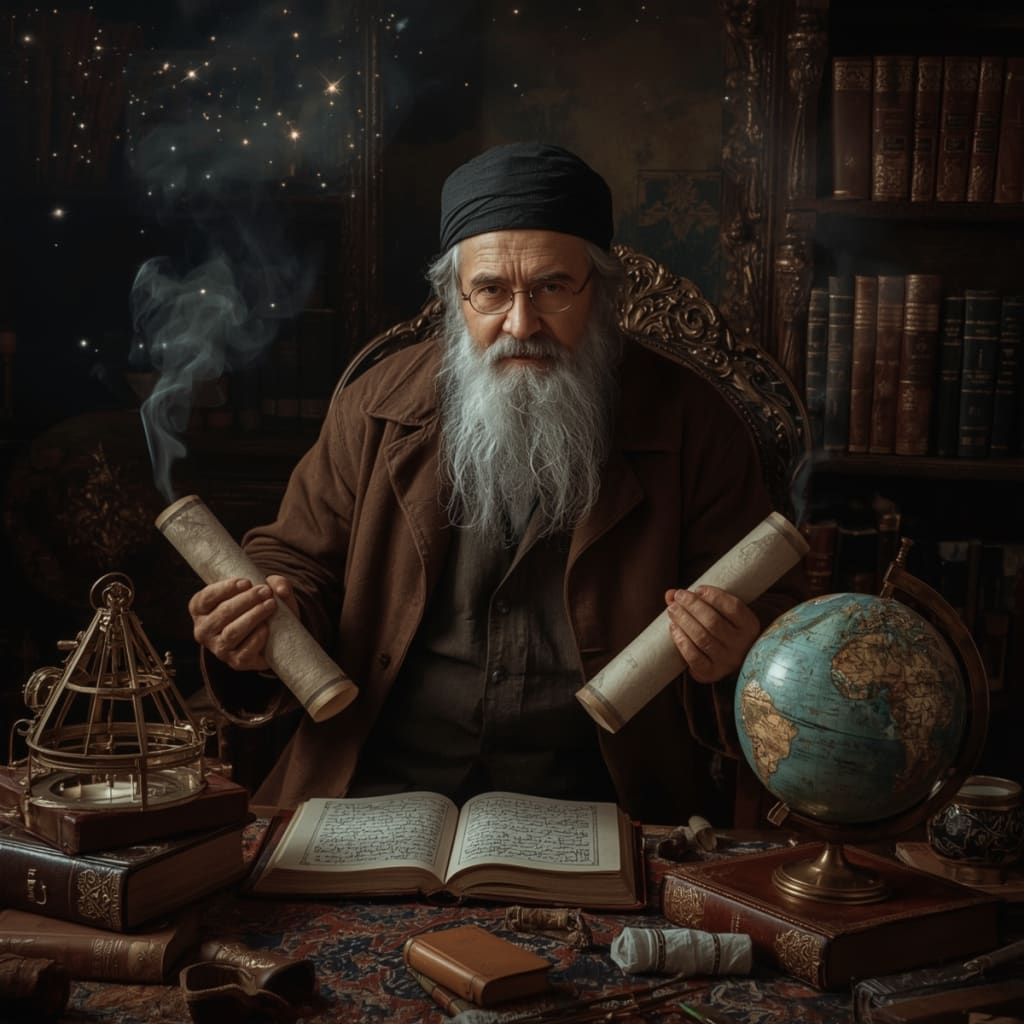
By Ikhtisham Hayat
In the golden age of Islamic civilization, when cities like Baghdad, Cordoba, and Samarkand sparkled with knowledge and innovation, a curious mind was born in the heart of Khwarezm (modern-day Uzbekistan). His name was Abu Rayhan Al-Biruni (973–1048 CE). History remembers him not just as a Muslim scientist but as one of the greatest polymaths the world has ever known.
From a young age, Al-Biruni displayed an unusual fascination with the natural world. While other children played, he was measuring shadows to understand the movement of the sun. With no formal university or mentor in his early years, Al-Biruni’s thirst for knowledge led him to learn Greek, Sanskrit, Persian, Hebrew, and Syriac—languages that would later become keys to unlocking ancient texts and lost sciences.
Al-Biruni lived during a time when the Islamic world was a melting pot of cultures and philosophies. Under the patronage of rulers who appreciated scholars, he had access to some of the best libraries in the world. One such opportunity came when the sultan Mahmud of Ghazni invited him to join his court. Though the invitation wasn’t entirely optional—Mahmud conquered Al-Biruni’s homeland—Al-Biruni accepted it with grace, seizing the chance to travel across the Indian subcontinent.
What could have been a period of bitterness turned into one of his most fruitful eras. While in India, Al-Biruni learned Sanskrit and studied Hindu philosophy, mathematics, astronomy, and medicine. His respect for Indian culture was rare for his time. He translated important Indian texts into Arabic and wrote his own masterpiece: "Kitab fi Tahqiq ma li’l-Hind" (The Book of India)—a detailed and respectful account of Indian society, science, and beliefs.
But Al-Biruni’s legacy was not confined to travel writing. He was a master of multiple sciences:
Astronomy: He calculated the radius of the Earth with remarkable precision using trigonometry and shadows—centuries before modern satellites.
Geography: He believed the Earth rotated on its axis, a concept not widely accepted in his time.
Physics: He proposed theories about gravity and the behavior of water that predated Newton’s laws.
Mathematics: He worked on spherical trigonometry, used in modern navigation and astronomy.
Pharmacology: He compiled hundreds of medicinal plants and minerals in his book “Kitab al-Saydalah” (The Book of Drugs), which served doctors for centuries.
One of his most remarkable qualities was his scientific method. Al-Biruni didn’t just believe something because it was written in a holy book or ancient text. He emphasized observation, experimentation, and logic—principles that would later become the foundation of modern science. He once wrote, "We must investigate everything to its depth, and not merely follow tradition."
He even debated religious and philosophical ideas with remarkable tolerance. Though a devout Muslim, Al-Biruni believed that truth must be pursued wherever it is found. In a time when religious tension was common, he respected other beliefs and cultures, embodying the Quranic verse, “O mankind! We created you from a single (pair) of a male and a female, and made you into nations and tribes, that you may know each other” (Surah Al-Hujurat, 49:13).
Despite all his achievements, Al-Biruni remained humble. He died at the age of 75, surrounded by books and instruments, still asking questions about the universe. It is said that on his deathbed, he asked a visiting scholar about an obscure point of Islamic law. When the man said, “Is this the time for such questions?” Al-Biruni replied, “Which is better, to die knowing or to die ignorant?”
Legacy
Today, craters on the moon bear his name. His books have been translated into multiple languages and still fascinate scholars. Yet, outside academic circles, few know about him. Al-Biruni’s life is a powerful reminder of a time when Islam was at the forefront of global science. When Muslims were not just consumers of knowledge but producers of it.
In our world today, where science and faith are often placed in opposition, Al-Biruni stands as a bridge—a man who proved that one can be deeply religious and profoundly scientific at the same time.
His story continues to inspire Muslim youth around the world. In classrooms in Pakistan, Uzbekistan, Iran, and beyond, students open their textbooks and read his name, perhaps not knowing that the curious boy from Khwarezm changed the course of human understanding forever.
About the Creator
Ikhtisham Hayat
Writer of quiet truths and untold stories.
Keep reading
More stories from Ikhtisham Hayat and writers in History and other communities.
The Justice of Hazrat Umar (RA)
By Ikhtisham Hayat In the vast desert city of Madinah, where the sun scorched the earth by day and the silence deepened by night, there walked a man whose shadow alone commanded respect. He wore no crown. His garments were plain, his sandals worn. Yet, he was the ruler of a vast Islamic empire that stretched from the Arabian Peninsula to the borders of Byzantium. This was Hazrat Umar ibn Al-Khattab (RA), the second Caliph of Islam.
By Ikhtisham Hayat6 months ago in History
The Quiet Rise of Global Militarization
The Quiet Rise of Global Militarization Across the world, governments are increasing military spending, expanding defense industries, and modernizing weapons systems—often without openly acknowledging why. There are no formal declarations of war, no mass troop mobilizations, and no clear enemy named in many cases. Yet behind the scenes, a quiet shift is taking place. Global militarization is rising, not loudly, but steadily, reshaping international relations in ways that may define the coming decades.
By Wings of Time 7 days ago in History


Comments (1)
Wonderful!