
The Light of Alhazen
The Muslim Scientist Who Unlocked the Secrets of Vision

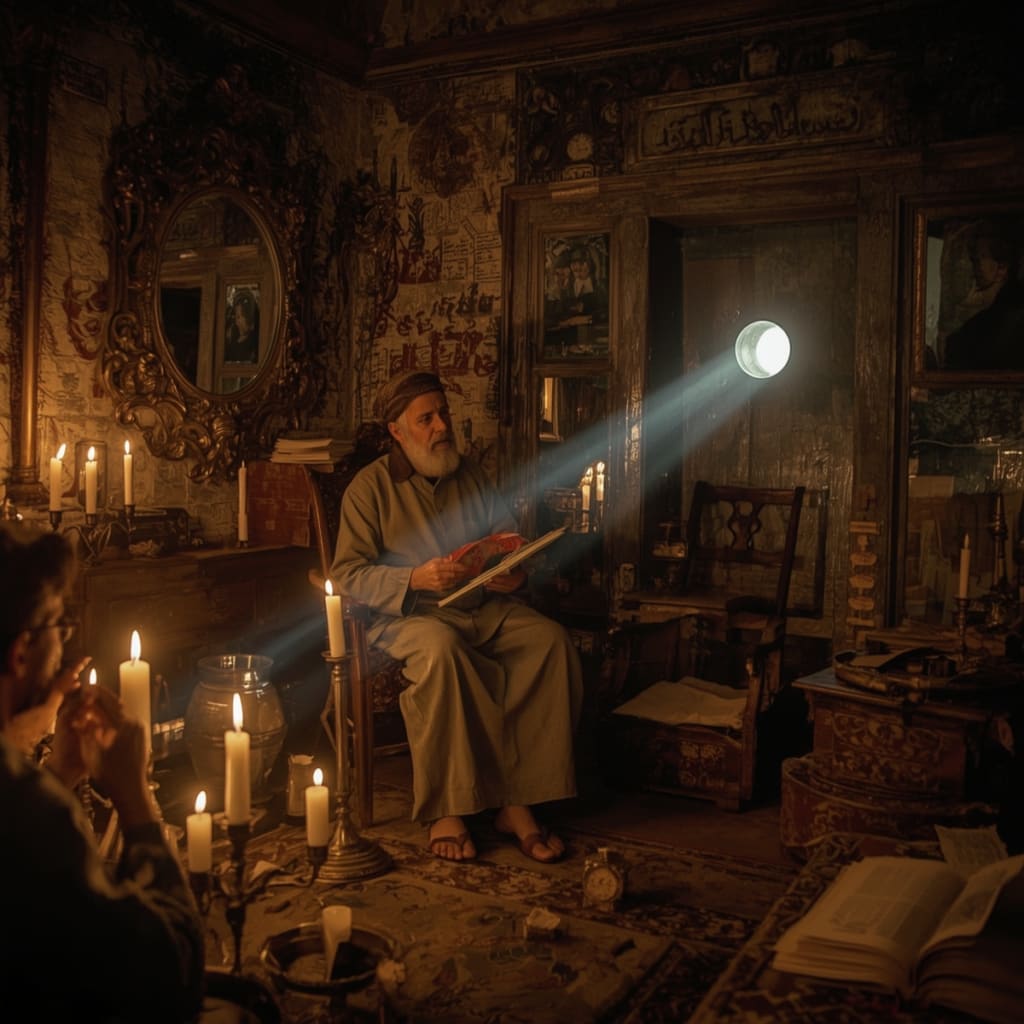
In the golden age of Islamic civilization, amidst the bustling streets of 10th-century Basra, a boy named Hasan Ibn al-Haytham was born. From a young age, he showed a deep curiosity for the world around him. While others played in the dusty courtyards or traded goods in noisy bazaars, young Hasan would often be found staring into the skies, observing how the stars twinkled and how the sunlight danced on the water’s surface.
His father, a civil servant, recognized Hasan’s sharp mind and sent him to study in Baghdad, the center of learning at the time. There, under candle-lit halls of grand libraries and with scrolls from Greece, Persia, and India stacked high, Hasan immersed himself in knowledge—mathematics, astronomy, theology, and most of all, optics.
But what set Hasan apart from others was his method. While many scholars relied on ancient texts and philosophies without question, Hasan believed truth must be proven by experiment. “Knowledge comes not from authority,” he would often say, “but from evidence.”
His revolutionary thinking would one day earn him the title: Alhazen, the father of modern optics.
As his fame grew, Alhazen was invited by the Fatimid Caliph in Egypt to help control the flooding of the Nile River. Confident in his abilities, Alhazen traveled to Cairo. But upon inspecting the Nile, he realized the task was impossible with the technology of the time. Fearing the caliph's wrath, he feigned madness and was placed under house arrest.
Though imprisoned, Alhazen saw this as a blessing in disguise.
In the quiet solitude of his room, he began one of the most important scientific works in history: Kitab al-Manazir (The Book of Optics). He experimented tirelessly with lenses, mirrors, and light. He darkened his room and allowed a single ray of light through a tiny hole. Observing how the image appeared upside down on the opposite wall, he conceptualized the camera obscura—a device that would later lead to the invention of the modern camera.
He challenged the Greek idea that the eyes emit rays to see. Instead, he correctly argued that vision occurs when light reflects off objects and enters the eye, forming an image. His understanding of the anatomy of the eye was centuries ahead of his time.
But Alhazen’s legacy wasn’t just in what he discovered—it was how he discovered. He developed a scientific method based on observation, hypothesis, experimentation, and conclusion. This method would lay the foundation for generations of scientists in both the East and West.
Years later, when the caliph died, Alhazen was freed. Instead of seeking revenge or luxury, he returned to his studies and continued writing. His books were translated into Latin and studied in Europe for centuries. Scholars like Roger Bacon, Kepler, and even Galileo were influenced by his works.
Yet, Alhazen never boasted of his achievements. In his writings, he often reminded his readers:
“The seeker after truth is not one who studies the writings of the ancients and, following his natural disposition, puts his trust in them... It is rather one who suspects his faith in them and questions what he gathers from them, one who submits to argument and demonstration.”
In his final years, Alhazen lived simply, surrounded by his books, instruments, and scrolls. One evening, as the sun dipped below the horizon and golden light poured into his study, a student asked him, “Master, after all this, do you still seek more knowledge?”
Alhazen smiled gently and replied, “The universe is vast, and I have only seen a drop in its ocean. To seek is to live.”
Legacy
Today, Ibn al-Haytham is remembered not just as a Muslim scientist, but as a pioneer of modern science. In a time when superstition often ruled over reason, he dared to question, to observe, and to test. He combined faith with intellect, showing that Islam and science could walk hand in hand.
His image once graced the Iraqi 10 Dinar note, and UNESCO celebrated the 1000th anniversary of his birth in 2015, naming it the “Year of Light.”
In every telescope that gazes into the heavens, in every camera that captures a moment, and in every child who wonders how the world works, there is a spark of Alhazen’s light—a light that will never dim.
About the Creator
Ikhtisham Hayat
Writer of quiet truths and untold stories.
Keep reading
More stories from Ikhtisham Hayat and writers in History and other communities.
The Star of Samarkand: The Story of Al-Biruni
By Ikhtisham Hayat In the golden age of Islamic civilization, when cities like Baghdad, Cordoba, and Samarkand sparkled with knowledge and innovation, a curious mind was born in the heart of Khwarezm (modern-day Uzbekistan). His name was Abu Rayhan Al-Biruni (973–1048 CE). History remembers him not just as a Muslim scientist but as one of the greatest polymaths the world has ever known. From a young age, Al-Biruni displayed an unusual fascination with the natural world. While other children played, he was measuring shadows to understand the movement of the sun. With no formal university or mentor in his early years, Al-Biruni’s thirst for knowledge led him to learn Greek, Sanskrit, Persian, Hebrew, and Syriac—languages that would later become keys to unlocking ancient texts and lost sciences. Al-Biruni lived during a time when the Islamic world was a melting pot of cultures and philosophies. Under the patronage of rulers who appreciated scholars, he had access to some of the best libraries in the world. One such opportunity came when the sultan Mahmud of Ghazni invited him to join his court. Though the invitation wasn’t entirely optional—Mahmud conquered Al-Biruni’s homeland—Al-Biruni accepted it with grace, seizing the chance to travel across the Indian subcontinent. What could have been a period of bitterness turned into one of his most fruitful eras. While in India, Al-Biruni learned Sanskrit and studied Hindu philosophy, mathematics, astronomy, and medicine. His respect for Indian culture was rare for his time. He translated important Indian texts into Arabic and wrote his own masterpiece: "Kitab fi Tahqiq ma li’l-Hind" (The Book of India)—a detailed and respectful account of Indian society, science, and beliefs. But Al-Biruni’s legacy was not confined to travel writing. He was a master of multiple sciences: Astronomy: He calculated the radius of the Earth with remarkable precision using trigonometry and shadows—centuries before modern satellites. Geography: He believed the Earth rotated on its axis, a concept not widely accepted in his time. Physics: He proposed theories about gravity and the behavior of water that predated Newton’s laws. Mathematics: He worked on spherical trigonometry, used in modern navigation and astronomy. Pharmacology: He compiled hundreds of medicinal plants and minerals in his book “Kitab al-Saydalah” (The Book of Drugs), which served doctors for centuries. One of his most remarkable qualities was his scientific method. Al-Biruni didn’t just believe something because it was written in a holy book or ancient text. He emphasized observation, experimentation, and logic—principles that would later become the foundation of modern science. He once wrote, "We must investigate everything to its depth, and not merely follow tradition." He even debated religious and philosophical ideas with remarkable tolerance. Though a devout Muslim, Al-Biruni believed that truth must be pursued wherever it is found. In a time when religious tension was common, he respected other beliefs and cultures, embodying the Quranic verse, “O mankind! We created you from a single (pair) of a male and a female, and made you into nations and tribes, that you may know each other” (Surah Al-Hujurat, 49:13). Despite all his achievements, Al-Biruni remained humble. He died at the age of 75, surrounded by books and instruments, still asking questions about the universe. It is said that on his deathbed, he asked a visiting scholar about an obscure point of Islamic law. When the man said, “Is this the time for such questions?” Al-Biruni replied, “Which is better, to die knowing or to die ignorant?”
By Ikhtisham Hayat6 months ago in History
Easter Island: When Stone Giants Tell a Human Story
In the heart of the vast Pacific Ocean, far away from crowded cities and modern noise, lies one of the most mysterious places on Earth: Easter Island. Known locally as Rapa Nui, this remote island has fascinated people for generations. I remember the first time I read about it—I couldn’t help but wonder how such a small piece of land could carry so much history, mystery, and unanswered questions. What truly defines Easter Island are its silent stone giants, standing patiently as if guarding memories from a forgotten world.
By Binan Mooon5 days ago in History
Israeli Fire Strikes Journalists and Children on One of Gaza’s Deadliest Days Since Ceasefire
In what has been described as one of the most tragic days in the Gaza Strip since the fragile ceasefire went into effect in October, Israeli military actions on January 21, 2026, resulted in the deaths of at least 11 Palestinians, including three journalists and two 13‑year‑old boys. The deadly incidents occurred across multiple parts of the densely populated enclave and have reignited international concern about civilian safety, press freedom, and the stability of the current ceasefire agreement between Israel and Hamas.
By Salaar Jamali3 days ago in History
The Duelist
The rays of a dying red sun flashed against the onrushing blade. The grey beards say the key to dueling lies in size, speed, reach, righteous fury, whatever the person in front of them pays them to say. Matteo knew better than any it was none of these and had an undefeated record on these sands to prove it.
By Matthew J. Fromm14 minutes ago in Fiction


Comments
There are no comments for this story
Be the first to respond and start the conversation.