controversies
It seems every time one racially-charged incident ends, a gender or religious controversy takes its place; Ruminate on the issues dividing our nation and world.
Learning Abuse is Okay. Content Warning.
My coparent and I agreed on when our children would call me. A schedule because he said that I was interfering with his parenting time. Our children have long called me twice a day if I wasn't physically available to them. I understand how much my ex hates it, but hey, I hate things too - it is called putting our children first.
By The Schizophrenic Mom2 days ago in The Swamp
Starmer Talks to Trump.
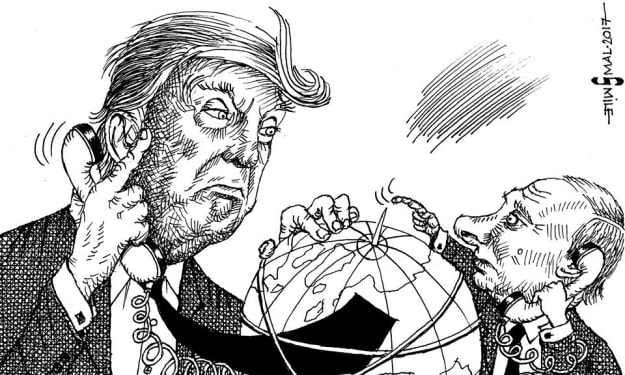
Sir Keir Starmer spoke to President Trump on the telephone last night. They spoke at length, according to a Downing Street Spokesman, about Greenland and the tanker Bella 1 or Marinera. Sir Keir Starmer's view on Greenland is in line with other European leaders. That is, they stand with the Danish Prime Minister Mette Frederiksen. Ms. Frederiksen has said that if the US were to invade Greenland, it would be the end of NATO. And rightly so, Denmark and America are NATO Allies. It would be a literal stab in Denmark's back if America went ahead and invaded Denmark. How can a friendship stand when your close friend has done something to offend you? That would be the case between the US and Denmark over Greenland. It would only embolden people like Putin.
By Nicholas Bishop4 days ago in The Swamp
Opinion | Why Black Biraciality Makes People Uncomfortable
I recently published an article titled “The Double Marginalization of Black Biracial People.” In it, I argue that Black biracial individuals - those with one Black parent and one white parent who are socially identified as Black - face two forms of marginalization: anti-Black racism and monoracism. (Monoracism refers to a specific type of oppression that affects mixed-race individuals.)
By Clare Xanthos5 days ago in The Swamp
Putin Dispatches Naval Vessels.
Vlad "The Invader" Putin (taken from Vlad "The Impaler" Tepes) has officially stepped into the situation between America and Venezuela on the high seas. It seems the capture of Nicolas Maduro, who is now facing trial in New York, crossed a red line for Russia. Maduro and Putin are close allies, and Maduro's successor, Delcy Rodriguez, will be just as close with her Russian counterpart.
By Nicholas Bishop5 days ago in The Swamp
Mette Frederiksen: Greenland isn't Yours!
Trump has always been obsessed with Greenland. During his first term, he mentioned it then. Now, in his second coming, President Trump stated the US needs Greenland for defence. Mentioning Russian and Chinese ships that pass that way. Of course, one has to take into account the minerals that lie under the snow that covers Greenland. So is Trump's interest merely for defence or business or both? The irony of it is that Greenland already has a US military base there with the permission of Denmark.
By Nicholas Bishop6 days ago in The Swamp
Maduro’s Wife at the Center of Venezuela Chaos: What Really Happened During the U.S. Strike
In the early hours of a tense and uncertain day, the world woke up to shocking headlines out of Venezuela. Explosions were reported. Statements flew across social media. And suddenly, one unexpected phrase dominated global search trends: “Maduro’s wife.”
By Bevy Osuos9 days ago in The Swamp
The Night a Song Brought Me Back to Myself
I didn’t watch the special for the spectacle. I watched because I needed to hear the song again. Not the version from the movie trailer or the TikTok clip. The one that lived in my bones—the one I’d hummed under my breath during chemo, during layoffs, during the long winter after my divorce. The song that said: It’s okay to be different. It’s okay to fall. It’s okay to rise anyway.
By KAMRAN AHMAD9 days ago in The Swamp
The Day the Stadium Felt Like Church
I wasn’t born into fandom. I was adopted into it. At ten years old, I didn’t understand offside rules or midfield rotations. I only knew that every Sunday, my grandfather would take my hand, walk me three blocks to the edge of the stadium, and sit with me on a cracked concrete step—just outside the gates, where the roar of the crowd bled into the street like a hymn.
By KAMRAN AHMAD10 days ago in The Swamp
Divisive Rhetoric Reloaded: Inside Trump’s Bold Midterm Bet
Donald Trump’s latest midterm strategy does not whisper. It shouts. It doesn’t arrive dressed in policy white papers or carefully hedged language aimed at consensus-building. Instead, it storms into the political arena with familiar tools: volume, confrontation, and an unmistakable sense of grievance. From rally stages to social media feeds, the message is relentless—America is under threat, enemies are everywhere, and only unwavering loyalty can hold the line.
By The Insight Ledger 11 days ago in The Swamp
Trump’s Shocking Endorsement: How Anti-Muslim Views Slipped Into the Mainstream
American politics has never been short on controversy, but every so often a moment arrives that feels heavier than the usual cycle of outrage. Donald Trump’s recent endorsement of a candidate known for openly anti-Muslim rhetoric was one of those moments. It wasn’t just another tactical move in a crowded political chessboard. It landed as a signal—clear, public, and impossible to ignore—about which voices are acceptable, which fears are worth amplifying, and which communities are once again expected to absorb the fallout. For many Muslims in the United States and beyond, the endorsement felt deeply personal. It didn’t read like an abstract policy disagreement or a debate over national security. It felt like a reminder that their faith, identity, and citizenship can still be treated as negotiable in the pursuit of votes. In a country that prides itself on religious freedom, the moment cut sharply: belonging, it seemed, was being put up for debate again. Why This Endorsement Hit So Hard Endorsements happen all the time. Politicians support allies, reward loyalty, and energize their base. What made this endorsement different wasn’t just the candidate’s history—it was the context. The political environment is already tense, polarized, and emotionally charged. Elections are approaching, global conflicts are inflaming sectarian narratives, and social media ensures every statement travels at the speed of outrage. In that climate, amplifying a figure associated with blanket anti-Muslim claims felt less like oversight and more like intention. Supporters defended the move as “free speech” or “tough talk on security.” Critics saw something else entirely: a calculated decision to legitimize rhetoric that paints Muslims as a monolithic threat rather than a diverse community of citizens. When such rhetoric is elevated by a former president—and a dominant figure in national politics—the line between fringe prejudice and mainstream discourse begins to blur. When Dog Whistles Become Megaphones Anti-Muslim sentiment in Western politics isn’t new. For years, it lived behind euphemisms—phrases about “integration,” “values,” or “security risks” that hinted at suspicion without naming it directly. Everyone understood what was being implied, even if it wasn’t said aloud. This endorsement stripped away much of that ambiguity. The candidate in question didn’t rely on coded language. Their record included sweeping generalizations, dehumanizing stereotypes, and claims that treated Muslims as a single, dangerous bloc. When a national leader amplifies that voice, the message changes. What was once whispered at the margins is suddenly spoken into a microphone. That shift matters. History shows that prejudice doesn’t need majority support to cause harm; it needs permission. When powerful figures appear to grant that permission, social barriers erode. Language hardens. Behavior follows. From Rhetoric to Real-World Consequences Words don’t exist in a vacuum. Political rhetoric shapes social norms, and social norms shape behavior. When Muslims are repeatedly framed as “other,” suspicion becomes easier to justify. Policies that disproportionately affect them—enhanced surveillance, travel restrictions, selective enforcement—become more palatable to the public. Discrimination doesn’t always announce itself loudly; often it creeps in quietly, normalized by repetition. Beyond policy, there are everyday consequences. Spikes in hate crimes often track with moments of heightened anti-Muslim rhetoric. Children face bullying at school. Adults face hostility at work. Ordinary acts—wearing religious clothing, speaking a different language, having a Muslim name—can suddenly feel risky. For those living this reality, the endorsement wasn’t theoretical. It was a reminder that political theater can spill directly into daily life. Inside the Muslim Community: Fear, Fatigue, and Determination Reactions within the Muslim community were complex and deeply human. There was anger—at being singled out yet again. There was exhaustion—from constantly having to explain that terrorism and extremism are not Islam, that Muslims are not a single ideology, and that millions of Muslim Americans contribute to society every day without incident. There was fear—especially among parents worried about their children’s safety and sense of belonging. But there was also resolve. Over the years, Muslim communities in the U.S. have grown more organized, more legally savvy, and more politically engaged. Advocacy groups, civil rights organizations, lawyers, journalists, and grassroots activists have built networks designed to respond quickly when rhetoric turns hostile. In many ways, moments like this sharpen that resolve. When silence feels dangerous, visibility becomes a form of protection. For every headline fueled by prejudice, there are efforts underway to challenge it—in courts, at ballot boxes, and in public discourse. Why This Is Bigger Than One Community It’s tempting to frame this controversy as a “Muslim issue.” That framing misses the point. When a society becomes comfortable with vilifying one religious group for political gain, it sets a precedent. The logic doesn’t stop with Muslims. It can be redirected toward any group that becomes politically convenient to target—Jews, Christians, Sikhs, Hindus, atheists, immigrants, or others who fall outside an imagined norm. Democracy relies not only on laws and elections but on unwritten agreements: that citizenship isn’t conditional, that rights aren’t selective, and that losing political power doesn’t mean losing basic dignity. When leaders undermine those agreements, they weaken the system for everyone. History offers plenty of warnings about where this path can lead. What begins as rhetoric can harden into policy. What starts as “just politics” can evolve into structural exclusion. The Role of Media and Amplification Media plays a crucial role in moments like this—not just in reporting events, but in framing them. Sensational coverage can amplify the most extreme voices, turning outrage into entertainment. Social media accelerates this effect, rewarding inflammatory content with attention and reach. In that environment, nuance struggles to survive. Yet media also has the power to contextualize, to challenge false narratives, and to center the voices of those affected rather than those provoking outrage. Whether it rises to that responsibility shapes how quickly harmful ideas spread—or how effectively they’re resisted. What Ordinary People Can Do When politics feels this ugly, it’s easy to feel powerless. But ordinary actions matter more than they appear. Refusing to normalize dehumanizing language is a start. Pushing back—calmly, clearly—when friends or colleagues repeat harmful narratives disrupts their spread. Listening to Muslims and other minorities about how rhetoric affects their lives matters more than debating abstract principles. Civic engagement matters too. Voting, supporting civil rights organizations, and paying attention to local politics all shape the environment leaders operate in. Endorsements carry weight because they assume public tolerance. Challenging that assumption changes the calculation. Even small acts—solidarity, empathy, everyday kindness—send a counter-signal. They remind targeted communities that they are not alone, and they remind opportunistic politicians that division has limits. A Moment That Will Be Remembered This endorsement will be remembered not just for what it said, but for what it revealed. It exposed how easily fear can be repackaged as policy talk. It showed how quickly fringe ideas can gain legitimacy when power amplifies them. And it forced a reckoning—for Muslims, for allies, and for anyone who believes that citizenship should not depend on faith. History rarely judges societies solely by their leaders’ words. It judges them by how people respond when those words test the boundaries of decency. In that sense, this moment is still unfolding. The final chapter won’t be written by endorsements alone, but by whether citizens accept a shrinking definition of belonging—or insist on a broader one that reflects the country’s reality. In the end, no endorsement, however shocking, can fully define a nation. That power rests with the people who decide whether prejudice gets applause—or resistance.
By The Insight Ledger 11 days ago in The Swamp