
EU Sanctions Russian Officials as Hungary Blocks Funds to Ukraine
EU targets Russian officials with sanctions, while Hungary blocks funds intended to aid Ukraine, exposing cracks in European unity.

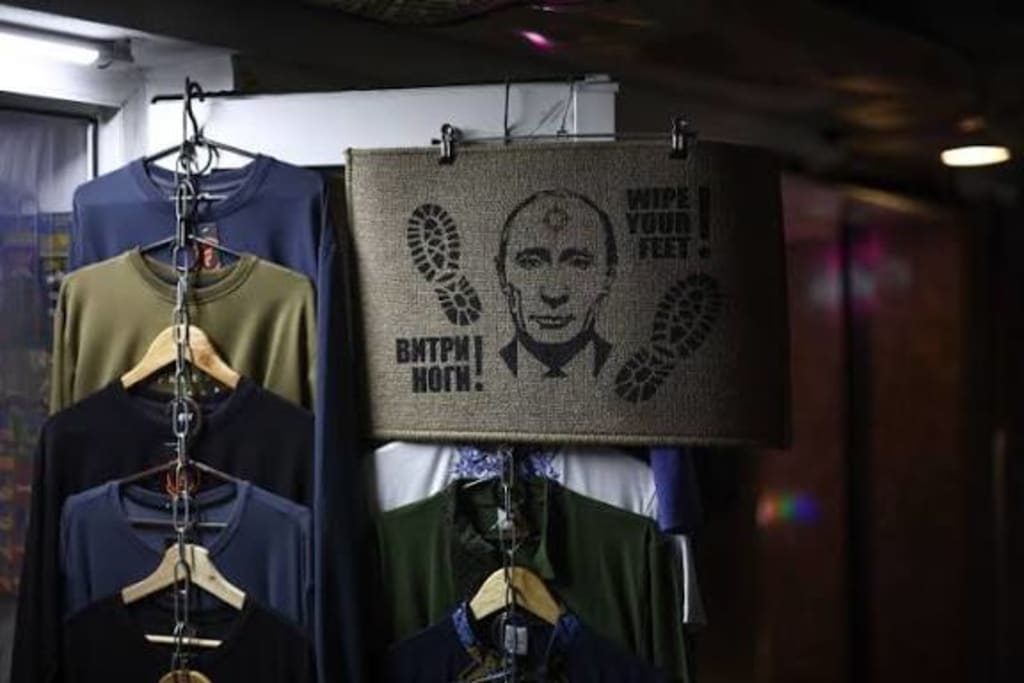
In a tense session that underscored the European Union’s internal divisions, EU member states imposed fresh sanctions on Russian officials linked to the ongoing conflict in Ukraine, even as Hungary blocked a portion of funds intended to support Kyiv’s war effort. The move highlights both the bloc’s commitment to pressuring Moscow and the political fractures that complicate collective action.
The sanctions target several high-ranking Russian politicians and military figures accused of facilitating or enabling military operations in Ukraine. Measures include travel bans, asset freezes, and restrictions on financial transactions within the EU. The European Council described the action as “a necessary step to hold accountable those responsible for destabilizing the region and perpetuating the war.”
EU officials emphasized that the sanctions are part of a broader strategy to maintain economic and political pressure on Russia, following months of escalating conflict. “We are demonstrating unity in condemning aggression and in supporting the sovereignty of Ukraine,” said an EU diplomat familiar with the discussions.
Hungary’s Block and Internal Disputes
At the same time, Hungary, long criticized for its close ties to Moscow, has blocked disbursement of certain EU funds allocated to Kyiv. Prime Minister Viktor Orbán cited concerns over financial oversight and alleged inefficiencies in the use of the funds, although critics argue that the move is politically motivated.
“The decision undermines European solidarity,” said a European Commission spokesperson. “EU funds are designed to support a country under attack, and blocking these resources contradicts the shared principles of the Union.”
The standoff exposes persistent challenges in coordinating EU foreign policy. While the bloc often speaks with one voice on paper, differing national interests, political alliances, and domestic pressures can complicate unified responses to crises.
Impact on Ukraine and the War Effort
For Ukraine, the timing of the partial block is problematic. The funds in question were intended for critical infrastructure repairs, humanitarian support, and military aid. Kyiv’s government expressed disappointment but maintained that international assistance remains vital.
“We rely on our partners to help sustain our people and defense capabilities,” said a Ukrainian government official. “Every delay in support weakens our ability to respond to aggression and protect civilians.”
The sanctions on Russia, however, were broadly welcomed in Kyiv. Analysts suggest that targeting individual officials and freezing assets could deter further escalation and signal that the international community is watching. “While sanctions alone won’t end the war, they send a strong message that those responsible cannot operate freely or enjoy the benefits of their positions,” said a policy analyst in Brussels.
EU’s Strategic Calculus
The dual actions — sanctions on Russian figures and the partial freeze of funds to Ukraine — illustrate the EU’s delicate balancing act. Brussels must uphold its commitment to Ukraine, maintain economic stability within the bloc, and navigate member states’ divergent political stances.
Some EU officials hope that Hungary’s objections can be resolved through negotiation, emphasizing enhanced monitoring and reporting requirements for fund usage. Others warn that prolonged resistance could embolden Moscow and undermine the EU’s credibility as a unified actor.
Looking Ahead
Observers expect the coming months to be critical. With sanctions likely to expand and political negotiations ongoing, the EU faces a test of both its internal cohesion and its ability to influence the trajectory of the war in Ukraine. The situation also serves as a reminder that European solidarity is not guaranteed and must be actively maintained amid competing domestic and international interests.
As Ukraine continues to face Russian military pressure, the international community watches closely. The EU’s ability to reconcile internal disagreements while sustaining support for Kyiv may prove decisive in shaping the region’s stability and the long-term geopolitical balance in Eastern Europe.
About the Creator
Fiaz Ahmed
I am Fiaz Ahmed. I am a passionate writer. I love covering trending topics and breaking news. With a sharp eye for what’s happening around the world, and crafts timely and engaging stories that keep readers informed and updated.
Keep reading
More stories from Fiaz Ahmed and writers in The Swamp and other communities.
“We Pray for Peace”: Indian Filmmaker from Troubled State Who Won a Bafta
The red carpet at the BAFTA Awards sparkled with stars, but for Aarav Mehra, the night was about more than glamour and applause. It was a moment of vindication, resilience, and a quiet plea for his homeland, a state long marked by political unrest and social tension. Mehra, whose documentary chronicled life amid conflict in the northeastern state of Manipur, accepted the award with humility, dedicating it not to himself but to the people whose stories he had risked everything to tell. “This is for those who have lived through decades of fear, hope, and resilience,” he said, his voice steady but emotional. “We pray for peace. We pray for understanding.” From Conflict Zones to Global Spotlight Born and raised in a region often overlooked by mainstream Indian media, Mehra’s early life was framed by instability. School closures due to unrest, military checkpoints in local towns, and sporadic clashes between rival groups shaped his formative years. Yet, amidst this turbulence, he found an outlet: storytelling. “Film became my escape, my way to make sense of the chaos around me,” he recalled. His first camera was a borrowed smartphone, and his earliest projects were short vignettes capturing daily life amid curfews and protests. Local screenings drew small crowds, but they also drew attention from activists and authorities alike. By his mid-twenties, Mehra had earned a reputation for fearless, socially conscious filmmaking. His work did not shy away from difficult truths: human rights violations, systemic poverty, and the psychological toll of living in a conflict zone. However, he also captured moments of joy, resilience, and the enduring humanity of his subjects. The Road to the Bafta Mehra’s Bafta-winning documentary, Whispers of the Hills, follows a group of young students navigating life in a town marked by periodic unrest. Shot over two years, the film blends observational cinema with intimate interviews, providing viewers with a window into a world rarely seen outside the region. The production itself was fraught with challenges. Crews were often forced to relocate due to security threats, equipment was confiscated on multiple occasions, and funding was sporadic. Yet Mehra remained steadfast, insisting that the stories must be told. “Every frame mattered,” he said. “It wasn’t just about winning awards. It was about truth, dignity, and giving voice to the voiceless.” The film premiered at several international festivals before catching the attention of BAFTA judges. Critics praised its sensitivity, cinematography, and the courage required to make such a film in a politically charged environment. Its win marks a historic moment: a filmmaker from one of India’s most troubled states taking a leading international stage. A Message Beyond Cinema In his acceptance speech, Mehra also issued a plea to world leaders and audiences alike. “Art can be a bridge,” he said. “It can carry stories across borders, languages, and conflicts. My hope is that through these stories, empathy will grow and understanding will follow.” For many in his home state, Mehra’s recognition is a source of pride. Local communities have followed his career from afar, often sending messages of encouragement and hope. In social media posts, teachers, students, and neighbors celebrated the achievement as validation that their experiences matter on the global stage. Looking Forward Mehra plans to continue his work, expanding into feature films while keeping a strong documentary focus. He also hopes to mentor young filmmakers from his region, emphasizing that storytelling can be both an act of survival and an instrument for change. “The Bafta is not the destination,” he said. “It’s a responsibility. The real victory is if these stories make people think, act, and feel differently.” In a world saturated with headlines of conflict, Mehra’s journey reminds audiences that courage, creativity, and compassion can shine a light into even the darkest corners, offering hope not only to the subjects of his films but also to the wider world.
By Fiaz Ahmed about 3 hours ago in The Swamp
A Gathering of Evil Bosses
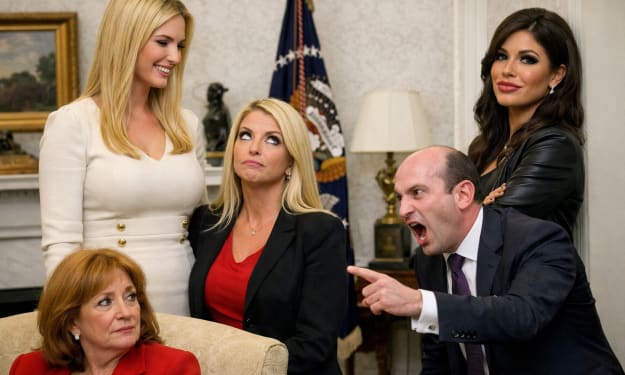
“I’m the queen of chin jutting while I smooth my hair, attacking, insulting, and deflecting to protect my appointer.” “Oh, please, Blondi, my hair is curled, highlighted, and longer than yours. I feature television commercials telling immigrants that we will give them a free plane ride home, and if they voluntarily turn themselves in, they will be allowed to legally apply for re-entry. It runs everywhere, and I look good in it! You can’t compete because of your blond hair. Mine is nicer, and my lips are prettier than yours.”
By Andrea Corwin 6 days ago in The Swamp



Comments
There are no comments for this story
Be the first to respond and start the conversation.