
Gold Is Now the Second‑Largest Currency — Ray Dalio on How ‘Capital Wars’ Drive Buyers Into Bullion
How shifting global monetary forces and geopolitical tensions are pushing investors — and central banks — toward gold as a core reserve asset

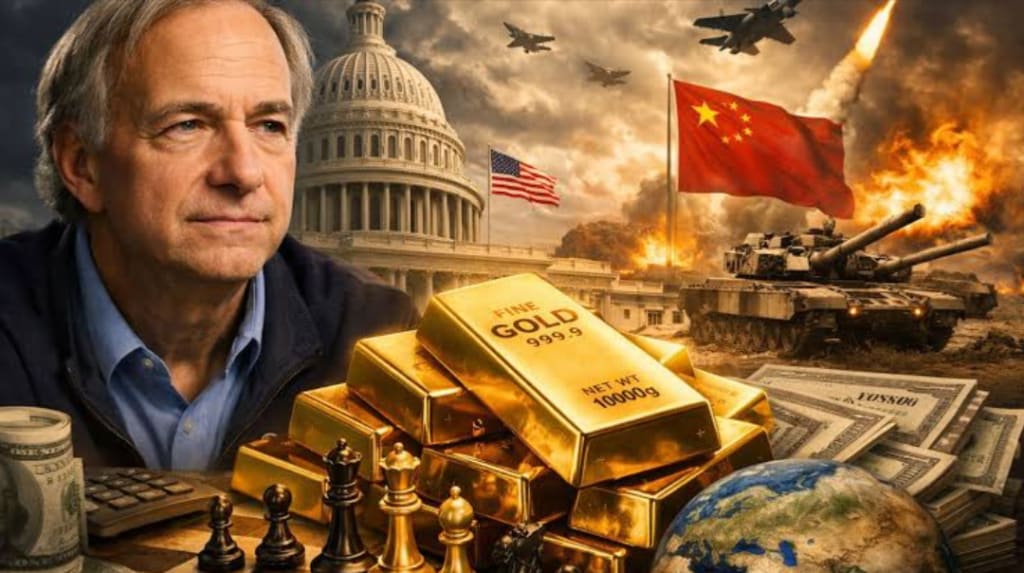
In a world grappling with rising debt, shifting monetary dynamics, and intensifying geopolitical conflict, one of the most influential voices in global finance has a striking message: gold is no longer just a precious metal — it has effectively become the world’s “second‑largest currency.” That’s the view of Ray Dalio, founder of Bridgewater Associates and one of the world’s foremost macroeconomic thinkers, who says that what he calls “capital wars” are driving buyers — from central banks to sovereign wealth funds — into bullion as a safeguard against the erosion of traditional fiat currencies.
---
Gold’s Reemergence as Fundamental Money
For much of modern history, gold’s role has been relegated to that of an investment hedge or portfolio diversifier. But in recent years, gold’s significance has been rising sharply in response to global economic stresses: persistently high debt levels, currency debasement, and the weakening purchasing power of major fiat currencies. According to Dalio, these forces are not merely financial but geopolitical — producing what he calls “capital wars.”
By this, Dalio means that as global tensions rise — whether through trade disputes, sanctions, or broader political rivalries — nations are reevaluating their holdings of traditional reserve assets like U.S. Treasuries and dollars. In their place, they increasingly turn to gold, which is perceived as less exposed to unilateral policy shifts and monetary inflation.
This shift reflects a structural recalibration in reserve portfolios: gold’s weight as a reserve currency is growing, he says — so much so that it now ranks second only to the U.S. dollar in terms of global holdings and strategic importance.
---
Why Gold Holds Appeal in “Capital Wars”
Dalio’s analysis hinges on two interrelated forces reshaping the monetary landscape:
1. The Limits of Fiat Money
Most modern currencies are fiat — not backed by tangible assets — and can be expanded at will through central bank monetary policy. While this provides flexibility, it also creates vulnerability. Excessive money printing in times of economic stress, as seen in recent decades, can erode currency value and inflate asset prices.
Unlike fiat currencies, gold has no issuer and no counterparty promise, meaning its value isn’t dependent on government fiscal discipline or central bank policy. Dalio argues that this makes it uniquely resilient in times when governments face mounting debt and weakened confidence in paper money.
2. Geopolitics and Monetary Trust
In an era of sanctions, trade wars, and unstable alliances, countries may fear holding assets they cannot fully control or that might be politically weaponized. U.S. dollar‑denominated assets, for example, are subject to U.S. policy decisions and geopolitical influence. As Dalio notes, non‑American holders of such assets may worry about political risk and economic leverage.
Gold, by contrast, is seen as a neutral store of value — something that cannot be frozen, devalued through printing, or manipulated by a single currency authority. This makes it attractive not just to private investors but also to sovereign actors seeking to protect national wealth.
---
Historical Context: Gold’s Monetary Role
Dalio often emphasizes that what we’re seeing now is not unprecedented, but rather a recurrence of historical patterns. Throughout history, currencies have either been backed by hard assets like gold or entirely fiat. Periods of heavy debt and monetary excess eventually led to currency debasement and crises, at which point gold — as the ultimate hard asset — regained prominence as a medium of exchange and store of value.
He points out that during such transitions, traditional reserve assets often lose purchasing power, while gold holds up relative to inflation and currency devaluation. This longevity, Dalio argues, is precisely why gold appeals to central banks and large institutional holders today.
---
How Investors Are Responding
Dalio’s comments reflect broader market behavior. In recent years, central banks have been net buyers of gold, steadily increasing their reserves even as prices climbed. Analysts link this trend not just to immediate market sentiment but to long‑term risk management strategies amid currency uncertainty.
Private investors, too, have shown heightened interest in gold. As inflation worries, geopolitical tensions, and questions about fiat sustainability have grown, demand for bullion — whether physical gold, ETFs, or futures — has surged. Many portfolio managers now treat gold as a core strategic holding, rather than merely a speculative play.
---
Gold vs. Other Assets: A Strategic Choice
Dalio also emphasizes that gold’s role should be understood within a broader asset allocation framework. He suggests that investors view gold not as a timing trade but as a strategic hedge — one that diversifies risk and preserves purchasing power when other assets falter.
In recommending a balanced approach, Dalio notes that gold behaves differently from equities, bonds, and fiat cash. During periods when fiscal instability undermines confidence in these assets, gold often performs well or at least retains value. This characteristic positions it uniquely as both a currency alternative and a risk management tool in investment portfolios.
---
The Role of “Capital Wars” in the Future Monetary Order
Dalio’s warning of “capital wars” — competition among nations for financial security and economic advantage — reflects a broader anxiety about the fragility of the current global monetary order. As countries seek to mitigate risk, the rotation into gold can be seen as part of a larger rebalancing of global wealth storage and reserve strategies.
That gold is now being described as a currency — and a major one at that — underscores just how much perceptions have shifted. What was once viewed primarily as a hedge or alternative asset is now being recognized in many quarters as a serious monetary instrument with strategic relevance.
---
Conclusion: A New Chapter for Gold
Ray Dalio’s characterization of gold as the second‑largest currency in the world — driven by “capital wars” and deep structural shifts in the global economy — is more than provocative rhetoric. It encapsulates a broader rethinking of money, risk, and reserve assets in an era of mounting debt, geopolitical uncertainty, and monetary experimentation.
For investors, policymakers, and nations alike, the growing appeal of gold speaks to a universal desire for stability and security. Whether this trend continues or evolves in new directions will play a defining role in how financial markets and global monetary systems navigate the challenges of the 21st century.
About the Creator
Keep reading
More stories from Salaar Jamali and writers in The Swamp and other communities.
Gold Stands Strong at $5,000 as Silver Faces Bubble Fears – Inside Saxo Bank’s Commodity Call
In the fast‑moving world of precious metals, bold forecasts and market warnings make headlines daily. But few have been as striking as the recent commentary from Ole Hansen, Head of Commodity Strategy at Saxo Bank, asserting that gold’s rally is fundamentally supported, while silver risks being caught up in bubble‑like behavior. This stark contrast between two historically correlated metals has sparked intense debate among investors, economists, and traders alike.
By Salaar Jamaliabout 23 hours ago in The Swamp
Zack Polanski: Thinks He Can Persuade Reform Voters to Support Him.
The Green Party has always been present in British politics. Known for their green and environmental politics. To begin with, they had one female MP; now they have four. Similar to their right-wing opponents, Reform UK, which also has 4 MPs.
By Nicholas Bishop7 days ago in The Swamp



Comments
There are no comments for this story
Be the first to respond and start the conversation.