
The Engineer in the Maternity Ward: How Judith Love Cohen Helped Save Apollo 13 Before Giving Birth to a Rock Star
When the oxygen tank exploded on Apollo 13, the astronauts' survival depended on a guidance system designed by a woman who was literally in labor while solving the equations. This is the true story of Judith Love Cohen—the unsung hero who proved that competence is the quietest form of courage

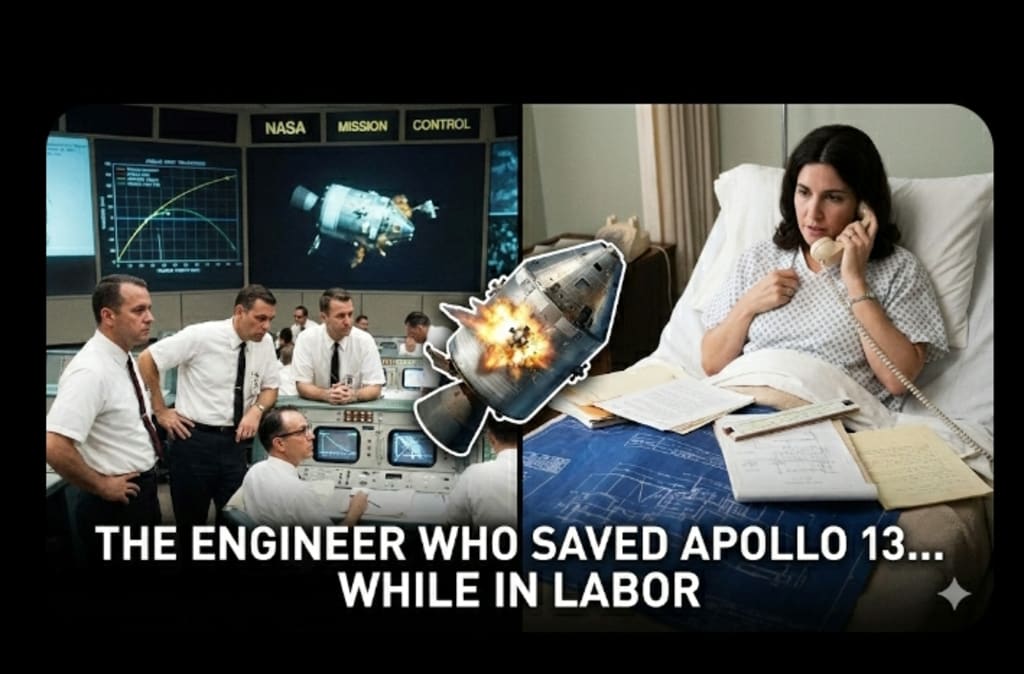
The incredible true story of Judith Love Cohen, the aerospace engineer who finalized the Abort Guidance System for Apollo 13 while in labor with her son, Jack Black. A deep dive into the history of women in STEM and the invisible labor that saved the space program.
Introduction: The Voice You Didn’t Hear
When we think of April 1970 and the near-disaster of Apollo 13, our minds immediately go to the famous iconography. We think of Jim Lovell’s calm voice saying, "Houston, we’ve had a problem." We think of the tense Mission Control room filled with chain-smoking men in white vests and skinny ties, led by the steely Gene Kranz. We think of the frantic improvisation of duct tape and cardboard to fix the CO2 scrubbers.
History is often distilled into these cinematic moments. It focuses on the people holding the microphone or the people holding the joystick.
But in the complex machinery of space exploration, survival is rarely the result of a single moment of pilot heroism. Survival is engineered years in advance. It is written in code, soldered into circuits, and calculated in notebooks long before the rocket ever leaves the pad.
One of the most critical components of the Apollo 13 survival story wasn't created in Mission Control during the crisis. It was created in a laboratory in California by a woman who was fighting a battle on two fronts: the immense technical challenges of sending men to the moon, and the stifling societal expectations of 1960s America.
Her name was Judith Love Cohen. She was not an astronaut. She was an engineer. And on the day her work was put to the ultimate test, she was busy doing something arguably more difficult than flying a spacecraft: she was solving a guidance problem while giving birth to a future Hollywood icon.
Part I: The Girl Who Wanted to See the Stars
To understand why Judith Love Cohen was the right person to have in your corner during a space disaster, you have to understand where she came from. Born in Brooklyn, New York, in 1933, Judith grew up in a world where the professional pathways for women were narrow and clearly signed.
If you were a smart girl in the 1940s and 50s, you were encouraged to become a teacher, a nurse, or a secretary. If you were exceptionally ambitious, perhaps you could become a librarian.
But Judith was fascinated by math. Her father taught her the basics of geometry using ashtrays on the kitchen table, sparking a love for spatial reasoning that would define her life. However, the world outside her kitchen was less encouraging. When she was in school, a guidance counselor looked at her high math scores and, with no irony intended, suggested she attend finishing school to learn how to be a lady.
It was the first of many times Judith would be told "no." And, characteristically, it was the first of many times she would ignore it.
She enrolled at Brooklyn College as a math major, but her heart was in engineering—a field that was, at the time, almost exclusively male. She later transferred to the University of Southern California (USC), where she finally pursued her engineering degree.
The atmosphere in engineering programs in the 1950s was not welcoming to women. They were often viewed as distractions or dilettantes. Judith recalled later that she never saw another woman in her engineering classes. She had to navigate a space where her presence was questioned daily, where her mistakes would be attributed to her gender, but her successes would be attributed to luck.
Despite the friction, she graduated with both a bachelor’s and master’s degree in electrical engineering. She didn't just want to participate in the technological revolution; she wanted to build it.
Part II: The Backup to the Backup
Judith landed a job at Space Technology Laboratories, which eventually became TRW (Thompson Ramo Wooldridge), a massive aerospace contractor that built the hardware for NASA’s most ambitious missions.
By the mid-1960s, the Space Race was at its fever pitch. The goal was the Moon, and the timeline was impossible.
Judith’s specialty was the guidance system for the Lunar Module (LM). The LM was the spidery, awkward-looking craft designed to detach from the main Command Module, land on the lunar surface, and then launch back up to reconnect for the ride home.
The guidance system is the brain of the ship. It tells the computer where it is in the dark void of space, how fast it is going, and which way the thrusters need to point. Without it, you are just a tin can drifting in infinity.
The Lunar Module had a primary guidance system (PGNS). But in spaceflight, redundancy is god. NASA required a backup system in case the primary one failed. This was called the Abort Guidance System (AGS).
The AGS was Judith’s baby.
It was designed to be a "lifeboat" system. If the main computer crashed during the descent to the Moon, the AGS had to be ready to take over instantly, calculate the trajectory, and fire the ascent engine to get the astronauts back to the Command Module safely.
It had to be simple, robust, and fail-safe. It was the kind of technology you hope you never have to use, like an airbag or an ejection seat. Judith and her team spent years agonizing over the code and the circuitry, ensuring that if the worst happened, the math would hold up.
Part III: The Problem in the Delivery Room
The legend of Judith Love Cohen usually centers on a single day in late August 1969.
At this point, the Apollo program was in full swing. Apollo 11 had successfully landed on the moon just a month prior. The pressure to keep the momentum going was immense.
Judith was heavily pregnant with her fourth child. But the work at TRW didn't stop for biology. There was a glitch in the Abort Guidance System—a complex problem regarding how the system handled a specific abort scenario. It was a knotty, stubborn piece of engineering that needed to be unraveled before the system could be certified for future missions.
On the day she went into labor, Judith was in her office. Most people would have packed up and headed to the hospital at the first contraction. Judith, however, took her computer printouts and her schematic drawings with her.
She checked into the hospital in Los Angeles. While the nurses were prepping her for delivery, she was working on the problem. She understood that the launch schedules were unforgiving. A delay in solving the AGS glitch could ripple out and delay a mission by months.
According to family lore—later confirmed by her son, Neil—she was in the throes of labor when she finally cracked the code. She picked up the phone in her hospital room and called her boss at TRW.
"I solved it," she reportedly said, explaining the fix for the guidance system.
Only after she had relayed the solution and ensured her boss understood the math did she get back to the business of giving birth.
Hours later, she delivered a baby boy named Thomas Jacob Black. The world would later know him as Jack Black, the high-energy comedian, actor, and musician.
Jack Black has famously told this story in interviews, laughing about how his mother was "working on a spaceship" while he was trying to be born. It’s a funny anecdote, but it reveals a profound truth about Judith’s character: She possessed a level of professional dedication that bordered on the superhuman.
Part IV: April 1970 — The Lifeboat is Deployed
Eight months after that hospital phone call, Judith’s work faced its ultimate test.
On April 13, 1970, Apollo 13 was hurtling toward the Moon. Inside were astronauts Jim Lovell, Jack Swigert, and Fred Haise.
200,000 miles from Earth, an oxygen tank in the Service Module exploded.
The explosion tore the guts out of the main spacecraft, the Odyssey. It lost oxygen. It lost power. It lost water. The Service Module was dead, and the Command Module was dying fast.
To survive, the crew had to move into the Lunar Module, the Aquarius. The LM was designed to support two men for two days on the lunar surface. Now, it had to support three men for four days on the voyage home.
The crisis presented a terrifying math problem. The Lunar Module had limited batteries. It didn't have enough power to run all its systems for the entire return trip. They had to shut down everything non-essential.
This included the primary guidance computer.
The primary computer was a power hog. To save electricity for the final re-entry, Mission Control ordered the crew to shut it down.
But you can't fly a spaceship blind. They needed a way to navigate—a low-power system that could be turned on quickly to verify their course during engine burns.
They turned to the Abort Guidance System.
This was the moment Judith Love Cohen had prepared for. The AGS wasn't just a landing backup anymore; it was the primary navigation tool for the return "burns"—the engine firings that would push the crippled ship out of lunar orbit and onto a path toward Earth.
One of the most critical maneuvers of the flight was the "PC+2 burn" (Pericynthion Plus 2 Hours). This engine firing had to be precise. If it was too short, they would skip off the atmosphere and be lost in space forever. If it was too long, they would burn up on re-entry.
The crew used the Abort Guidance System to monitor the burn. They relied on Judith’s algorithms to tell them if they were pointed in the right direction.
For days, the world held its breath. In California, Judith watched the news. She knew exactly what systems were keeping those men alive. She knew the margins of error. She knew the redundancies.
When the Aquarius finally released the Command Module and the crew plummeted through the atmosphere to a safe splashdown in the Pacific, it was a triumph of improvisation. But it was also a triumph of preparation.
The astronauts came home because they had a lifeboat. And that lifeboat worked because Judith Love Cohen had ensured—even from a hospital bed—that it was flawless.
Part V: The Legacy of Invisible Competence
Judith Love Cohen didn't get a ticker-tape parade. When the movie Apollo 13 was released in 1995, her character wasn't in it. The narrative focused on the men in the trench at Mission Control, which is understandable—it was their drama.
But Judith’s story represents a different kind of drama: the quiet drama of competence.
After Apollo, she didn't stop. She went on to work on the Hubble Space Telescope, specifically the Science Operations Ground System. She continued to work at TRW for decades, rising to become a principal engineer—a rarity for a woman of her generation.
Later in life, she realized that the problem wasn't just about hiring women engineers; it was about creating them. She looked at the children's books available for girls and saw nothing but princesses and domesticity.
So, she retired from engineering and started a publishing company. She wrote and published a series of books titled "You Can Be a Woman Engineer," "You Can Be a Woman Architect," and "You Can Be a Woman Astronomer."
She spent the last chapter of her life traveling to schools, speaking to young girls, and telling them the truth that she had learned the hard way: Math doesn't care about your gender. The universe doesn't care who you are. If the calculation is right, the rocket flies.
Part VI: Why We Need This Story Now
Judith Love Cohen passed away in 2016. Her son, Jack Black, continues to be a global superstar. But in recent years, largely due to social media, Judith’s story has begun to eclipse her son’s fame in certain circles.
Why does this story resonate so deeply right now?
We live in an era of "loud" success. We are taught that to matter, you must be visible. You must be an influencer. You must have a brand. You must be the face of the operation.
Judith Love Cohen represents the opposite. She represents invisible excellence.
She proves that the most important people in the room are often the ones who aren't saying a word, but who have done the work. She reminds us that civilization runs on the backs of people who check the math, who test the circuits, and who solve the problems before the crisis even begins.
Her story is a reminder to every American—especially those who feel stuck in the background, those who feel unappreciated, those who feel like cogs in a machine—that being a "cog" is actually a glorious thing if that cog keeps the machine from crashing.
Judith Love Cohen proved that you don't need permission to be great. You don't need society to agree that you belong. You just need to do the work.
When Apollo 13 splashed down, three men walked out of the capsule and waved to the cameras. The world cheered for them.
But in a quiet office in California, and in a nursery with her newborn son, Judith Love Cohen knew the truth. She knew that part of the reason they were breathing the air of Earth was written in the notebook she had taken to the hospital.
She didn't need the applause. The splashdown was enough.
About the Creator
Frank Massey
Tech, AI, and social media writer with a passion for storytelling. I turn complex trends into engaging, relatable content. Exploring the future, one story at a time
Keep reading
More stories from Frank Massey and writers in Motivation and other communities.
The Wrong Stuff: The Untold Story of the Mercury 13 and the Dreams That Were Grounded by Bias
When we look back at the grainy, triumphant footage of the early 1960s Space Race, the imagery is deeply embedded in the American psyche. We see towering rockets capped with tiny silver capsules, Mission Control centers filled with chain-smoking men in white shirts and skinny ties, and, of course, the astronauts themselves. They were the embodiment of mid-century masculine heroism: fighter jocks with buzzcuts and iron jaws, possessing what author Tom Wolfe famously dubbed "The Right Stuff." They were Alan Shepard, John Glenn, and Gus Grissom—names etched into history books as the pioneers who rode fire into the heavens to beat the Soviet Union.
By Frank Massey 24 days ago in Motivation


Comments
There are no comments for this story
Be the first to respond and start the conversation.