
Her Hands Smell of Petrol, Not Pity
A young girl’s battle against poverty and judgment.

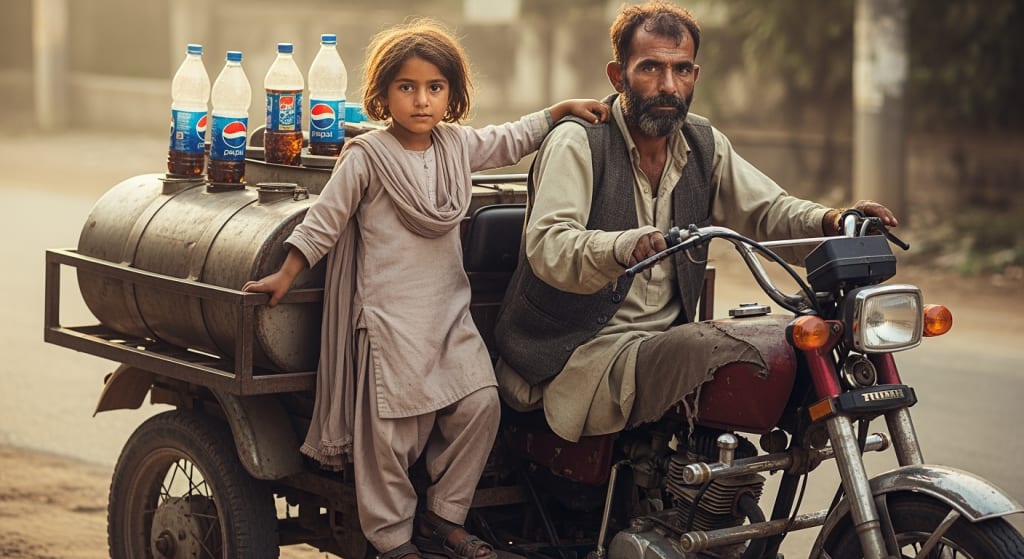
In the narrow, sun-scorched streets of a small town in Pakistan, a three-wheeled motorcycle rattles its way through traffic. On its cart sit rows of recycled glass bottles, each one filled with petrol. The driver, Wali Khan, steers with his left hand—the only one that still works. His right hand and leg remain lifeless, paralyzed since the night tragedy struck in 2018.
Once, Wali lived with dignity and stability. A respected manager in a transport company, he wore pressed shirts and carried a leather briefcase. His home echoed with laughter from his four daughters and his only son. But one rainy night, on his way back from work, a speeding truck crashed into his car. Wali survived with half his body paralyzed. His eight-year-old son did not survive.
The grief was unbearable, but the weight of poverty was even heavier. Medical bills drained his savings, and his career was gone. Still, Wali refused to surrender. With help from a friend, he modified a motorcycle to fit his disabled body, attaching a small wooden cart for carrying petrol in old Pepsi bottles. It was hard, it was humble, but it was honest.
And standing beside him every single day is Mahnoor—his youngest daughter, just 12 years old.
Mahnoor’s Silent Strength
Mahnoor is no ordinary child. A 6th-grade student, she rises before dawn to help her mother with chores, ties her hair back in a simple ponytail, and packs her schoolbag. Before class, she joins her father at the cart—dusting bottles, refilling them, and preparing for the day’s work. After school, she returns to help again, still in her uniform or an old kurta, never complaining about the smell of petrol that clings to her hands.
When asked what scares her the most, Mahnoor doesn’t mention poverty or hunger. Instead, she says quietly:
“Not poverty… but the way people look at me. Those eyes filled with judgment. That’s what scares me.”
She talks about the men who smirk, the women who whisper, and the children at school who tease her. “People think if you work on the street, you must be beggars,” she explains. “But we don’t beg. We earn.”
And the way she says it—we earn—is heavy with dignity, a lesson she has learned not from books, but from life itself.
A Daughter Who Refuses to Break
Some days are harder than others. When fuel prices rise, profits vanish. When Wali’s body stiffens with pain, Mahnoor does most of the lifting. Once, when a man tried to snatch a bottle without paying, Mahnoor sprinted after him barefoot and brought it back. Later, she simply said:
“He thought we were weak. But we’re not.”
Despite her responsibilities, Mahnoor excels at school. Her teachers describe her as disciplined and determined, ranking among the top in her class. When asked why she doesn’t quit school to work full-time, she answers instantly:
“Because my father didn’t let me stop dreaming. Even when he couldn’t walk.”
Beside her, Wali listens with quiet pride. “After I lost my son,” he whispers, “I thought I had lost my strength. But then I saw it return—in her.”
Dreams Beyond the Cart
Home for the family is a single rented room with a leaky roof and little furniture. There is no fridge, no backup power when electricity fails, and no spare money for luxuries. Yet Mahnoor dreams bigger than her reality. She wants to become a doctor—not for wealth, but to help fathers like hers walk again. She studies with fierce determination, often reading her science books beside the very cart where she sells petrol. She already knows every bone in the human body, especially the spine, which failed her father.
More Than Survival: A Choice
Mahnoor’s story is not just about hardship—it’s about choice. The choice to stand beside her father when the world turned away. The choice to work with dignity instead of begging. The choice to dream in a place where girls are often told not to.
Every drop of petrol she pours is a message of defiance. Every glance she returns to those who judge her is filled with strength. Every step she takes is a reminder that tragedy does not have to define destiny.
Final Message
In a world that often fails its most vulnerable, Mahnoor stands tall—not with privilege, but with courage. She teaches us that dignity has no age, and resilience has no limit.
Mahnoor is not waiting for change. She is becoming it.
About the Creator
Shehzad Anjum
I’m Shehzad Khan, a proud Pashtun 🏔️, living with faith and purpose 🌙. Guided by the Qur'an & Sunnah 📖, I share stories that inspire ✨, uplift 🔥, and spread positivity 🌱. Join me on this meaningful journey 👣
Keep reading
More stories from Shehzad Anjum and writers in Motivation and other communities.
Fear Fighter, Stand Tall ✊🏾✨
Fourteen-year-old Malik Rivers tugged at the straps of his navy backpack as he walked through the crowded hallways of Jefferson Middle School. It felt like his bag was carrying a mountain, but in truth, it only held his binder, history book, lunchbox, and a basketball tucked between his gym clothes.
By Shehzad Anjum4 months ago in Motivation
Lauren Sanchez Bezos celebrates Jeff Bezos with a heartfelt Instagram birthday post
The vibe of the tribute felt less like a celebrity flex and more like a quiet love letter Lauren Sanchez Bezos is in full celebration mode, and this time the spotlight is on her husband, Jeff Bezos. The media personality and entrepreneur marked Bezos’ birthday with a tender Instagram Story that blended romance, nostalgia, and a quietly powerful image that spoke volumes.
By Dena Falken Esq5 days ago in Motivation



Comments
There are no comments for this story
Be the first to respond and start the conversation.