Latest Stories
Most recently published stories on Vocal.
Why I Keep Blockading Food Distribution Centres. AI-Generated.
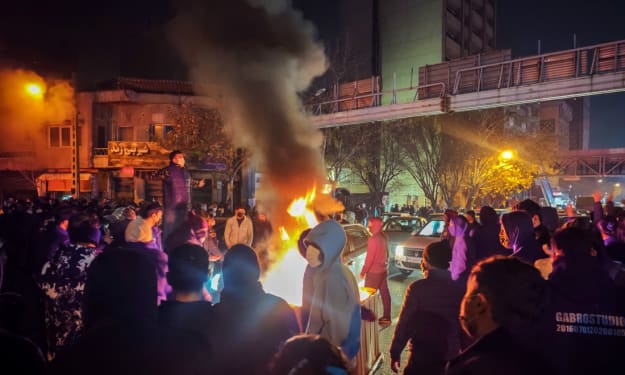
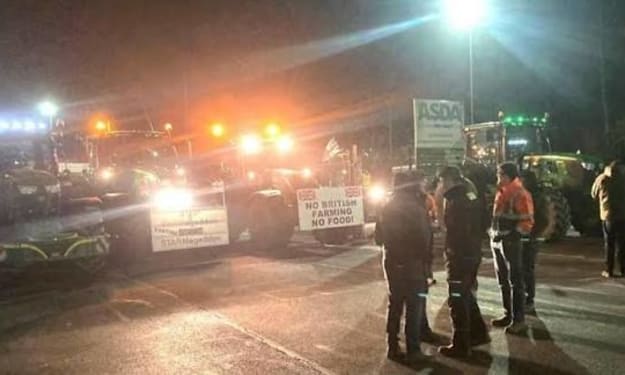
To many people, the idea of blocking food distribution centers sounds cruel and irresponsible. These facilities supply groceries to thousands of families, charities, and local markets. Disrupting them risks harming the very communities already struggling with inflation, unemployment, and food insecurity. Yet for some protesters, these actions are seen as a desperate attempt to be heard in a system they believe no longer listens. The decision to block such sites does not come lightly. It grows out of frustration, anger, and a belief that traditional protest has failed. For years, activists have marched, petitioned, and written to officials about rising food prices, corporate control of agriculture, and unequal access to basic necessities. Many feel ignored. “When you block traffic, people complain but forget,” one protester explained. “When you block food supply, suddenly everyone pays attention.” This logic reflects a deeper belief: that disruption is the only language powerful institutions understand. A Protest of Desperation Those who justify these actions often describe them as moral protests rather than criminal ones. They argue that food distribution centers symbolize a system that prioritizes profit over people. Large corporations dominate supply chains, while small farmers and low-income consumers struggle to survive. For these activists, the blockade is meant to expose contradictions: warehouses filled with food exist alongside families who cannot afford meals. They claim their actions force uncomfortable conversations about inequality and corporate responsibility. However, this reasoning clashes sharply with public opinion. Many citizens see the protests as punishing ordinary people instead of policymakers. Food bank volunteers and truck drivers are often caught in the middle, unable to do their jobs and sometimes facing verbal abuse or threats. The Human Cost Critics argue that such protests cross a moral line. Food distribution is not just another industry; it is part of society’s lifeline. Any disruption can have immediate consequences for hospitals, shelters, and vulnerable populations. Health workers warn that delays in food delivery can affect elderly residents, children, and patients who depend on regular supplies. Even a short interruption can ripple through the system, causing shortages that take days to fix. “These actions hurt the wrong people,” said one community organizer. “They don’t hurt politicians. They hurt families.” This tension between intention and impact is at the heart of the controversy. Protesters may aim to challenge injustice, but the method risks creating new harm. Protest Versus Public Trust Another consequence is the erosion of public support. Movements rely on sympathy and shared values. When tactics appear extreme, public trust collapses. Instead of discussing the underlying issues—corporate power, food access, or government policy—the focus shifts to disruption and legality. Law enforcement has increasingly treated blockades as serious offenses, citing risks to public safety and essential services. Arrests and fines have followed. Courts in several countries have ruled that blocking food supply infrastructure crosses from civil disobedience into endangerment of public welfare. This legal response reflects a growing belief that some forms of protest must have limits, especially when they interfere with survival needs. A Crisis of Communication At its core, the issue reveals a breakdown in communication between citizens and institutions. Protesters feel unheard. Authorities see disorder. Both sides harden their positions. Sociologists note that extreme protest methods often emerge when people believe peaceful channels are ineffective. History shows similar patterns in labor movements and civil rights struggles. Yet history also shows that movements succeed when they build alliances, not when they isolate themselves from the public. The challenge is how to protest power without harming the powerless. Searching for Alternatives Some activists are now questioning their own strategies. They argue that targeting food systems risks undermining the very justice they seek. Instead, they call for boycotts, mass strikes, or legal challenges that pressure corporations and governments directly. Others emphasize community-based action—supporting food banks, helping farmers, and creating local supply networks—rather than disrupting existing ones. “If the goal is food justice,” one former protester said, “then we should be feeding people, not stopping food.” A Moral Reckoning The debate over blockading food distribution centers forces a difficult moral reckoning. Is disruption justified if it draws attention to injustice? Or does it become wrong when it threatens basic human needs? There is no easy answer. What is clear is that society must confront the issues driving such protests: rising inequality, fragile supply chains, and growing mistrust in institutions. Protest is a powerful tool, but it also carries responsibility. When the line between resistance and harm blurs, movements risk losing their purpose. The question is not only why people block food centers, but whether such actions truly bring us closer to the justice they claim to seek—or push us further apart.
By Fiaz Ahmed 9 days ago in Journal
Scientists Study ‘Rivers in the Sky’ Over Atlantic to Improve Rain and Flood Forecasts. AI-Generated.
Scientists are intensifying their study of “atmospheric rivers”—vast streams of moisture in the sky that carry enormous amounts of water across continents—over the Atlantic Ocean. These invisible rivers in the atmosphere are critical in delivering rainfall, replenishing water supplies, and sometimes causing devastating floods. Understanding their behavior could help improve weather prediction models and disaster preparedness worldwide.
By Aarif Lashari9 days ago in The Swamp
Mining: US, UK, EU, Australia and More to Meet to Discuss Critical Minerals Alliance. AI-Generated.
The United States, United Kingdom, European Union, Australia, and several other nations are set to hold a high-level meeting to discuss the formation of a Critical Minerals Alliance. The discussions come as the global demand for essential minerals—used in technologies ranging from electric vehicles to renewable energy systems—soars, and countries seek to secure resilient, sustainable supply chains.
By Aarif Lashari9 days ago in The Swamp
Why Do the Northern Lights Keep Appearing?. AI-Generated.
In recent months, the Northern Lights — also known as the aurora borealis — have been appearing more frequently and in places where they are rarely seen. From northern Europe and Canada to parts of the United States and even lower latitudes, skies have been glowing with vivid curtains of green, pink, and purple light. Scientists say this surge in aurora activity is not random. It is closely tied to changes in the Sun and Earth’s magnetic environment. The growing visibility of the Northern Lights has fascinated skywatchers while raising questions about what is happening in space above our planet. What Are the Northern Lights? The Northern Lights occur when charged particles from the Sun collide with gases in Earth’s atmosphere. These particles are carried toward Earth by solar wind and guided by the planet’s magnetic field toward the polar regions. When they strike oxygen and nitrogen molecules high in the atmosphere, energy is released in the form of light. Different gases produce different colors. Oxygen creates green and red light, while nitrogen produces blue and purple hues. The shimmering patterns are shaped by Earth’s magnetic field lines and the movement of solar particles. Under normal conditions, auroras are mostly visible near the Arctic Circle. But during periods of intense solar activity, they can be seen much farther south. The Role of the Sun’s Activity Cycle The primary reason the Northern Lights have been appearing more often is the Sun’s natural 11-year solar cycle. The Sun goes through periods of low and high activity, known as solar minimum and solar maximum. During solar maximum, the Sun produces more sunspots, solar flares, and coronal mass ejections (CMEs). Currently, the Sun is approaching or entering a phase of heightened activity. This means it is releasing stronger bursts of charged particles into space more frequently. When these particles reach Earth, they interact with the magnetosphere and intensify auroral displays. Scientists say this cycle explains why auroras have become brighter and more common over the past year. Solar Storms and Geomagnetic Disturbances Large solar eruptions, especially coronal mass ejections, can cause powerful geomagnetic storms when they strike Earth’s magnetic field. These storms compress and disturb the magnetosphere, allowing more solar particles to penetrate the atmosphere. During such events, auroras can spread across much wider areas than usual. This is why people in regions like the northern United States, the UK, Germany, and even parts of southern Europe have reported seeing the lights recently. While these storms are visually stunning, they can also disrupt satellites, radio communications, and power grids if they become strong enough. Why They Seem More Frequent Now There are several reasons people feel the Northern Lights are appearing more often: Increased solar activity – The Sun is entering a more active phase of its cycle. Better monitoring technology – Satellites now track solar storms more accurately and alert the public when auroras are likely. Social media exposure – Stunning images shared online make auroras feel more frequent and widespread. Clearer skies in some regions – Reduced air pollution in certain areas has made night skies more visible. Together, these factors have created the impression of constant aurora events. Are the Northern Lights Dangerous? For most people on Earth’s surface, auroras are harmless. They occur high above the ground, usually more than 100 kilometers above the surface. However, strong solar storms associated with intense auroras can affect modern technology. Airlines sometimes reroute flights away from polar regions during major solar events to avoid radiation exposure and communication disruptions. Power companies also take precautions to protect electrical grids from geomagnetic interference. Scientists stress that while solar storms can be disruptive, they are a natural part of space weather and are carefully monitored. What This Means for the Future Experts predict that auroral activity will remain strong for the next few years as the Sun continues through its active phase. This means more opportunities for people outside polar regions to witness the Northern Lights. Astronomers and space agencies are using this period to study how solar activity affects Earth’s atmosphere and technology. Understanding these interactions is becoming increasingly important as humanity relies more heavily on satellites, GPS systems, and global communications networks. Some researchers also see this as a reminder of how closely Earth is connected to space. The glowing skies are not just beautiful displays — they are visible evidence of powerful forces shaping our planet from 150 million kilometers away. A Rare Gift of Nature For many, the repeated appearance of the Northern Lights has been a rare gift. Communities that never expected to see auroras have gathered at night to watch the skies in awe. The phenomenon has sparked renewed interest in astronomy and space science among the public. Despite modern explanations, the Northern Lights still carry a sense of mystery. Ancient cultures believed they were spirits, gods, or messages from the heavens. Today, science has revealed their true origin, but the emotional impact remains the same. As long as the Sun continues its cycles of activity, the Northern Lights will keep returning — reminding humanity that even in an age of technology, nature still has the power to surprise and inspire.
By Fiaz Ahmed 9 days ago in Longevity
The Most Powerful Woman in Football – Meet the Game’s First Female Super Agent. AI-Generated.
For decades, football’s most influential figures have been club owners, managers, and male player agents operating behind the scenes. But today, a new face of power has emerged in the sport: the world’s first widely recognized female super agent, reshaping the business of football and challenging one of the game’s most male-dominated industries. Her rise marks a turning point not only for women in sports management but also for how football’s global business is conducted. Breaking Into a Closed World When she first entered football representation, the industry was dominated by established male agents with decades of connections. Negotiations took place in boardrooms where women were rarely seen. Early in her career, she faced skepticism from club executives who doubted her knowledge of contracts and tactics. “People assumed I was there to assist someone else,” she once said in an interview. “They didn’t expect me to lead negotiations.” Instead of retreating, she learned every detail of football law, transfer regulations, and financial structures. She built relationships not through bravado but through preparation and precision. Within a few years, she began representing promising young players overlooked by major agencies. Building a Global Client List Her reputation grew when she successfully negotiated high-value transfers for several international stars. These deals included record-breaking contracts, image rights agreements, and sponsorship packages with multinational brands. Unlike traditional agents who focus solely on transfer fees, she positioned herself as a full-career strategist. Her agency offers legal support, mental health services, financial planning, and media training to players. “She doesn’t just negotiate contracts,” said one player she represents. “She plans your entire career.” Her client list now includes elite footballers across Europe, South America, and Africa. Several play in top leagues such as the Premier League, La Liga, Serie A, and the Bundesliga. Changing the Culture of Representation What sets her apart is not only her success but her approach. She has introduced a more transparent style of negotiation, focusing on long-term stability rather than short-term profit. In an industry often criticized for secrecy and aggressive tactics, she insists on ethical standards and player welfare. “Footballers are not just assets,” she has said. “They are human beings with futures beyond the pitch.” This philosophy has attracted players who want more control over their careers and fewer exploitative arrangements. Influence Beyond Transfers Her influence now reaches beyond contracts. She advises clubs on youth development policies and serves as an informal consultant to federations seeking to modernize their management structures. She is also a vocal advocate for women in football leadership. Through mentorship programs, she helps young women enter sports law, management, and representation. Her success has already inspired a new generation of female agents and executives who see her as proof that power in football no longer belongs exclusively to men. Resistance and Challenges Despite her achievements, resistance remains. Some critics argue that football’s power structures are slow to accept change. She has faced online harassment and sexist criticism, particularly when representing high-profile male players. “There are still rooms where I have to prove myself twice,” she admitted. “But results speak louder than prejudice.” She has also had to navigate conflicts with powerful figures who prefer the traditional system of influence. Yet each successful deal strengthens her position, making it harder to dismiss her authority. A New Definition of Power In football, power has long been measured in money and influence. Today, her power is defined by trust. Players trust her with careers worth millions. Clubs trust her professionalism. Sponsors trust her brand vision. Her agency now ranks among the most profitable in the sport, managing contracts worth hundreds of millions of dollars. Industry analysts say her rise reflects a broader shift in football’s business culture toward professionalism, diversity, and accountability. Impact on Women’s Football She has also used her platform to promote women’s football, helping female players secure better contracts and sponsorships. Several of her clients compete in top women’s leagues and international tournaments. By representing both men and women, she has created a bridge between two worlds of football that rarely intersect at the business level. This dual focus has helped normalize the idea that women can lead major negotiations in a sport traditionally ruled by men. The Road Ahead Looking forward, she plans to expand her agency into Asia and North America and invest in youth academies that prioritize education alongside football training. Her long-term vision is to redefine what it means to be an agent: not a deal-maker alone, but a guardian of players’ futures. “Football is changing,” she said recently. “And those who don’t change with it will be left behind.” A Symbol of Transformation The rise of football’s first female super agent is more than a personal success story. It is a signal that power in football is evolving. Talent, intelligence, and integrity now compete with tradition and old networks. In a game watched by billions, her presence behind the scenes represents a quiet revolution. She is not only negotiating contracts — she is rewriting the rules of influence. And as football continues to globalize and modernize, her story proves that the most powerful figures in the sport no longer look the same as they once did.
By Fiaz Ahmed 9 days ago in Unbalanced
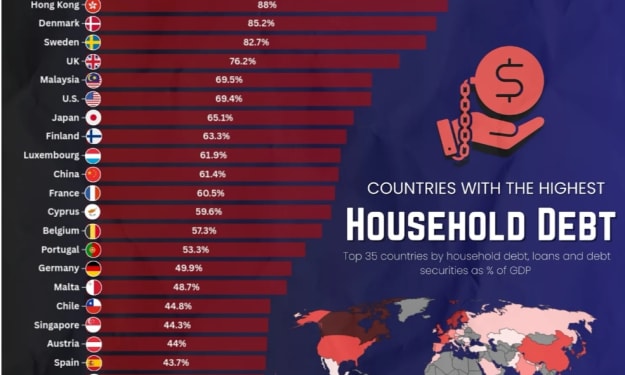
Charted: The 35 Countries with the Highest Household Debt. AI-Generated.
Household debt has become a major economic indicator, reflecting not only the financial habits of citizens but also broader economic trends in each country. From mortgages and personal loans to credit cards and other forms of borrowing, household debt levels provide insight into consumer confidence, government policies, and potential financial vulnerabilities.
By Aarif Lashari9 days ago in The Swamp
Fumfer Physics 40: Cosmic Ratios, Large Numbers, and the Information Structure of the Universe
In this exchange, Scott Douglas Jacobsen asks Rick Rosner about striking ratios in physics that appear across vastly different scales. Rosner points to large-number disparities, such as the enormous strength difference between electromagnetism and gravity at the particle level, and contrasts microscopic lengths with the scale of the observable universe. He cautions against misapplied figures, noting that some famous numbers belong to entirely different physical contexts. While no single cosmic object strikes him as anomalous, Rosner emphasizes unresolved questions about cosmic maturity, heavy-element origins, and the nature of time. He ultimately frames time as closely tied to information flow, arguing that our lack of a rigorous definition of information remains one of physics’ deepest gaps.
By Scott Douglas Jacobsen9 days ago in Interview
‘We Will Fight This War’: CM Bugti Says 145 Terrorists Killed in 40 Hours Across Balochistan. AI-Generated.
Balochistan Chief Minister (CM) Akhtar Bugti has declared that security forces killed 145 terrorists in just 40 hours, as counterterrorism operations intensified across the province. The announcement comes amid ongoing efforts by Pakistani authorities to restore stability in the region, which has faced insurgency, attacks on infrastructure, and sectarian violence for years.
By Aarif Lashari9 days ago in The Swamp
Mismanaging Your Emotions At Work Leads To Occupational Burn Out
People being forced to fake how they feel in the work place is one of the main causes of occupational burn out. That’s according to new research by Emlyon Business School. Researchers have discovered that the surface acting creates a form of exhaustion which drains the ability an employee possesses to be able to organise themselves and take part in everyday work-related tasks. This effects an organisation’s ability to function well and cater for it’s own staff and customers. This creates a huge impact on the ability each individual has to manage their own cognitive capacity as well as eroding their sense of authenticity. This puts a huge impact on team trust and makes engaging in leadership more difficult.
By Ashish Prabhu9 days ago in Lifehack
Selena Gomez and Benny Blanco Are Ready to Start a Family: Exploring Surrogacy and Adoption. AI-Generated.
Selena Gomez and Benny Blanco are officially ready to turn the page on their next chapter. Following their wedding in September, insiders report that the newlyweds are eager to start a family immediately. The couple is reportedly moving with a sense of urgency, actively exploring alternative paths to parenthood, specifically surrogacy and adoption.
By Ann D. Burch9 days ago in Fiction