Latest Stories
Most recently published stories on Vocal.
The Complete Guide to Recovering Your Snapchat Password (Legitimate Methods & Protection Tips). AI-Generated.
Losing access to your Snapchat account can be frustrating and concerning. Whether you've forgotten your password or suspect unauthorized access, this comprehensive guide provides legitimate recovery methods, essential protection strategies, and answers to frequently asked questions. It's crucial to emphasize that hacking into someone else's Snapchat account is illegal and unethical. This article focuses exclusively on legitimate account recovery for your own account and protective measures.
By Alexander Hoffmannabout 8 hours ago in 01
Mother’s Day Jewelry: Timeless Gifts That Celebrate Love and Appreciation
Mother’s Day jewelry is one of the most heartfelt ways to express love, appreciation, and respect for mothers. Unlike ordinary gifts, jewelry holds emotional value and becomes a lasting reminder of special moments. From elegant gemstone rings to delicate necklaces and timeless bracelets, Mother’s Day jewelry beautifully symbolizes the unconditional bond between a mother and her family.
By Margaret Johnsonabout 8 hours ago in Marriage
Top 10 AI Development Companies in the USA
The rise of generative artificial intelligence technology has been revolutionizing the manner by which companies innovate, automate their processes, generate content, as well as optimize customer experience. From smart chatbots, analytics, and image, video, to code generators, companies recognize that the future of their businesses may involve a large reliance on generative artificial intelligence, thereby searching for trusted companies for the development of the technology.
By Olivia Carterabout 8 hours ago in Futurism
OBLIT
This is me. My name is Oblit. It's odd, isn't it? I live on an island. Well, at least I think I do. I haven't seen anyone else in a long time, so I assume I do. I live inside a little house - it's quaint. A five-windowed bungalow, built on a street with only half-constructed houses all around. The lights don't light up at night - and the various concrete and plaster walls that decorate the plain green field only serve as props to my living. I live inside 1557 Rangolin Street. One front door, one back. A modest little backyard with benches and various plants sprouting from scattered pots. Two sets of gardening tools, one for me, one in case I forgot the other.
By Albert Xiongabout 8 hours ago in Horror
How Japan saved its biggest city from collapse
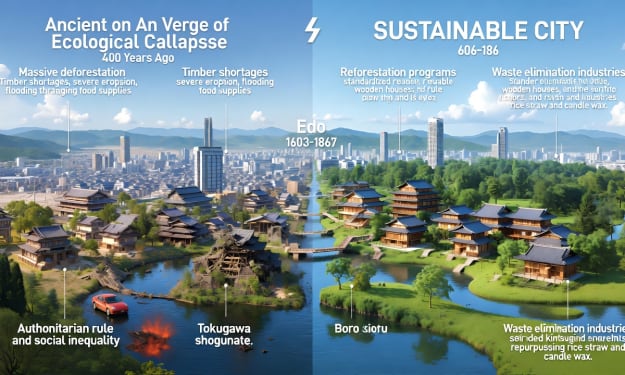
400 years ago, the place we now call Tokyo was known as Edo. It was already one of the largest cities in the world, with almost 1 million people living there. But the city was close to a big ecological problem. Years of cutting too many trees had caused heavy deforestation. Edo now had shortages of wood, bad soil erosion, and floods that often happened. These problems put food supplies in danger. However, in just a few decades, Edo changed a lot and became one of the most sustainable and smart cities ever in history. So, how did this city that wasted almost nothing come to be? In 1467, Japan started a long time of bloody civil wars that went on for more than 100 years. But in 1600, Tokugawa Ieyasu won against his enemy warlords and brought Japan under one rule. This started the Tokugawa shogunate, which ruled from 1603 to 1867. During this time, Ieyasu and the later shoguns made big changes that affected Japan's money system, land, and way of life. The shoguns were worried about growing power from other countries. So, they made very strict rules on contact with the outside world. They stopped foreign traders from coming in, and Japanese people could hardly leave the country. Because imports dropped suddenly, the Tokugawa shoguns worked hard to increase things made inside Japan. At the same time, they reduced use and waste. These ideas were not completely new. They came from the Buddhist idea called mottainai, which means not wasting things and being happy with "just enough." The shoguns saw how much damage had happened to the forests around the capital, Edo. So, they made rules to limit cutting trees and started big programs to plant new forests. Villagers had to plant millions of trees at first, and later they got paid to do it. To reduce the need for wood, they brought in strict rules for sharing timber. Houses were built with standard wooden parts that could be taken apart and used again. Soon, whole businesses grew up to use the city's waste and turn it into something useful. People used farm waste, like rice straw, to make rope and packing things. Drops of candle wax were collected and made into new candles. Craftsmen fixed old umbrellas and worn sandals instead of throwing them away. Even human waste was collected and used as fertilizer for fields. Inside homes, families learned ways to reuse or change old things instead of throwing them out. Kimonos were mended again and again. When the cloth became too old to fix, it was used to cover futons. Then it was cut into diapers or cleaning rags. Finally, the last bits were burned as fuel. Artisans fixed broken pottery with kintsugi. They joined the pieces with lacquer and painted gold along the cracks, making them beautiful. A tradition called boro grew up. People sewed bits of old cloth together to make pretty patched clothes. These were passed down in families for many years. At the same time, poetry, theater, and books became very popular. People also studied Chinese Confucian ideas and some European science books. These were allowed in Japan, even though the writers themselves were not welcome. But the Tokugawa period had problems too. There were very strict laws, and the government ruled in a strong, controlling way. It was a feudal society with big differences between rich and poor. Most farmers (peasants) had to pay a heavy rice tax called nengu to their local lords, called daimyo. This tax was often very hard for them. By the second half of the 1800s, prices went up a lot (inflation), which made the economy weak. Outside pressures also grew, like when the United States used warships to force Japan to open up. All this made Japan start trading with foreign countries again. In the end, it led to the fall of the Tokugawa shogunate. Even with these problems, this time in history teaches us a strong lesson. Edo changed from a city almost destroyed by nature problems to a lively center of culture. It shows that broken things can be fixed, and fixing them can make something even more beautiful. Today, only about 7% of the world's economy is circular (reuse and recycle). Edo's story reminds us that we can build economies based on using limited things carefully, not on buying more and throwing away.Follow for more stories like this.
By Munesh Yadavabout 8 hours ago in Education
What Your Grandmother Knew about Gold that Wall Street Forgot. AI-Generated.
My grandmother kept her gold bangles in a faded velvet pouch at the back of her wardrobe. Not in a safe, not in a bank vault, just tucked between old shawls and photographs. When I asked her once why she bothered keeping them, she looked at me like I'd asked why the sky was blue.
By Marcus Briggsabout 8 hours ago in Lifehack
Diary of Anony Elle
If you are reading this the battle has begun. I have packed a small suitcase, a small duffle bag, and a bookbag to begin my travels from Chicago to the Orlando area. I am looking for my babies and I will go to the highest mountain and the DEPTHS OF HELL to find them!
By Anony Elleabout 8 hours ago in Journal
Trump Says ‘Help Is on Its Way’ as He Urges People in Iran to ‘Keep Protesting’ and ‘Take Over’ Their Institutions. AI-Generated.
Former US President Donald Trump has sparked fresh controversy after publicly urging people in Iran to “keep protesting” and to “take over” their institutions, while declaring that “help is on its way.” His remarks, delivered through public statements and amplified on social media, have immediately drawn global attention, raising questions about foreign interference, escalation, and the real-world consequences of such rhetoric.
By Aarif Lashariabout 8 hours ago in The Swamp
Why Antennas Are Quietly Powering the Connected Future. AI-Generated.
You never see the moment connectivity almost fails. There’s no warning when a signal weakens, no headline when a network holds instead of collapses. Yet behind every seamless scroll, instant upload, and perfectly timed navigation cue, a hidden system is working relentlessly to keep the world stitched together. At the heart of that system is a technology so overlooked it’s practically invisible until it isn’t.
By Andrew Hamiltonabout 8 hours ago in Journal
Sisvida Exchange:Advancing Automation and AI in Financial Technology. AI-Generated.
Sisvida Exchange and Its Impact on Financial Technology Executive Summary Over the past decade, financial technology (FinTech) has reshaped the financial services sector, transforming how payments, transactions, and data management are conducted. Sisvida Exchange has emerged as a noteworthy entity influencing this evolution, primarily through its integration of advanced technologies that enhance operational efficiency and data-driven decision-making. While often associated with digital asset facilitation, its broader significance lies in its contributions to technological processes that underpin modern financial systems. This report examines the role of Sisvida Exchange in advancing FinTech, focusing on technological innovation, data utilization, and integration within the broader financial ecosystem.
By Sisvida Exchangeabout 8 hours ago in Trader