science
The Science Behind Relationships; Humans Media explores the basis of our attraction, contempt, why we do what we do and to whom we do it.
'New Colour' No One Has Seen Before. Content Warning.
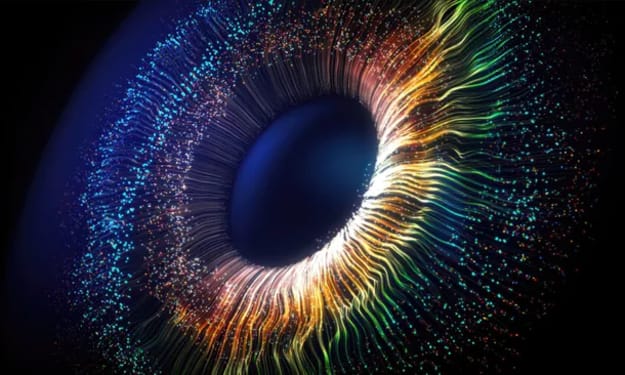
Researchers at the University of California, Berkeley have discovered a previously unknown color they have dubbed "olo" in a ground-breaking study. This discovery, which was published in Science Advances, challenges our understanding of how humans perceive color and opens up new research opportunities in visual studies and neuroscience. The Finding of "Olo" Dr., a neuroscientist, is in charge of the research team. A novel method was used to stimulate the human retina by Michael Lee. They used a device called "Oz" to focus on M-cones, which are cells in the retina that are responsible for detecting medium wavelengths of light, which are typically associated with green hues. The S-cones and L-cones, which detect short wavelengths and long wavelengths, were omitted by this precise stimulation. The end result was the perception of a brand-new color called olo that has no known wavelength. Olo was described by participants as a unique, highly saturated blue-green color. The three-cone model of human color vision is challenged by this phenomenon, which suggests that olo exists outside of the standard color gamut. Understanding Color Vision in Humans The trichromatic theory, which asserts that the retina contains three types of cones that are sensitive to short (blue), medium (green), and long (red) wavelengths of light, serves as the foundation for human color vision. In order to produce the perception of color, the brain processes the input from these cones. However, the discovery of olo, which appears to be a singular experience that is not attributable to the stimulation of the existing cone types, has cast doubt on this model. The trichromatic model's limitations and the possibility of additional, previously unknown mechanisms in human color vision are intriguingly questioned by the perception of olo. Implications for Visual and Neuroscience Research The field of neuroscience will be significantly affected by the discovery of olo. It gives researchers a new tool for understanding how the brain processes sensory information and how complex visual processing is. Researchers can gain insight into the neural pathways involved in color perception and the brain's construction of our visual reality by comprehending how olo is perceived. Additionally, the capacity to create a brand-new color experience may be useful in the treatment of visual disorders. The method used to make Olo may provide therapeutic options for people who are color blind or have other visual impairments by helping to retrain the brain to process visual stimuli. The Debate Regarding "Newness" Even though the Berkeley team says that olo is a new color, some experts still don't believe it. Dr. According to vision scientist John Barbur of the University of London, olo might not be a new color but rather a more intense version of an existing color. He suggests that the brain may perceive olo as a distinct color experience because of the extreme saturation of a blue-green hue. This debate demonstrates the difficulty of defining what constitutes a "new" color and the complexity of color perception. Additionally, it emphasizes the need for additional research to determine whether olo is a variation of existing color stimuli or a truly novel perceptual experience. The Study of Color Perception's Future The discovery of olo opens the door to additional research into the limits of human color perception. The possibility of stimulating various combinations of retinal cells to elicit additional new colors is currently being investigated by researchers. Understanding the full spectrum of human color perception could have an impact on art and design, virtual reality, and user interface development, among other fields. These kinds of discoveries also have ramifications that go beyond the confines of the laboratory. In conclusion, our fundamental understanding of color and perception is challenged by the discovery of olo. It opens up exciting possibilities for future neuroscience research and applications, whether it is a brand-new color or an enhanced version of an existing one. Who knows what other unseen colors might be waiting to be discovered as scientists continue to investigate the limits of human perception.
By rasong nokrek10 months ago in Humans
How Does Your Brain Create New Memories? . AI-Generated.
How Does Your Brain Create New Memories? Neuroscientists Discover ‘Rules’ for How Neurons Encode New Information Have you ever wondered how your brain keeps track of a brand-new phone number, a favorite song, or the face of a new acquaintance? Neuroscientists have been trying to figure out exactly how our brains make memories for decades. Now, a new study has revealed the exact rules that govern how neurons encode new information. The human brain's network of approximately 86 billion neurons, which are constantly communicating through chemical and electrical signals, is at the center of this process. Understanding how these neurons function has been one of science's most difficult puzzles, despite the fact that they constitute the physical foundation of memory.
By articelmunaf10 months ago in Humans
Discovery of a new colour. AI-Generated.
Humans have relied on the three cone cells in their eyes, which are sensitive to the wavelengths of red, green, and blue, to perceive the kaleidoscope of colors around them for centuries. But what if there was a color that we couldn't see with our eyes alone? Recent scientific advancements suggest that such a hue might now be within reach, either through biological quirks, optical illusions, or cutting-edge technology.
By ridnan awal10 months ago in Humans
Understanding Cochlear Implants: A Breakthrough in Restoring Hearing
What Is a Cochlear Implant? A cochlear implant is a surgically implanted electronic device designed to provide a sense of sound to individuals with severe or profound sensorineural hearing loss. Unlike traditional hearing aids, which amplify sound, a cochlear implant bypasses damaged portions of the ear and directly stimulates the auditory nerve, allowing the brain to process sound signals.
By Quillian Murphy10 months ago in Humans
Are we Alone in the Universe?
In 1950, Enrico Fermi postulated his famous paradox: If life is common enough in the universe to give rise to us, then where is everybody? Recently, a philosopher has advanced a proposal to resolve this paradox: We are not alone in the universe, and there are many alien civilizations out there. But they wisely choose to keep to themselves.
By SAQIB AKRAM10 months ago in Humans
Modern Science
Modern Science: Shaping the Future with Innovation and Discovery Innovating and Discovering the Future One of humanity's greatest achievements is modern science. From curing diseases to exploring the cosmos, science has fundamentally changed the way we live, work, and understand our universe. Scientific discovery has accelerated significantly in the 21st century, particularly as a result of cutting-edge technology, interdisciplinary collaboration, and global issues that call for novel solutions. In this article, we’ll explore how modern science is transforming our world, the fields leading this revolution, and the ethical questions we must confront as science continues to evolve.
By Naymur Islam10 months ago in Humans
When Lecture Halls Become Battlefields: Why Do U.S. College Shootings Keep Happening?
Introduction: A Night of Horror in Florida… Not the First, Nor the Last On a chilly evening in Florida, Florida State University (FSU) became the latest stage for a nightmare that haunts American society with grim regularity: a student brandishing a firearm, shots shattering the campus silence, and young lives cowering under desks, fearing for their survival. This scene is not new. From the Virginia Tech massacre (2007) (32 dead) to Sandy Hook (2012) and the Robb Elementary shooting (2024) , the cycle of violence repeats as if trapped in a never-ending loop.
By sondos azhari10 months ago in Humans
SMELLY BUT SCIENTIFIC
We’ve all been there—trapped in an elevator, on a hot commute, or mid-gym session when a distinct, unpleasant whiff cuts through the air. It's a curious mix of onion, cheese, and something... musky. Maybe even a hint of wet goat? Body odor—often joked about, rarely understood—is far more than just an awkward hygiene issue. It's a complex biological phenomenon, intricately tied to your genetics, sweat glands, diet, and even your emotional state.
By Kreative William 25410 months ago in Humans
THE HIDDEN EPIDEMIC
In the mid-1990s, a groundbreaking discovery quietly shook the foundations of public health. The Centers for Disease Control (CDC) and Kaiser Permanente uncovered a powerful link between early childhood trauma and the leading causes of death in the United States. It wasn’t a virus. It wasn’t a new environmental toxin. It was something far more personal—and far more common. It was childhood trauma.
By Kreative William 25410 months ago in Humans
ADDICTION ISNT THE ENEMY
For a century now, the world has been waging a war against addiction — a battle filled with punishment, stigma, and fear. But what if everything we thought we knew about addiction is wrong? What if the real answer isn’t more control, more punishment, or more shame — but more love, understanding, and human connection?
By Kreative William 25410 months ago in Humans