
Discovery of a new colour
Expanding the Limits of Human Vision
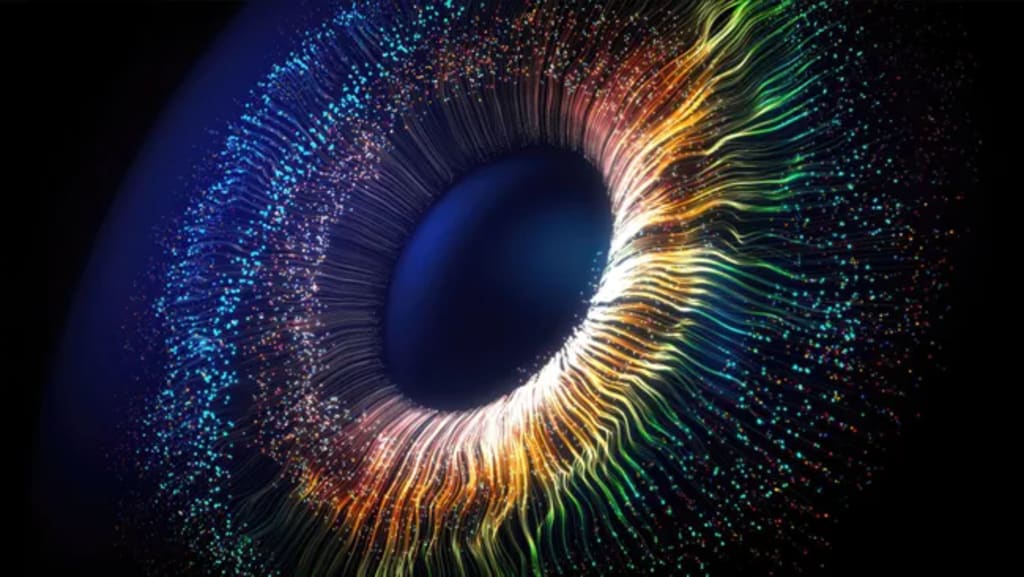
Humans have relied on the three cone cells in their eyes, which are sensitive to the wavelengths of red, green, and blue, to perceive the kaleidoscope of colors around them for centuries. But what if there was a color that we couldn't see with our eyes alone? Recent scientific advancements suggest that such a hue might now be within reach, either through biological quirks, optical illusions, or cutting-edge technology.
Limitations of Color Perception The wavelength range of the human eye is between 380 nm (violet) and 700 nm (red). Even though some animals, like bees and reindeer, can see ultraviolet and infrared light beyond this range, we can't see it. The brain combines signals from red, green, and blue cones to create the millions of colors we recognize even within our visible spectrum. But what if there is a color that doesn't fit into this framework, one that doesn't match any one wavelength or RGB combination? Through optical tricks, genetic mutations, or artificial enhancements, researchers are currently looking into ways to push these boundaries.
1. Beyond the Rainbow: Colors Impossible to Find In the 1980s, researchers discovered that certain "impossible colors," such as hyperbolic orange and stygian blue, could be perceived in controlled laboratory settings. The brain is tricked into seeing a forbidden mix when opposing color signals, such as red and green, become exhausted. These hues do not exist in nature. For instance: Red that appears to glow without light is called self-luminous red. A green that is more vivid than any natural pigment is called hyperbolic green. Despite the fact that these colors are fleeting and necessitate precise visual conditioning, they demonstrate that human perception is capable of transcending ordinary experience.
2. Tetrachromacy: Visionaries of the Four-Cone The majority of humans are trichromats, but a small number, mostly women, have four cone cell types due to a genetic mutation. Theoretically, these tetrachromats can distinguish between up to 100 million colors, including shades that trichromats cannot even begin to comprehend. How it works: They are able to detect subtle variations in yellows, oranges, and teals that appear identical to normal vision thanks to their additional cone, which is located between red and green. The difficulty: Because trichromats and tetrachromats cannot describe these colors, scientists must conduct spectral light experiments to confirm their perception. Tetrachromacy has the potential to unlock a previously unknown color spectrum, but there are currently only a small number of confirmed tetrachromats.
3. New Nanomaterials and Pigments The first new blue pigment in over 200 years, YInMn Blue, was accidentally synthesized in 2009 by chemists. Quantum dots and photonic crystals have recently made it possible to produce colors that are more pure than traditional dyes. Vantablack: absorbs 99.965 percent of light, resulting in a black so dark that it resembles a void. "The Pinkest Pink" is a color that looks like radioactive radiation. Although these materials do not introduce entirely new hues, they do broaden the range of hues that are visually accessible and push hues beyond their natural limits.
4. Artificial Colors: The Future of Brain-Computer Interactions What is the most extreme possibility? avoiding the eyes at all costs. Scientists experimenting with brain implants and magnetic stimulation have induced "phosphenes"—flashes of light seen without actual light.
"Non-spectral colors" are hues that have no real-world equivalent, like "ultra-cyan" or "infrared magenta," and it is possible that a neural interface could stimulate the visual cortex to perceive them. With the exception of being artificially induced, this would be comparable to how synesthetes "see" sounds or numbers as colors. Conclusion: Is a brand-new color revolution imminent? Despite the fact that no single discovery has yet revealed a universally new color, the advancements in neuroscience, genetics, and nanotechnology suggest that we are closer than ever before. Humanity may soon be able to perceive hues previously unimaginable through tetrachromatic vision, impossible colors, or brain-machine synthesis. The search goes on for the time being, but the next time you see a sunset, keep in mind that there might be a whole range of colors just out of your reach.
About the Creator
Keep reading
More stories from ridnan awal and writers in Humans and other communities.
How Do Himalayan Salt Bricks Create Healthier Hospitals?
Himalayan salt bricks are changing how hospitals promote health. Today, medical centers seek simple ways to help patients heal safely. Instead of using advanced technology, some now opt for natural materials, such as salt bricks.
By david smith2 days ago in Humans


Comments
There are no comments for this story
Be the first to respond and start the conversation.