
World War I: The Great War That Changed the World
From Alliances to Armistice: Causes, Battles, and Lasting Consequences of the First Global Conflict
Introduction
World War I, also known as the "Great War," was one of the most transformative and devastating events in modern history. Fought between 1914 and 1918, it involved most of the world’s great powers, reshaped global politics, and laid the groundwork for much of the twentieth century’s turbulence. What began as a regional conflict in the Balkans escalated into a global war due to entangled alliances, militarism, imperial rivalries, and rising nationalism. By the time it ended, millions were dead, empires had collapsed, and the world was permanently altered.
This article explores the origins, major battles, strategies, and consequences of World War I in detail. It examines the factors that led to the outbreak, the experiences of soldiers and civilians, and how the aftermath shaped the modern world.
The Origins of World War I
1. Nationalism and Imperial Rivalries
Europe in the early 20th century was a continent of rising nationalism. Countries like Germany, Italy, and Serbia were driven by national pride and the desire to expand influence. Meanwhile, Britain, France, and Germany competed for overseas colonies in Africa and Asia, intensifying imperial rivalries.
2. Militarism
The arms race played a crucial role in heightening tensions. Germany and Britain were particularly competitive in building naval power, with the German Kaiser Wilhelm II challenging British naval supremacy. On land, huge standing armies and advanced weaponry meant that Europe was prepared for large-scale war long before it began.
3. The Alliance System
Two powerful alliance blocs divided Europe:
The Triple Entente: France, Russia, and Britain.
The Triple Alliance: Germany, Austria-Hungary, and Italy.
While these alliances were meant to deter aggression, they created a dangerous domino effect. A conflict involving one country could quickly drag multiple nations into war.
4. The Spark: Assassination in Sarajevo
On June 28, 1914, Archduke Franz Ferdinand of Austria-Hungary and his wife Sophie were assassinated in Sarajevo by Gavrilo Princip, a Bosnian Serb nationalist. Austria-Hungary blamed Serbia, and with Germany’s backing, declared war. Russia mobilized in defense of Serbia, leading Germany to declare war on Russia and France. When Germany invaded Belgium to attack France, Britain entered the war.
What might have been a local conflict escalated into a world war within weeks.
Major Powers and Their Roles
The Central Powers
Germany: The strongest Central Power, Germany sought to dominate Europe and secure colonies abroad.
Austria-Hungary: A declining empire, it hoped victory would suppress nationalist movements.
Ottoman Empire: Joined in 1914, fighting against Russia and Britain in the Middle East.
Bulgaria: Entered in 1915 to reclaim Balkan territories.
The Allied Powers
France: Motivated by revenge for its loss to Germany in 1871 and eager to reclaim Alsace-Lorraine.
Russia: Supported Slavic nations like Serbia, but struggled with internal weakness.
Britain: Entered to protect Belgium and maintain European balance of power.
Italy: Initially part of the Triple Alliance, it switched sides in 1915 after promises of territorial gains.
United States: Joined in 1917, bringing fresh manpower and resources that tilted the war.
The Nature of the War
Trench Warfare
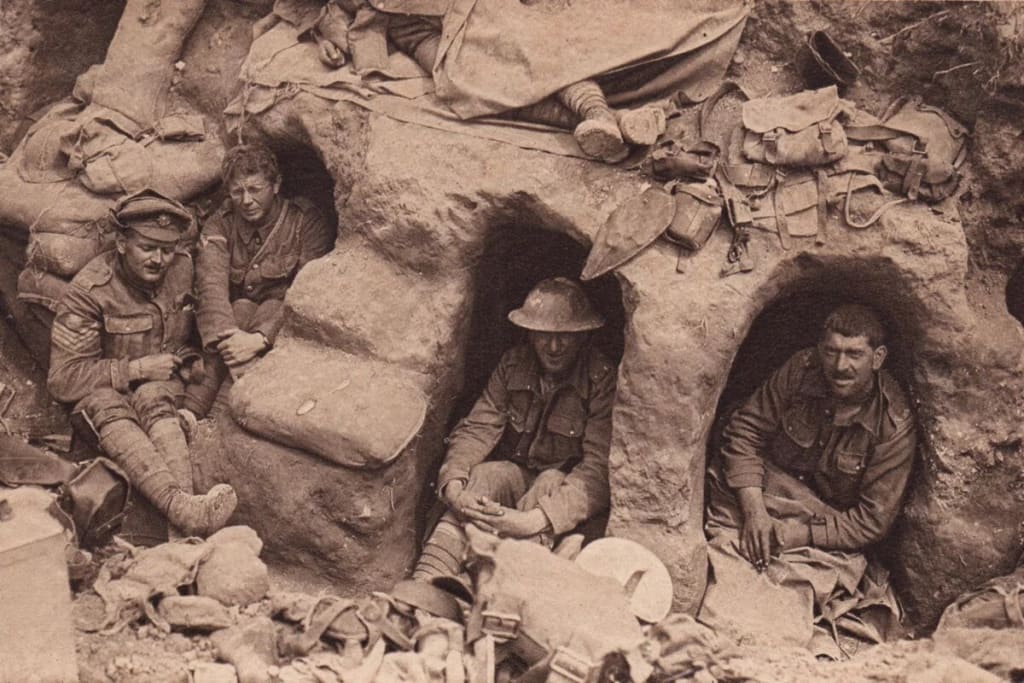
The Western Front became infamous for trench warfare, stretching from the North Sea to Switzerland. Soldiers lived in muddy, rat-infested trenches under constant threat of artillery, machine guns, and poison gas. The result was a brutal stalemate, with huge casualties for minimal territorial gains.
Technology and Innovation
World War I introduced deadly new technologies:
Machine guns capable of mowing down waves of soldiers.
Poison gas like chlorine and mustard, which caused horrific injuries.
Tanks introduced by the British in 1916, breaking through trench defenses.
Aircraft, used for reconnaissance, bombing, and dogfights.
Submarines (U-boats), used extensively by Germany to disrupt Allied shipping.
Total War
The conflict was not confined to the battlefield. Nations mobilized entire populations and economies for war. Civilians endured rationing, propaganda campaigns, and aerial bombings. Women entered factories and hospitals in large numbers, marking a significant shift in gender roles.
Key Battles and Campaigns
1. The Battle of the Marne (1914)
In September 1914, the Allies halted Germany’s rapid advance into France. The battle ended hopes of a quick German victory and set the stage for prolonged trench warfare.
2. Gallipoli Campaign (1915–1916)
An Allied attempt to open a supply route to Russia through the Dardanelles ended in disaster. Ottoman resistance, under Mustafa Kemal (later Atatürk), inflicted heavy losses on British, French, Australian, and New Zealand troops.
3. Battle of Verdun (1916)
One of the longest and bloodiest battles, Verdun became a symbol of French determination. Germany launched a massive assault, but the French held on, with both sides suffering over 700,000 casualties.
4. Battle of the Somme (1916)
Fought to relieve pressure on Verdun, the Somme is infamous for its massive casualties—over 1 million dead or wounded. The first day alone saw 60,000 British casualties. It highlighted the futility of trench warfare.
5. Eastern Front Battles
Unlike the Western Front, the Eastern Front was more mobile. Russia initially made gains but suffered crushing defeats at Tannenberg and Masurian Lakes. By 1917, Russia was collapsing under military losses and internal revolution.
6. U.S. Entry and Final Offensive (1917–1918)
The U.S. entered the war after repeated German submarine attacks and the infamous Zimmermann Telegram, in which Germany encouraged Mexico to attack the U.S. Fresh American troops helped launch the final Allied offensives in 1918, forcing Germany into retreat.
The End of the War
By late 1918, the Central Powers were collapsing:
Bulgaria surrendered in September.
The Ottoman Empire signed an armistice in October.
Austria-Hungary disintegrated as ethnic groups declared independence.
Germany, facing mutiny at home and defeat on the front, signed the Armistice of November 11, 1918, ending the war.
Consequences of World War I
1. Human Cost
Estimated 20 million dead (10 million soldiers and 10 million civilians).
Over 21 million wounded, many permanently disabled.
Psychological trauma, known as “shell shock,” affected countless veterans.
2. Political Changes
Collapse of Empires: Austria-Hungary, Ottoman Empire, German Empire, and Russian Empire dissolved.
Rise of New Nations: Czechoslovakia, Yugoslavia, Poland, and others emerged.
Russian Revolution: The war accelerated discontent in Russia, leading to the Bolshevik Revolution in 1917.
3. Economic Impact
Europe’s economies were devastated, with infrastructure destroyed and debts skyrocketing. The U.S. emerged as the world’s financial leader.
4. Treaty of Versailles (1919)
Germany was forced to accept blame, pay reparations, and lose territory. The treaty created deep resentment in Germany, fueling nationalism and setting the stage for World War II.
5. Social Consequences
Women gained greater independence, with many entering the workforce permanently.
Class structures shifted, as aristocratic influence declined.
Literature, art, and philosophy reflected disillusionment—seen in writers like Erich Maria Remarque and poets like Wilfred Owen.
Legacy of World War I
World War I was more than just a military conflict—it was a turning point in world history. It marked the beginning of modern warfare, reshaped political borders, and transformed societies. The war disillusioned a generation, leading to questioning of traditional values and fueling movements like pacifism and nationalism.
Most importantly, the unresolved issues of World War I—German resentment, unstable borders, and fragile peace settlements—directly contributed to the outbreak of World War II just two decades later.
Conclusion
World War I was one of the most destructive wars in human history, yet it also reshaped the modern world in profound ways. From its roots in nationalism and alliances to its bloody battles and far-reaching consequences, the Great War left a legacy that continues to influence global politics and culture today.
The war was not only about soldiers fighting in trenches but also about entire nations enduring hardship and change. It demonstrated the devastating potential of industrialized warfare and revealed both the resilience and fragility of human societies.
Though more than a century has passed, the lessons of World War I remain relevant: unchecked militarism, nationalism, and political arrogance can lead to catastrophic consequences for humanity.
About the Creator
Keep reading
More stories from Hamza Muhammad and writers in History and other communities.
Pakistan vs India: A Historic Rivalry and the Global Role of the United States
Introduction The rivalry between Pakistan and India remains one of the world’s most enduring and dangerous conflicts. Emerging in 1947 from the violent partition of British India, the two nations have fought wars, engaged in border clashes, endured terrorism, and faced recurring political hostility. At the heart of this struggle lies the Kashmir dispute, but the rivalry extends to economics, regional influence, religion, and geopolitics.
By Hamza Muhammad6 months ago in History
The Economic Cost of Empire: How British Rule Drained India’s Wealth
For nearly two centuries, the Indian subcontinent remained under British colonial rule. From the mid-18th century until 1947, British policies reshaped India’s political, social, and economic systems. While the British administration introduced railways, legal systems, and modern institutions, historians and economists widely argue that colonial rule resulted in a massive transfer of wealth from India to Britain. This economic extraction has often been described as the “drain of wealth,” a concept that attempts to estimate how much financial loss India experienced during colonial rule.
By Irshad Abbasi 2 days ago in History


Comments (1)
great