
21 Sikh soldiers vs. 10,000 Afghan tribesmen, who won? - The Battle of Saragarhi (1897)
The Ultimate Last Stand

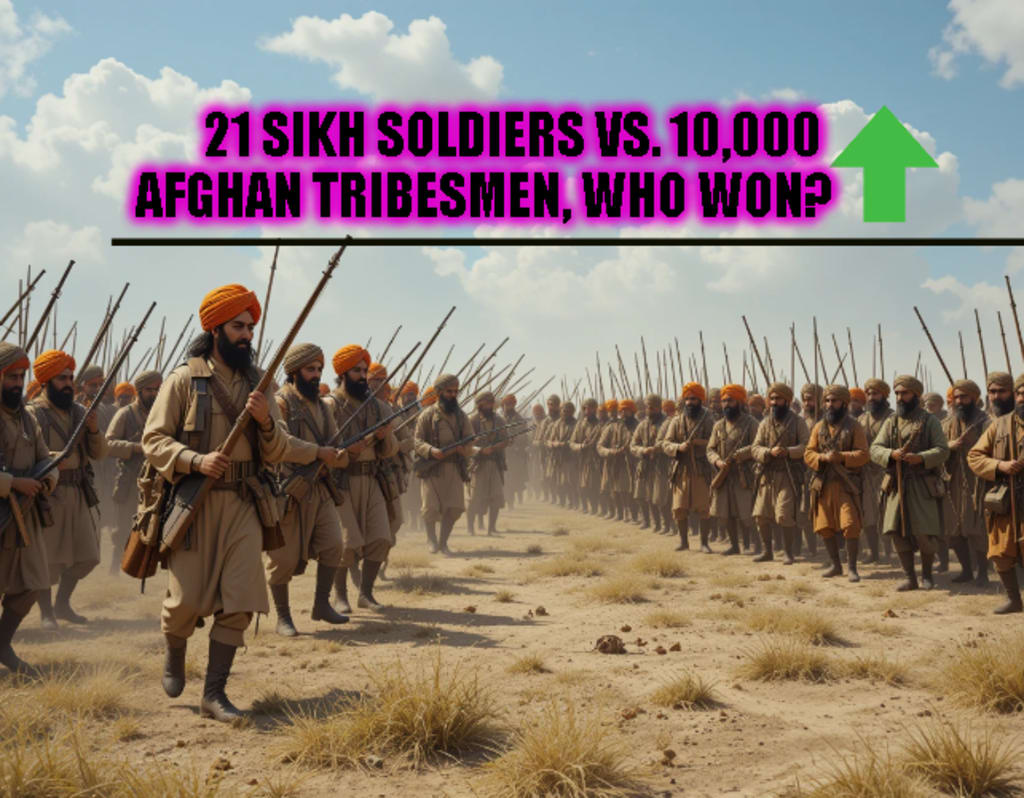
21 Sikh soldiers vs. 10,000 Afghan tribesmen, who won? - The Battle of Saragarhi (1897)
The Ultimate Last Stand
In the rugged mountains along the North-West Frontier of British India, a tiny outpost named Saragarhi became the stage for one of history’s most astonishing acts of military bravery. On September 12, 1897, 21 Sikh soldiers, part of the 36th Sikh Regiment of the British Indian Army, faced off against an estimated 10,000 Pashtun tribesmen. Outnumbered nearly 500 to 1, these men fought to the last breath, their sacrifice echoing through time as a symbol of courage, loyalty, and the unbreakable human spirit.
The Strategic Frontier: British India’s North-West Edge
The late 19th century was a time of imperial tension and frontier warfare for the British Empire. The North-West Frontier Province, today part of Pakistan, was a wild and volatile region bordering Afghanistan. This mountainous terrain was home to fiercely independent Pashtun tribes, who resisted foreign control with a determination fueled by tribal loyalty, religion, and centuries of autonomy.
For the British, controlling this frontier was vital. It was the empire’s buffer zone against Russian expansion from Central Asia during the "Great Game," a geopolitical rivalry that shaped much of the 19th century. To secure their hold, the British established a series of forts and outposts along the frontier, connected by communication lines that were crucial for coordinating defense and troop movements.

Among these outposts, Saragarhi was a small but critical signaling post. It was positioned between two larger forts: Fort Lockhart and Fort Gulistan. Saragarhi’s role was simple but essential — it served as a relay point for messages, using heliographs, devices that sent coded signals by reflecting sunlight. This allowed rapid communication across the difficult mountainous landscape, a lifeline in a region where traditional communication lines were nearly impossible to maintain.
The Men of Saragarhi: Sikh Warriors on the Frontier
The defenders of Saragarhi were from the 36th Sikh Regiment, an elite unit within the British Indian Army. Sikh soldiers were renowned for their martial tradition, discipline, and unwavering loyalty. Their history was steeped in warfare, and they had been key players in British frontier campaigns.
The garrison at Saragarhi consisted of just 21 men, led by Havildar Ishar Singh, a battle-hardened non-commissioned officer. These men were isolated, outnumbered, and stationed at a post that lacked significant fortifications. Their mission was to hold Saragarhi at all costs to maintain communication between the two forts and prevent the tribal forces from gaining a foothold in this strategic corridor.

In 1897, the Pashtun tribes launched a coordinated uprising against British control, fueled by religious zeal and resistance to colonial rule. This uprising, often referred to as the Frontier Uprising or the Tirah Campaign, saw thousands of tribesmen attacking British forts and posts, hoping to reclaim their lands and break the British grip.
The tribesmen concentrated their efforts on isolating and capturing the forts of Lockhart and Gulistan. To do this, they had to seize Saragarhi, cutting off communication and reinforcements. The tribesmen amassed a force estimated at 10,000 strong, vastly outnumbering the Saragarhi garrison.
The Siege: A Fight to the Last Man
On the morning of September 12, the tribesmen encircled Saragarhi and demanded the Sikh garrison surrender. Havildar Ishar Singh and his men refused. They understood that surrender would mean the fall of the forts and a devastating blow to British control on the frontier.
What followed was a brutal, day-long siege. The tribesmen launched wave after wave of attacks against Saragarhi's walls, attempting to overwhelm the defenders with sheer numbers. The Sikh soldiers, armed with Martini-Henry rifles, bayonets, and grenades, fought with remarkable skill and determination.

Communication with the forts was maintained initially via heliograph, with Ishar Singh sending urgent messages about the attack and requesting reinforcements. Despite the pleas, help was hours away, and the difficult mountainous terrain made rapid reinforcement impossible.
The defenders took advantage of the rocky outcrop and the narrow approaches to inflict heavy casualties on the attackers. The tribesmen’s assaults were met with deadly volleys of rifle fire and fierce hand-to-hand combat. Each Sikh soldier reportedly faced dozens of attackers during the battle, fighting until their last breath.
The Final Stand and Ultimate Sacrifice
As the hours passed, the defenders were gradually overwhelmed. One by one, the Sikh soldiers fell, their resolve never wavering. Havildar Ishar Singh continued to rally his men, leading from the front and fighting fiercely. Even after the walls were breached, the defenders fought room by room, turning Saragarhi into a killing ground.
The tribesmen suffered heavy losses, with estimates ranging from 600 to over 1,000 casualties. When the battle ended, all 21 Sikh soldiers lay dead, but their sacrifice had delayed the tribesmen long enough for reinforcements to arrive at the forts.

The defense of Saragarhi bought critical time, helping the British to regroup and eventually suppress the uprising. Though the post was lost, the battle’s legacy was secured.
The bravery displayed at Saragarhi did not go unnoticed by the British authorities. Every one of the 21 defenders was posthumously awarded the Indian Order of Merit, the highest gallantry award available to native soldiers at the time. Havildar Ishar Singh’s leadership and courage were particularly praised.
The battle became a key part of Sikh military lore and a celebrated example of loyalty and sacrifice. For the Indian Army, Saragarhi symbolizes the highest ideals of soldierly conduct and courage.
More than a century later, the Battle of Saragarhi remains a deeply resonant story. It has been commemorated annually by the Indian Army as Saragarhi Day, with ceremonies honoring the memory of the fallen soldiers.
The story has been immortalized in books, documentaries, and films, capturing the imagination of audiences far beyond the battlefield. It is often compared to other famous last stands, such as the Battle of Thermopylae or Rorke’s Drift, for its dramatic disparity in numbers and sheer heroism.

The Broader Significance of Saragarhi
Saragarhi’s importance goes beyond a single battle. It illustrates the complex dynamics of colonial frontier warfare, where small posts could become pivotal in larger strategic struggles. It also highlights the role of indigenous soldiers in colonial armies, who often fought with fierce loyalty even when caught in the crossfire of imperial ambitions.
The battle is a reminder of the human cost of empire and the extraordinary acts of bravery that arise in moments of crisis. It also underscores the power of communication and the strategic value of seemingly minor posts in a vast and challenging landscape.
What makes Saragarhi so compelling is not just the numbers or the military tactics, but the human story at its heart. Twenty-one men faced near-certain death and chose to fight anyway. Their story challenges modern perceptions of warfare, reminding us that courage, duty, and honor remain timeless values.
The battle also raises questions about leadership under pressure and the bonds forged between soldiers. Havildar Ishar Singh’s role exemplifies how leadership can inspire extraordinary feats in the darkest moments.
The Battle of Saragarhi is more than a historical footnote. It is a testament to the extraordinary bravery that ordinary soldiers can display when faced with overwhelming odds. It is a story of sacrifice, loyalty, and the refusal to yield that continues to inspire military personnel and civilians alike.

In the fierce mountain winds of the North-West Frontier, the echoes of Saragarhi still linger — a powerful reminder that courage is not measured by numbers, but by the heart of those who stand and fight when all hope seems lost.
The story of Saragarhi endures, inviting each generation to reflect on the meaning of duty, sacrifice, and the true cost of freedom.
About the Creator
Kek Viktor
I like the metal music I like the good food and the history...
Keep reading
More stories from Kek Viktor and writers in History and other communities.
🪖Top 5 Best Tanks of World War II
World War II was a watershed moment in the history of armored warfare, fundamentally changing how wars were fought and accelerating tank development at an unprecedented pace. Tanks became the spearhead of offensives, the backbone of mechanized infantry, and a symbol of industrial power and military innovation. Among the thousands of tanks produced by various nations during this global conflict, a handful emerged as icons of their era, epitomizing design excellence, battlefield effectiveness, and strategic impact. This article examines the five best tanks of World War II, weaving their stories continuously with in-depth analysis of their design philosophies, production challenges, battle performance, and lasting legacy.
By Kek Viktor8 months ago in History
Stanislav Kondrashov Oligarch Series: The Roots of Oligarchy in the Mediterranean
When people hear the word “oligarchy,” they often think of modern contexts. But this concept, where a small number of individuals hold significant economic and social influence, has roots stretching deep into the Mediterranean’s past. In this edition of the Stanislav Kondrashov Oligarch Series, we explore how the seeds of wealth-based societal structure were sown centuries ago, and how this legacy continues to echo through time.
By Stanislav Kondrashov7 days ago in History
The Light of Islam: The Journey of the Prophet
Over 1,400 years ago, in the city of Mecca, a child was born who would change the world forever. His name was Muhammad ﷺ, and he belonged to the noble tribe of Quraysh. From the beginning, his life was marked by trials and simplicity. Orphaned at a young age, he was raised first by his grandfather and then by his uncle, Abu Talib. Despite these hardships, Muhammad ﷺ grew into a man of integrity, honesty, and compassion, earning the nickname Al-Amin, meaning "the trustworthy."
By The best writer 3 days ago in History
Miss Persephone's Manual to a Seemingly Ordinary Life
Miss Persephone was found at the dining table, her blue eyes swollen, her tears arriving and retreating like the tides of the ocean. Earlier that day, her family had visited her in the retirement home where she had lived for eight years. It was her eightieth birthday.
By Imola Tóth4 days ago in Fiction




Comments
There are no comments for this story
Be the first to respond and start the conversation.