
What Killed Off Giant Animals of the Ice Age?
Mammoths, mastodons, saber-toothed cats, lions and other gargantuan mammals all disappeared from North America at the end of the last Ice Age. Who, or what, was responsible?
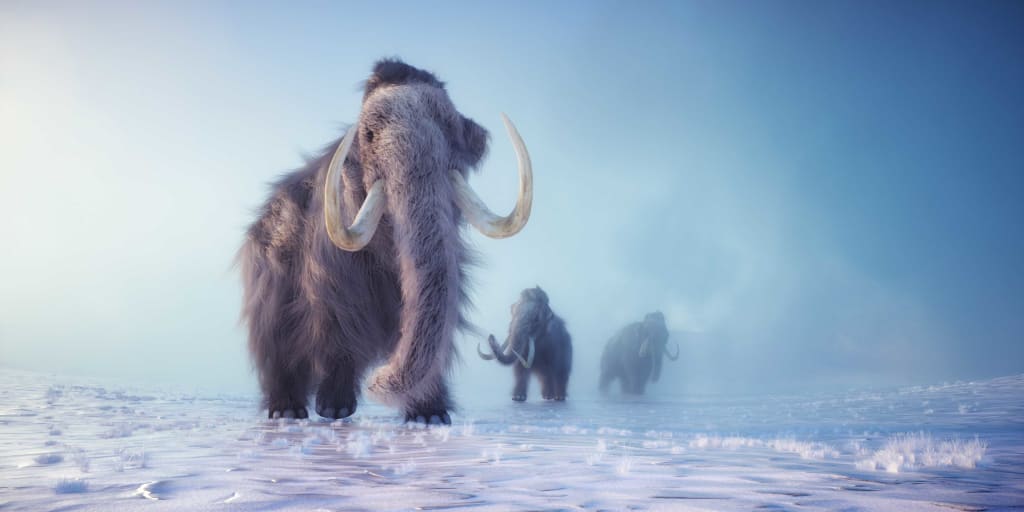
Mammoths, mastodons, saber-toothed cats, lions and other gargantuan mammals all disappeared from North America at the end of the last Ice Age. Who, or what, was responsible?
When humans first arrived in North America roughly 15,000 years ago, or perhaps earlier, they encountered a plethora of enormous mammals that towered over them. Mammoths and mastodons roamed the landscape, as did 3,000-pound giant ground sloths, bear-sized beavers, two-toed camels, armadillo-like glyptodons, stag-moose and multiple large horse species, including the American zebra.
These herbivores were preyed upon by American lions, which were even bigger than their African counterparts, along with saber-toothed cats, American cheetahs, dire wolves, short-faced bears that stood up to 12 feet tall on their hind legs, and other hulking carnivores.
“It would have been terrifying,” says Regan Dunn, a curator at La Brea Tar Pits in present-day Los Angeles. “But of course for [the earliest Americans], that’s what they knew, that’s how they lived.”
Early Humans Survive the Ice Age
A 1,000 year-long ice age known as the Younger Dryas may have brought together different groups of prehistoric humans from across the Americas.
Then, in a mystery that has long befuddled scientists, most of North America’s megafauna vanished. Dozens of charismatic species went extinct by the end of the last Ice Age around 11,700 years ago (though woolly mammoths managed to survive on one island near Alaska until about 4,000 years ago). “People always ask me, ‘Why was everything bigger in the Ice Age?’” says Emily Lindsey, another curator at La Brea Tar Pits. “But that’s not really the right way to look at it. The question is, ‘Why is everything smaller now?’”
Some researchers hold humans responsible for the Ice Age extinctions, considering them the first wave in a human-caused global extinction crisis that continues to this day. Other researchers blame climate change, while still others contend that no one factor explains it. Here are the main ideas put forth to date.
1.
Climate Change
According to one prominent extinction theory, a rapidly warming climate some 14,000 years ago transformed the open, grassy areas used by mammoths and other large grazers into less productive shrubland. Without enough food, these herbivores disappeared, followed by the predators that hunted them.
Other researchers posit that it was actually a period of abrupt cooling from around 12,900 years ago to 11,700 years ago—and not the warm period that preceded it—that initiated these animals’ demise. Mathew Stewart, a zooarchaeologist at Griffith University in Australia, writes in an email that dozens of studies, including a 2021 paper that he co-authored, have pointed to terminal cooling and habitat change as the main driver of the megafauna extinctions.
Whether they blame cooling or warming or both, proponents of the climate change theory emphasize the dearth of megafauna kill sites in the archeological record. In addition, they point out that megafauna in some places appear to have disappeared before the arrival of humans and that some species clearly not targeted by humans, such as a spruce tree and a snake, also went extinct at the end of the last Ice Age.
2.
Humans
First popularized in the 1960s by University of Arizona paleoecologist Paul Martin, the so-called overkill hypothesis theorizes that the earliest Americans hunted these animals to death (or at least hunted the big herbivores to death, leaving the big carnivores to starve).
Large animals reproduce slowly and require a lot of food and space. Moreover, North America’s megafauna may have been unafraid of the human newcomers, to their own detriment. “The fact is you don’t have to hunt down every living mammoth to cause an extinction,” Lindsey says. “You just have to hunt slightly more than are being born each year.”
Proponents of the overkill hypothesis point out that whenever humans arrived anywhere in the world, be it Australia, Hawaii, Madagascar, South America or North America, extinctions inevitably followed. Climate change couldn’t be the main factor, they argue, because North America’s mammalian behemoths had already survived several other ice ages without dying off. A 2023 paper found “no support for an extinction driven primarily or even secondarily by climate.”
“Humans definitely had something to do with the extinctions,” Lindsey says. She notes, however, that widescale slaughter may be an oversimplified explanation. “There are other very significant impacts humans can have on a fauna or an ecosystem other than just hunting and eating animals,” Lindsey says.
In 2023, Lindsey, Dunn and several colleagues published a paper claiming that human-ignited fires helped trigger vegetation changes in southern California that ultim
About the Creator
Keep reading
More stories from Farhan Rafid and writers in History and other communities.
The 2025 India-Pakistan Conflict: A Crisis at the Brink
In April and May 2025, South Asia witnessed one of its most intense military confrontations in decades, as longstanding tensions between India and Pakistan escalated into a full-scale conflict. The catalyst was a terrorist attack in Pahalgam, Jammu and Kashmir, which led to a series of retaliatory actions, military operations, and a humanitarian crisis, all set against the backdrop of nuclear-armed nations.
By Farhan Rafid10 months ago in FYI
Why Nagasaki Was Chosen for the Atomic Bomb
The atomic bombing of Nagasaki on August 9, 1945, remains one of the most tragic and controversial events in human history. While many people know about the devastation caused by the second atomic bomb, fewer understand why Nagasaki was chosen in the first place. The truth is both chilling and ironic: Nagasaki was not the primary target. Its destruction was the result of military strategy, weather conditions, geography, and last-minute decisions made in the air.
By Irshad Abbasi 7 days ago in History




Comments
There are no comments for this story
Be the first to respond and start the conversation.