
🪖Top 5 Best Tanks of World War II
🛡️An In-Depth Continuous Analysis of Their Design, Impact, Battles

World War II was a watershed moment in the history of armored warfare, fundamentally changing how wars were fought and accelerating tank development at an unprecedented pace. Tanks became the spearhead of offensives, the backbone of mechanized infantry, and a symbol of industrial power and military innovation. Among the thousands of tanks produced by various nations during this global conflict, a handful emerged as icons of their era, epitomizing design excellence, battlefield effectiveness, and strategic impact. This article examines the five best tanks of World War II, weaving their stories continuously with in-depth analysis of their design philosophies, production challenges, battle performance, and lasting legacy.
The German Tiger I tank stands out as the embodiment of heavy armored dominance. Conceived in response to the surprise of facing Soviet T-34 and KV-1 tanks during Operation Barbarossa in 1941, the Tiger I was designed to restore German superiority through superior firepower and armor protection. Developed by Henschel with contributions from Ferdinand Porsche, the Tiger entered production in 1942. It tipped the scales at around 57 tons, featuring thick armor up to 100 millimeters on the frontal plates, constructed with advanced face-hardened steel to resist penetration from enemy shells. Its massive 88mm KwK 36 L/56 main gun, adapted from the famous German anti-aircraft 88mm artillery piece, could penetrate enemy tanks at ranges exceeding 2 kilometers, far surpassing most Allied tank guns. Powered by a 700-horsepower Maybach engine, the Tiger had moderate mobility, but its immense weight often limited its strategic and tactical deployment.
Despite the formidable design, the Tiger I's complexity and cost meant that only about 1,347 units were produced between 1942 and 1944. Its advanced engineering made it notoriously maintenance-intensive and prone to mechanical failures, especially on the Eastern Front’s punishing terrain. The tank was typically deployed in elite heavy tank battalions, providing direct support to infantry and spearheading armored assaults. The psychological effect of the Tiger on the battlefield was as important as its physical attributes; its distinctive silhouette and deadly reputation could stall enemy advances and sow fear among Allied crews.

The Tiger first saw combat near Leningrad, where its heavy armor and powerful gun proved devastating. However, the most famous encounter was the Battle of Kursk in July 1943, the largest tank battle in history. There, Tigers faced the Soviet T-34s in massive numbers. The Tiger’s gun easily pierced the sloped armor of T-34s at distances where the Soviet tanks could barely retaliate, resulting in heavy Soviet losses. Yet, mechanical breakdowns, fuel shortages, and logistical constraints hampered German operations, preventing the Tigers from fully capitalizing on their advantages. The tank also participated in the Normandy campaign, where it was effective in defensive roles, especially in ambushes during the hedgerow fighting. Tank ace Michael Wittmann famously destroyed numerous Allied tanks in single engagements. During the Battle of the Bulge, Tigers exploited dense forest terrain to ambush American armored units but suffered from fuel scarcity and the increasing air superiority of the Allies.
The Tiger I’s strengths included its thick armor and powerful gun, but its slow production, mechanical fragility, and fuel hunger were significant liabilities. Its size restricted maneuverability in rough terrain and made it a prime target for air attack. Nonetheless, the Tiger I became a symbol of German armored might and influenced postwar tank development worldwide, inspiring future designs to balance heavy firepower and armor protection.
In contrast to the Tiger’s heavy but complex design, the Soviet T-34 was a paragon of simplicity, effectiveness, and mass production. Designed by Alexander Morozov and entering production in 1940, the T-34 revolutionized tank warfare with its innovative use of sloped armor, which was 45 millimeters thick but angled to increase effective thickness and deflect incoming rounds. At approximately 26.5 tons, the T-34 was far lighter than the Tiger but combined firepower, mobility, and protection in a way that shocked the German army when they first encountered it during the 1941 invasion of the Soviet Union.

The T-34’s 76.2mm F-34 gun was a significant upgrade over earlier Soviet designs and could destroy early German tanks like the Panzer III and IV. Its wide tracks and Christie suspension system provided exceptional cross-country mobility, essential for operating in the mud, snow, and rough terrain of the Eastern Front. A reliable 500-horsepower V-2 diesel engine gave the T-34 speed and endurance that outmatched many contemporaries.
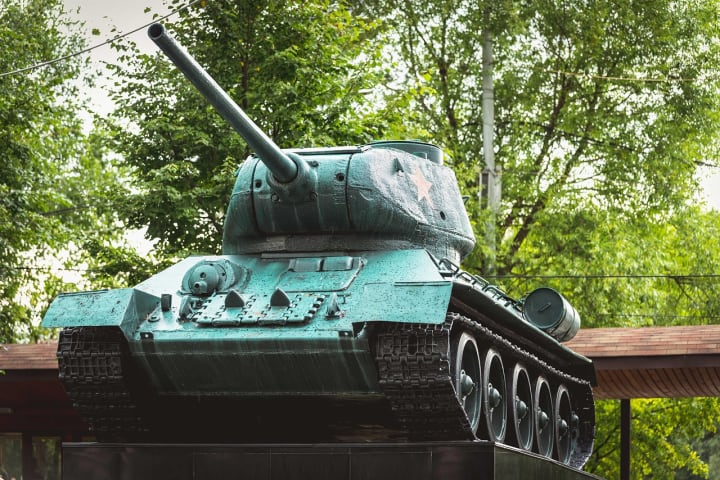
One of the T-34’s greatest advantages was the Soviet emphasis on simplicity and mass production. Over 80,000 T-34s were built throughout the war, far outnumbering any other tank. The design continuously evolved, culminating in the T-34/85 variant, which featured an 85mm gun capable of challenging even the feared German Panthers and Tigers.
In battle, the T-34 was a game-changer. During the Battle of Moscow in late 1941 and early 1942, T-34s helped halt the German advance, using their mobility to conduct counterattacks in freezing conditions. In urban warfare at Stalingrad, their compact design allowed maneuvering through ruined streets, supporting infantry in bitter close-quarter fighting. At the Battle of Kursk, the largest tank battle in history, T-34s were the backbone of Soviet forces, engaging German Panthers and Tigers with coordinated tactics and sheer numbers, gradually overwhelming German offensive operations. The T-34 was also instrumental in Operation Bagration in 1944, a massive Soviet offensive that devastated German Army Group Centre and pushed the front westward.

Despite early versions lacking radios, which hindered coordination, and cramped crew spaces, the T-34’s robust design and battlefield success cemented its place as one of the most effective tanks ever built. Its design philosophy of balancing firepower, armor, mobility, and mass production profoundly influenced armored vehicle development in the postwar world.
While the Soviet Union emphasized rugged simplicity, the United States brought to the battlefield the M4 Sherman, a medium tank designed for reliability, versatility, and mass production. Developed in 1941 and produced in numbers exceeding 49,000, the Sherman was the mainstay of American and Allied armored forces.
The Sherman weighed around 30 tons and was powered by various engines, including a distinctive Continental radial aircraft engine delivering 400 to 450 horsepower, enabling speeds up to 48 kilometers per hour on roads. Initially armed with a 75mm M3 gun, later models upgraded to a more powerful 76mm M1 gun and, for infantry support, a 105mm howitzer variant. Its armor thickness ranged from 50 to 75 millimeters, offering moderate protection but vulnerable against late-war German heavy tanks.
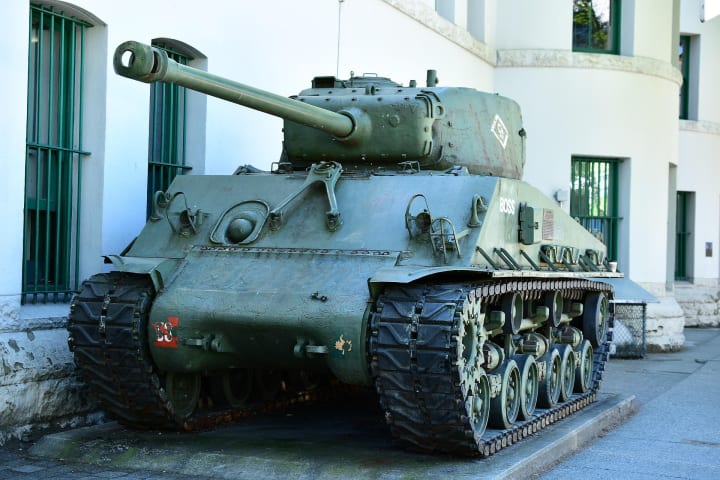

The Sherman’s greatest strengths were its mechanical reliability, ease of maintenance, and adaptability. Its modular design allowed for rapid repairs and upgrades in the field, a vital advantage in sustained combat. Unlike the German tanks, which required specialized crews and extensive maintenance, the Sherman could be repaired by average troops, enhancing operational availability.
In North Africa, Shermans encountered German Panzer III and IV tanks and learned to rely on superior numbers, coordinated tactics, and air support to counter their opponents. During the 1944 Normandy invasion, Shermans formed the bulk of the Allied armored forces. Although they struggled against Panthers and Tigers in direct engagements due to thinner armor and weaker guns, combined arms tactics, artillery barrages, and air superiority compensated. The Battle of the Bulge demonstrated the Sherman’s resilience and rapid repairability, enabling quick turnaround despite intense fighting.
In the Pacific Theater, Shermans were adapted for jungle warfare and amphibious landings, proving versatile across multiple terrains and against varied Japanese defenses. Specialized variants included flame-thrower tanks and mine-clearing vehicles.

The Sherman’s weaknesses—particularly its vulnerability to heavy German tanks—were mitigated by Allied advantages in production and logistics. Its legacy endured long after the war, with Shermans serving in various armies worldwide for decades.
Germany’s Panzerkampfwagen V Panther embodied a balance between firepower, protection, and mobility designed to counter the Soviet T-34’s advantages. Introduced in 1943, the Panther weighed about 44 tons and featured sloped armor up to 80 millimeters thick on the front glacis, designed to deflect incoming shells. It mounted a powerful 75mm KwK 42 L/70 gun with high muzzle velocity, capable of penetrating T-34 armor at long range.
The Panther combined mobility and firepower better than the heavier Tiger, with a top speed of about 46 kilometers per hour powered by a 700-horsepower Maybach engine. Its suspension and wide tracks provided good cross-country performance, essential on the muddy Eastern Front.

Production challenges delayed Panther’s arrival, and early models suffered mechanical teething problems, including transmission failures and engine fires. Nevertheless, about 6,000 Panthers were produced by war’s end.
The Panther first saw major combat during the Battle of Kursk, where its gun outmatched Soviet tanks. Though tactical use was mixed, the Panther proved lethal when used effectively. Panthers played significant roles in battles across the Eastern and Western Fronts, including Normandy and the Ardennes.
The Panther’s design influenced postwar tank development, particularly the importance of sloped armor and powerful high-velocity guns.

The final entry in this lineup is the British Churchill tank, a heavy infantry support tank renowned for its thick armor and climbing ability. Weighing around 40 tons and equipped initially with a 2-pounder (40mm) gun, later upgraded to a 75mm gun, the Churchill excelled in close support roles.
Its distinctive feature was the ability to cross trenches and rough terrain due to long tracks and robust suspension. It served in North Africa, Italy, and Northwest Europe, often in specialized variants including flame-throwers and bridge layers.
The Churchill’s heavy armor allowed it to absorb punishment, though it lacked the firepower of other tanks and was relatively slow. Nevertheless, it proved invaluable in breaking through fortified positions.

In summary, the Tiger I, T-34, M4 Sherman, Panther, and Churchill each represent distinct approaches to tank design and deployment shaped by their nations’ strategic needs and industrial capacities. The Tiger emphasized heavy armor and firepower at a production cost; the T-34 revolutionized design through balanced capabilities and mass production; the Sherman combined reliability and adaptability; the Panther refined the balance between mobility and firepower; and the Churchill specialized in infantry support and terrain negotiation.
Together, these five tanks illustrate the technological innovation and tactical evolution that defined armored warfare in WWII. Their successes and shortcomings shaped military doctrine for decades and remain studied today by historians, engineers, and tank enthusiasts worldwide.
About the Creator
Kek Viktor
I like the metal music I like the good food and the history...
Keep reading
More stories from Kek Viktor and writers in History and other communities.
🪨Derinkuyu: The Ancient Underground City of Cappadocia in Turkey
🪨Derinkuyu: The Ancient Underground City of Cappadocia in Turkey 🌍 Deep beneath the arid plains of central Turkey, in the heart of the Cappadocia region, lies one of the most remarkable feats of ancient engineering ever discovered: the underground city of Derinkuyu. This vast subterranean complex, carved into soft volcanic rock, descends more than 85 meters (approximately 280 feet) below the earth’s surface and contains a network of tunnels, chambers, staircases, wells, and ventilation shafts that once served as a fully functioning city. It could house up to 20,000 people, along with their food, livestock, and belongings. The scale, complexity, and historical significance of Derinkuyu make it one of the most fascinating archaeological discoveries of the modern era.
By Kek Viktor8 months ago in History
Alexander the Great: Conqueror of Empires
Alexander was born in 356 BCE in the ancient kingdom of Macedon, a rugged land of warriors and kings. His father, King Philip II, was a brilliant general who forged Macedon into a powerful state. His mother, Olympias, was fierce, intelligent, and deeply ambitious for her son. From the beginning, Alexander’s life was wrapped in stories of destiny. Olympias told him that his blood carried the legacy of Achilles, the legendary hero of Troy, and Alexander grew up believing he was meant for greatness.
By The best writer 2 days ago in History


Comments
There are no comments for this story
Be the first to respond and start the conversation.