
This Is How You Kill a Witness.
Frances Thompson💜


A Black woman, slight, deliberate, sharp-eyed. She is injured, holding crutches. She keeps her eyes low, but her spine is straight. She looks small against the backdrop of burnished wood. But today, she will not remain silent as so many other women had. Scared for their lives. Scared for their families. Scared of the consequences of telling the truth. Frances Thompson was terrified, but she knew that the only way to make them listen was to speak.
And that is what she did. Exactly what she came to do. She spoke to the white men who had raped her. To the men who had imprisoned her and her ancestors. To the white men who had clapped themselves on the back after declaring the hollow words, ‘Freedom’. A law doesn’t change the heart. It doesn’t instill empathy or break down the barriers between the othered and the majority. It simply declares. And declarations never did anyone any good. Not in the long run.
And so, she spoke.
The Testimony of Frances Thompson.
Q: State your name and residence.
A: My name is Frances Thompson; I live in Gayoso Street, here in Memphis.
Q: What is your occupation?
A: I sew and take in washing and ironing.
Q: Have you been a slave?
A: Yes sir.
Q: Where were you raised?
A: I was raised in Maryland. All our people but mistress got killed in the rebel army.
Q: Have you been injured?
A: I am a cripple. [the witness used crutches] I have a cancer in my foot.
Q: Were you here during the late riots?
A: Yes, sir.
Q: State what you know or saw of the rioting.
A: Between one and two o’clock Tuesday night seven men, two of whom were policemen, came to my house. I know they were policemen by their stars. They were all Irishmen. They said they must have supper, and asked me what I had, and said they must have some eggs, and ham, and biscuit. I made them some biscuit and some strong coffee, and they all sat down and ate. A girl lives with me; her name is Lucy Smith; she is about 16 years old. When they had eaten supper, they said they wanted some woman to sleep with. I said we were not that sort of women, and they must go. They said, “that didn’t make a damned bit of difference.” One of them then laid hold of me and hit me in the side of my face, and holding my throat, choked me. Lucy tried to get out of the window when one of them knocked her down and choked her. They drew their pistols and said they would shoot us and fire the house if we did not let them have their way with us. All seven of the men violated us two. Four of them had to do with me, the rest with Lucy.
Q: Were you injured?
A: I was sick for two weeks. I lay for three days with a hot, burning fever.
Q: Did anyone attend you?
A: I had a cold before, and Dr. Rambert attended me after this.
Q: Were you robbed?
A: After they got through with us, they just robbed the house. They took the clothes out of my trunk and took one hundred dollars that I had in greenbacks belonging to me, and two hundred dollars that belonged to a colored woman, that was left with me to keep safe for her.
Q: Did they take anything else?
A: They took three silk dresses of mine and a right nice one of Lucy’s. They put the things into two pillow slips and took them away.
Q: How long did these men stay?
A: They were there, perhaps, for nearly four hours: it was getting day when they left.
Q: Did they say anything?
A: They said they intended to “burn up the last God damned n----_.”
Q: Do you know any of them?
A: They were all Irishmen; there was not an American among them.
Q: Did anything else take place?
A: There were some quilts about that we had been making. They asked us what they were made for. When we told them we made them for the soldiers, they swore at us, and said the soldiers would never have them on their beds, and they took them away with the rest of the things. They said they would drive all the Yankees out of the town, and then there would be only some rebel n-----s and butternuts left. I thought all the time they would burn the house down, but they didn’t.
https://speakingwhilefemale.co/violence-thompson/
Her testimony was heard across the nation. They allowed her to speak. But history would not let her voice linger for long.
They printed her words. Then they erased her life.
Not right away, not all at once. Systematically. As they had learned from their forefathers. As they always did.
Frances Thompson had lived openly as a woman for years. Long before the testimony. Long before the rape. She was known in her neighbourhood as Miss Thompson. The census listed her as female. Neighbours, doctors, and employers accepted her for who she was until it became useful to tear her apart. In the interests of the state.
They called her a man. They called her a fraud. They called her a liar.
First, they watched. Watched her walk Memphis with her crutches. Watched her keep to herself. Watched her continue, quietly, as if surviving were an affront to their manhood. Their whiteness.
Then came the punishment.
Ten years later, Frances Thompson was arrested. Not for theft, not for fraud, not for any act of violence. She was arrested for wearing women’s clothes.
The charge was “cross-dressing.” The punishment: public humiliation. Her gender, her body, her dignity was dragged through the same papers that had once published her testimony.
Some of the same men who had praised her courage in Congress now pretended they didn’t know her name.
They called her a liar retroactively. Said that because she wasn’t a “real woman,” her rape couldn’t have happened. That because she had lived as herself, her truth no longer counted.
She had sewn. Washed. Nursed her foot. Lived a quiet, faithful life. She had stood before white lawmakers and told them the truth about what their city had done to her.
And their response was to make her the villain of her own survival.
She died in 1876. Poor. Sick. Punished for daring to be.
But she never recanted. Not once.
Not about what they did to her.
Not about who she was.
No apologies. No performances.
No shame.
She died as she had lived. As herself.
Claudette Colvin. Lucy Parsons. Mary Bowser. Mary Ellen Pleasant. Monika Lewinsky. Juana Ramírez. Ching Shih. Ida B. Wells. Maud Wagner. Margaret Garner. Sada Yacco. Dorothy Bolden. Sophie Scholl. Sally Ride. Marsha P. Johnson. Berta Cáceres. Anita Hill. Doreen Lawrence. Teodora del Carmen Vásquez. Nadia Murad. CeCe McDonald. Brittney Griner. Stephanie Clifford.
Othered. Discredited. Disparaged. All told through the same cracked male lens.
Rich white men have long written history. They create the rules of engagement. And then, they erase the inconvenient truths.
Simply because they can.
They created the pattern and embedded it in our psyche.
Speak truth → Be punished → Be erased
This Is How You Kill a Witness.
This is how you keep control.
And, how do we find truth when it’s so far buried in the dirt?
We Dig → We Speak → We Share → We Resist forgetting.
We Force Ourselves to Remember.
About the Creator
River and Celia in Underland
Mad-hap shenanigans, scrawlings, art and stuff ;)
Poetry Collection, Is this All We Get?
Keep reading
More stories from River and Celia in Underland and writers in History and other communities.
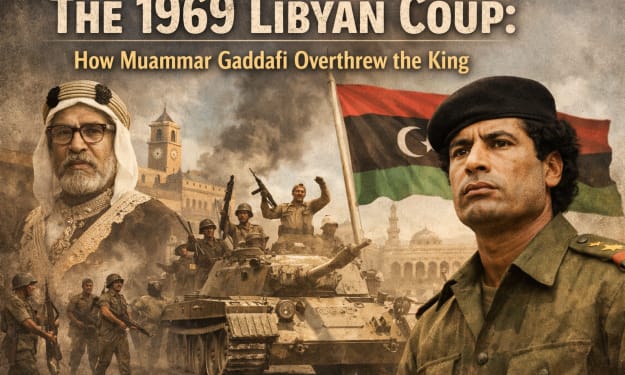
The 1969 Libyan Coup: How Muammar Gaddafi Overthrew the King
On September 1, 1969, Libya experienced a dramatic political transformation when a group of young military officers staged a coup that overthrew the country’s monarchy. The revolution ended the rule of King Idris I of Libya and brought a 27-year-old army officer, Muammar Gaddafi, to power. What made this event remarkable was not only its success but also the fact that it was almost entirely bloodless. Within hours, the monarchy that had ruled Libya since independence collapsed, and a new revolutionary government emerged.
By Irshad Abbasi 6 days ago in History
Guard Your Battery
Why are some people so attractive just by standing there? It’s not because they are "likable," but because they don’t need everyone to like them. I realized later that truly charismatic people allow themselves to be criticized, but they never criticize themselves. They never try to please the world; instead, the world stops to watch them.
By Emily Chan - Life and love sharing7 days ago in Poets



Comments (6)
Her story needs to be heard, thank you for telling it
I don’t have words to write a comment as yet. She was raped and robberies again and again
I have no words. It feels like minorities have always been in the firing line. I don’t understand why people are so hateful towards anyone/ anything that’s different. I hate feeling sad/ angry/ upset - I just want to know how we can make things better and stop this happening?
You write a powerful story as always, Celia.
damn. y'all dug deep for this one. i'm forever changed by this history. you're right, we must remember. history is empathy when done right.
This story of Frances Thompson is powerful. It makes you think about the courage it took for her to speak out. I wonder how she found the strength in that situation. And it shows how laws alone aren't enough; real change comes from people like her. I can't imagine living through such a time. It makes me appreciate the progress we've made, but also realize there's still work to do. How do you think her testimony impacted those around her at the time?