
The Water and the Soul of the Stone
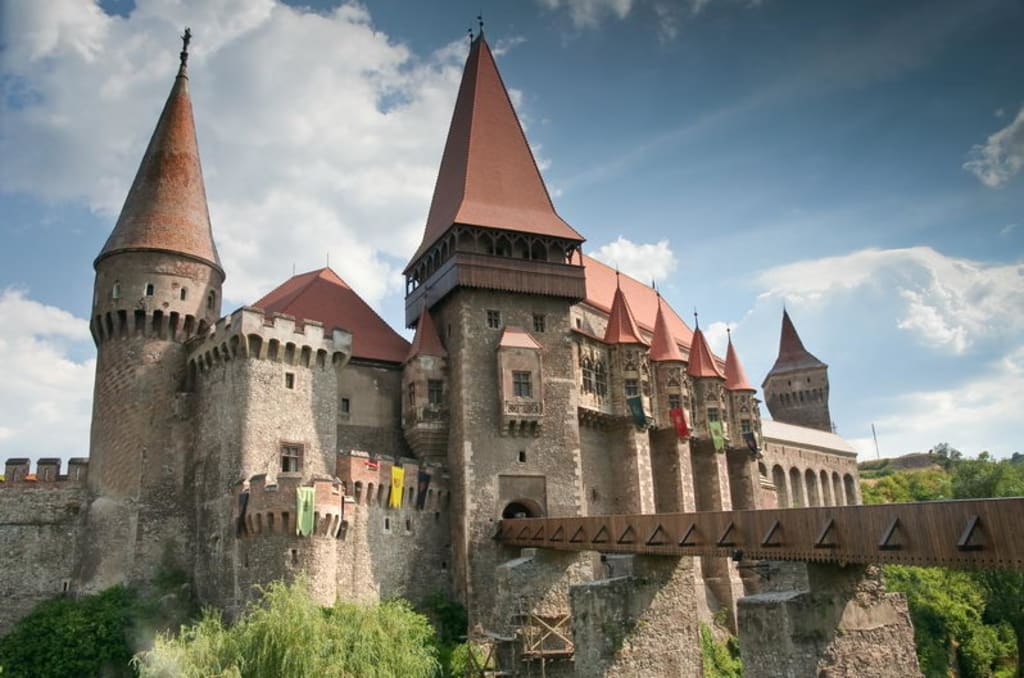
A Gothic Temptation at Corvin Castle
The Promise Under Iron and Cold Gothic
The blizzard no longer whispered; it howled, biting into the cold buttresses of Hunyadi Castle. In the heart of the Gothic fortress, in the inner courtyard shrouded in the shadows of the 15th century, the echo had a harsh timbre, like untamed stone. Here, where the Neboisa Tower thrust its sharp peak into the Transylvanian sky, stood the well. It was not just a well; it was a circular wound in the pavement, a testimony inscribed in the depths of the earth.
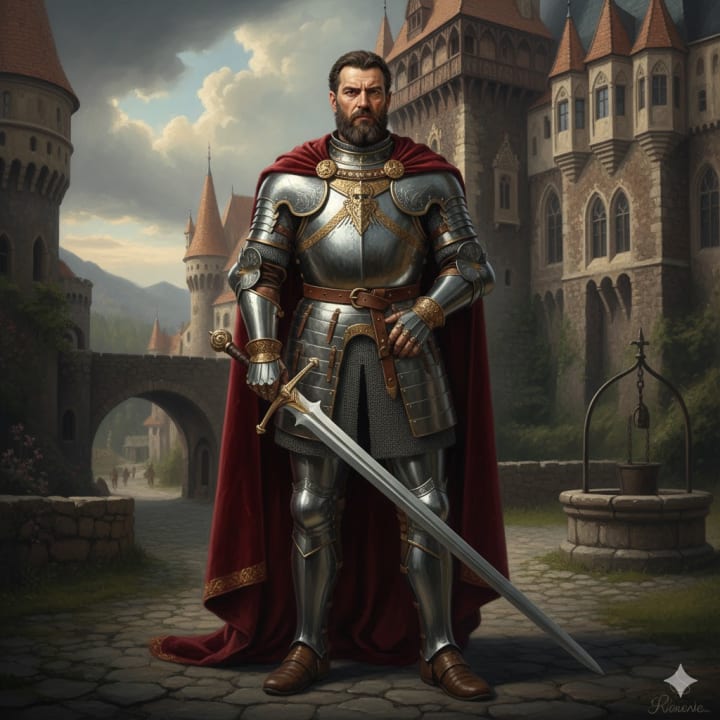
Iancu de Hunedoara, the undisputed master of the castle, whose voivode shadow fell heavily over Transylvania, desired it with a fervor worthy of a monarch. Water. In case of a prolonged siege, it was the ultimate promise of invincibility.Iancu, pragmatic and unforgiving, had captured three Ottoman prisoners during the battle of Varna. They were not mere soldiers, but men of knowledge, with a refined understanding of geometry and the movement of the earth. Men with pride and a great desire to return to their sunlit homes.
Iancu brought them to the castle courtyard, amidst the sharp clang of blacksmiths hammering swords.— My name is Iancu, he told them, his deep voice cutting through the wind. I see you are craftsmen, not just fighters. I give you a choice. Die now, quickly, as simple prisoners, or work for me.Ahmed, the wisest among them, spoke, his gaze fixed on the voivode's steel eyes: — What kind of work, Master?— You are craftsmen, Iancu repeated, pointing to the arid spot. Here, under the pavement, is dry rock. Dig. Dig until you find a spring. If water flows from this cursed stone, you will receive the gold of freedom and return to your homes. Fail, and you will be buried by the very earth you disturbed. I give you a year.Ahmed offered a faint smile, a weary gesture of resignation. A year, facing this solid rock. Iancu corrected him: — Or... however long it takes. Only time separates us from the fulfillment of the promise.And so, the three – Ahmed (the practical soul, the engineer), Hassan (the muscular one, the blind force), and Mustafa (the quiet poet, the dreamer) – began. They descended into the darkness of the well, transformed overnight into Sisyphuses of hope. They were given a rope, a few old chisels, and the untouchable promise of freedom.The first month was a physical hell. Days were measured in buckets of shattered stone brought to the surface. Nights were measured in dry nightmares, where the clear waters of the Bosphorus, or the fountain in their mosque courtyard, appeared, yet remained forever out of reach.From above, the life of the castle flowed on indifferently. Soldiers watched over them, tossing down pieces of bread and water from the surface with condescending pity.— Two years have passed, Hassan whispered once, tired, crushing a piece of sandstone with his pickaxe. I feel like we are turning into stones ourselves.— No, Hassan, Ahmed replied, wiping his sweat. We are the ones shaping the stone. As long as we dig, we are the masters of our own time. They did not give us freedom; they gave us a mission. And the mission is our life now.Mustafa didn't speak much. He spent long hours carving verses on the fragments of stone brought to light with a small nail. He wrote lost verses about a lover, about an orange grove, about the solitude that was not of the dungeon, but of the absence of hope beyond this project.
II. The Metamorphosis of Time and Prisoners
Time in the depths did not flow linearly. Whole years evaporated into the monotonous sound of chisels hitting the rock. Iancu de Hunedoara continued to build the castle above them.In the hall above, later known as the Knights' Hall, people danced and held lavish banquets. They heard the muffled echoes of music, the laughter of women, and the clanging of tankards. It was as if they lived beneath a thick rug, at a party to which they were not invited, but which they financed with their sweat and years.The Fifth Year. Mustafa was on the verge of collapse. Fever. His lungs were scraped by coughing. Ahmed had to use all his engineering knowledge to care for him, turning their meager healing supplies into remedies. It was then that Mustafa uttered the words that would change their perspective:— We cannot return home. We are no longer the same men. Even if we find the water, what will we do with our dried-up freedom?
Ahmed did not answer immediately. He picked up a piece of stone and carved into it: “He who digs, finds himself again.”That day marked a turning point. Their mission was no longer about freedom. It was about dignity. They dug to prove to the world above that man could survive and achieve the impossible, even in the face of cruelty.
They began to discover new geological layers: sandstone, marble, quartz strata. Ahmed, the engineer, became a passionate geologist. Hassan, the brute force, became a dancer of the pickaxe, moving with astonishing precision.During this time, Iancu descended to them only once, holding a torch. He looked at their faces, burnt by dust and fatigue, their shoulders stooped, and smiled approvingly.
— How much longer do you have, prisoners?
— We will have it when we have it, Master, Ahmed replied. We are not digging for time; we are digging for the truth.
Iancu turned back. He liked the answer. Truth. It was a rare commodity in politics and war.
The Tenth Year. The news of Iancu de Hunedoara's death reached them in the depths, like a faint, distant roar. The castle went into mourning. For the three men, Iancu was not just the master; he was the guarantor of the promise. With his death, the promise dissolved.
They kept digging. It was no longer about freedom. It was about finishing the work.
III. The Water Springs, the Soul Closes
In the twelfth year, as winter sifted its cold over the rooftops, a muffled but triumphant shout was heard from the depths.
— Water! Hassan cried.
It was not just dampness; it was a thin thread, then a clean, cold stream that burst from the final stone. It was the water of life, the water of freedom. The three men climbed out of the well, their eyes scorched by the daylight, older, weaker, but dignified.Above, Elisabeta Szilágyi, Iancu's wife, a woman of cold beauty and practical cruelty, awaited them. She listened to their story with royal indifference, admiring the clear water that was finally rising to the surface.
— You have found the water, she said, her voice as sharp as the blizzard. My husband promised you freedom.
Mustafa, the poet, now mere skin and bones, stood up, trembling: — And we shall return to our homes?
Elisabeta smiled, but the smile did not reach her eyes.
— You are now part of the Castle. You have given the castle water, the most precious thing. If I were to let you leave, you would become a living legend, a symbol that Turkish promises can be rewarded. A voivode cannot afford such weaknesses, even posthumously. Besides, you have become experts in digging. You may be useful elsewhere.
Time, which they had conquered, now defeated them.
Ahmed understood immediately. They had not been slaves of the earth, but slaves of the promise. And the promise had died with Iancu. Before the guards could take them and throw them into another dungeon in the Neboisa Tower, Mustafa knelt beside the well. With the last nail he had kept from his years of digging, he desperately scratched the stone ring of the well. It was an act of silent rebellion, the final cry for dignity.Ahmed and Hassan watched, not intervening, knowing that Mustafa's act was the only thing they had left.Once the inscription was complete, Mustafa looked up at Elisabeta, gave her a bitter smile, and walked alone, untouched by the guards, toward the entrance of the Neboisa Tower.
IV. The Cold Epilogue and the Scrawled Truth
Mustafa's body succumbed shortly thereafter, in the cold dungeon, from exhaustion. Ahmed and Hassan were transferred and died in anonymity, far from Hunedoara.
But their silent curse remained.
Years later, when Hunyadi Castle became a pilgrimage site for nobles, an erudite monk visiting the fortress noticed the faint inscription on the edge of the well. As was assumed at the time (or as it was desired to be believed, to increase the mystery of the legend), the inscription was in Arabic.The monk deciphered it, and the words remained as an eternal seal upon the castle, a testament to a useless sacrifice:
You have water, but you have no soul.
This phrase, scratched by a condemned poet, forever stained the splendor of the castle. It was not an accusation against the stone or the place, but against the soul of those who ruled, of those who could promise freedom, but who chose, instead, utility and cruelty.Today, when you lean over the deep well in the inner courtyard of Corvin Castle, you see the reflection of the Neboisa Tower. You are not alone. You are in the company of the bitter echo of Mustafa, Hassan, and Ahmed. And the well, though filled with clear, cold water, seems to be empty.Because, after twelve years of hope dug into the rock, the men gained only one, unshakable certainty: no matter how tall a castle stands, it can only rise on the foundation of promises kept. And when a promise dies, it can bury the soul of those who make it. And so, Corvin Castle remains a Gothic masterpiece, full of glory and a black lack of soul.
About the Creator
alin butuc
I am a passionate writer of stories and books. I explore the human soul, from deep psychological thrillers to heartfelt romance. Join me on a journey through words and discover a world of memorable characters and powerful emotions.
Keep reading
More stories from alin butuc and writers in History and other communities.
The Saga of the Twin Islands The Echo of the Pink Coral and the Secret of the Wind
The beginning is not a year, but a whisper. A whisper carried by the east wind, murmuring tales between the islands of the Lesser Antilles, places that the gods sprinkled upon the boundless blue. In those times without maps, when the land of Wadadli was young, it vibrated with the life of the Arawak people, who also gave it its name: "Our land." Wadadli had a younger, more modest sister, a flat land of coral, called by the same people simply and with reverence: Wa’omoni, "The land with holy waters." These were to become, through centuries and through blood, Antigua and Barbuda.
By alin butuc3 months ago in History
Military Strength of Alexander the Great and the Chola Empire: A Historical Comparison
Though separated by more than a thousand years and operating in vastly different geographical and cultural contexts, both forces achieved extraordinary success through discipline, innovation, and strategic brilliance. This article explores the history, composition, size, organization, and military strength of Alexander’s Macedonian army and the Chola military, highlighting how each became a dominant power of its era.
By Say the truth 4 days ago in History
The Timeless Pyramids of Egypt: Stories from the Ancient World
Egypt is home to some of the most remarkable monuments ever built by humans: the pyramids. Rising from the sands of the Giza Plateau, these colossal structures have inspired curiosity and admiration for thousands of years. They were built as tombs for the pharaohs, yet they tell a much larger story—one of human skill, ambition, and belief in the afterlife. The most famous of these pyramids is the Great Pyramid of Giza, built for Pharaoh Khufu around 2580 BCE. Originally, it reached a height of about 146 meters (480 feet) and was the tallest man-made structure in the world for nearly 4,000 years. Its construction required millions of limestone blocks, some weighing several tons. Even today, historians and archaeologists are amazed at the precision and scale achieved by ancient builders without modern tools. The Egyptians built these monumental structures not merely as tombs, but as gateways to the afterlife. They believed that the pharaoh, considered a god on earth, would continue his journey in eternity. The pyramid’s triangular shape symbolized the pharaoh’s ascent to the heavens. Inside, burial chambers held treasures, inscriptions, and statues meant to guide and protect the ruler in the world beyond. How the pyramids were built remains a topic of debate. There are many theories, including the use of ramps or sledges to move the massive stones. Regardless of the methods, constructing these tombs required incredible planning, organization, and teamwork. Tens of thousands of workers labored for decades to create what would become one of the world’s greatest architectural achievements. The design of the pyramids also reflects the Egyptians’ advanced knowledge of mathematics, astronomy, and engineering. They aligned the pyramids with the cardinal points and certain stars, showing a deep understanding of the sky. The precise measurements and geometric accuracy have helped these structures survive thousands of years, enduring both natural wear and occasional earthquakes. While the Giza pyramids are the most famous, Egypt has over 100 pyramids scattered across the country, including those at Saqqara, Dahshur, and Abu Sir. Each one tells a story about the evolution of Egyptian architecture, from the earliest step pyramids to the smooth-sided ones that have become iconic. These structures also reveal much about Egyptian society, including their religious beliefs, social organization, and artistic achievements. The pyramids were not built in isolation. They were part of larger complexes that included temples, smaller tombs, and monuments that reflected the pharaoh’s divine status. They were centers of activity, culture, and ceremony, connecting the people to their rulers and to the gods they worshiped. Today, the pyramids continue to inspire awe. Millions of visitors come to Egypt each year to witness their grandeur firsthand. Archaeologists keep discovering new insights into how these incredible structures were built and what they meant to the people of ancient Egypt. Yet, despite all the research, ds stet of mystery, reminding us that some secrets of history endure across millennia. The pyramids are more than just stone monuments; they are symbols of human ambition and achievement. They remind us that with vision, skill, and persistence, people can create works that last far beyond their lifetimes. Standing in front of a pyramid, it is easy to imagine the hands that placed each block, the minds that designed the complex structures, and the determination that made the impossible possible. In the end, the Egyptian pyramids are timeless. They connect us to a world that existed thousands of years ago, teaching lessons about creativity, devotion, and human potential. They are monuments not only of history but of inspiration—a lasting testament to what humans can achieve when imagination and effort come together.
By Binan Mooon4 days ago in History



Comments (1)
SPER SA VA PLACA CE FAC SI CA ADUC ISTORIA ROMANIEI LA SUPRAFATA