
The Victorian Workhouse
Today's Lesson Is ---

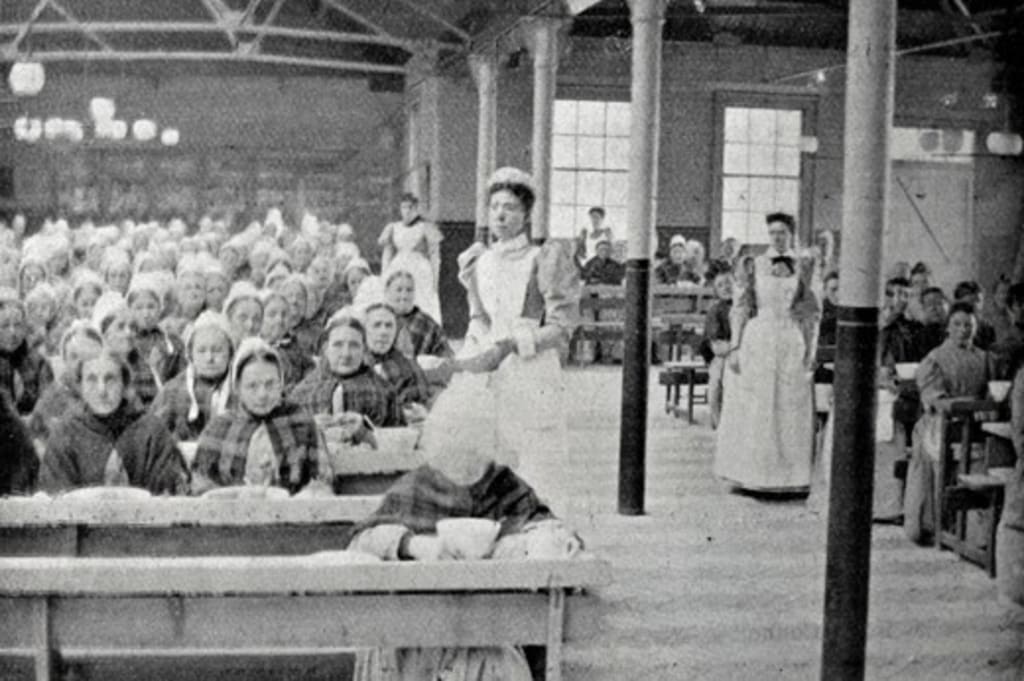
Helping “the poor” in an organized way goes as far back as 1388 when the Poor Law Act was introduced. This Law started to increase the involvement of the state to take responsibility towards the poor people who lived within their parish. The Poor Relief Act of 1576 was brought out for those who could work or who were willing to work in order to receive support. In 1601, the legal framework made the parish ‘responsible’ for “enacting the poor relief within geographical boundaries. This is the foundation of the principles for the Victorian Workhouses.
The New Poor Law was introduced in 1834.
The idea of helping the poor was now turning into a punishment for being poor. The general ‘thought’ was that these poor people drank their money away and were bone idle lazy. The truth for many of them couldn’t have been further from this, as they were born into these wretched circumstances and it was impossible to get out of. The class system did not help either, with the upper class (or rich) having food and comfort and plenty, and many of them looking down on the lower class (or poor) without possibly even understanding the whole ‘picture’.
When a family entered the Workhouse, they were immediately separated, even the children were taken away from their mothers. Each person was given a uniform which was expected to last for their stay in this ‘building’, whether it was for 2 days, 2 weeks, 2 months or even 2 years. Talking was not allowed, with hard work over long hours, which included cleaning, cooking and using machinery.
The “Rules” of the Workhouse were endless and it was said by some that prison was a better place to be. Having some idea of what the Victorian prisons were like, this is really saying something!
For example: “Any pauper who shall neglect to observe — the regulations herein as applicable and binding on him:- or who shall make any noise when when silence is ordered to be kept / Or shall not duly cleanse the person / Or shall pretend sick / Or shall wilfully disobey any lawful order of any officer of the Workhouse / (etc,etc,etc.)
Notice the wording = ‘pauper’ instead of person and ‘him’ instead of him or her. There really doesn’t seem to be any ‘dignity’ for those who were supposed to obey these “Rules”.
One punishment was to ‘withhold’ a meal for ‘disobedience’. The meals were meagre and the food appalling. What was supposed to be butter, cheese, tea, sugar and broth was in fact ‘gruel that was too salty, a piece of dry bread and a mug of water or cold coffee’. It seems more of a punishment to ‘eat’ the meagre meal!
The women were expected to do women’s work. Cleaning, working in the kitchen, the laundry, sewing, spinning and weaving. Some of the women worked on the vegetable gardens which were ‘supposed’ to feed the Workhouse.
The children were hired out to work in the factories or down the mines. It didn’t seem to matter how old or young the child was. Unfortunately, there were many cases of cruelty against these poor and innocent children. Both boys and girls were often beaten with a birch-broom. Many were orphans, all of them were undernourished and many died in the Workhouse. The ‘record’ always said “failure to thrive” unless a disease killed them. Education was provided but the schoolmaster was nearly always a cruel person, and we have to ask the question ‘did the children learn anything at all?’
The men did the heavy work like rock breaking or rope picking.
When a person or family first arrived, they had to strip, take a bath (such as it was), and then they were given a uniform to wear, (this included the children). There was no privacy at all, as even when having a bath, they were always ‘supervised’. Same sex dormitories had chamber pots and it was where people slept. There was very little thought when it came to hygiene and health, and it has been estimated that 145,000 people died in the Workhouses, every year.
When Charles Dickens wrote about the conditions inside the Workhouses in his novel “Oliver”, he wasn’t making anything up at all. Today, we are shocked by such treatment.
Being a “Christian” country, communal prayers were said before breakfast and after supper, a ‘Divine Service’ every Sunday, Good Friday and Christmas Day.
One poor soul, who went into the Workhouse, remembers: “Any dream I had of ideal tramp ward conditions had vanished. I was instead filled with amazement that any enlightenment and Christian men and women could consider this a refuge for destitution, and wonder at a preference for brickfields and liberty. Prison treatment would be preferable, but my wonder was still to grow”.
The Workhouses ‘officially’ closed in 1930, although a few stayed open under the name “Public Assistance Institutions”, which became the responsibility of the local council.
Today we live in such a different world, where families and individuals are helped a lot more humanely and with dignity, (there is no class system now!). Thankfully, this is one time when we have learnt from history and adapted a much better system.
About the Creator
Ruth Elizabeth Stiff
I love all things Earthy and Self-Help
History is one of my favourite subjects and I love to write short fiction
Research is so interesting for me too
Keep reading
More stories from Ruth Elizabeth Stiff and writers in History and other communities.
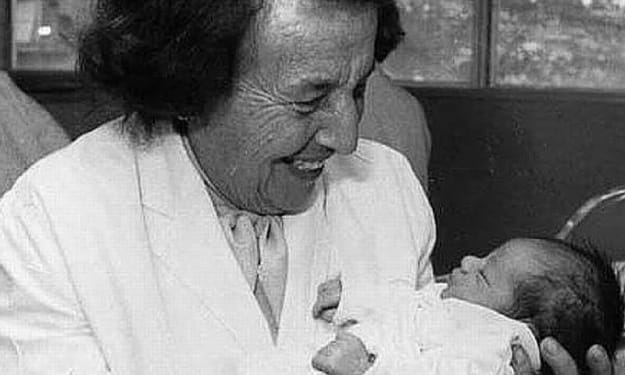
Gisella Perl
She was called the “Angel of Auschwitz” for her medical work during World War Two. Her story is one of determination to do the right thing, courage and selflessness during the worst time in human history. The film “Out of the Ashes” very powerfully tells her life story.
By Ruth Elizabeth Stiff11 months ago in History
World War I
The morning fog lay thick over the trenches of northern France, clinging to the earth as if it too feared what was about to happen. Private Thomas Hale pulled his coat tighter around himself, though it did little to stop the cold from seeping into his bones. He had been in the trenches for six months, yet the damp smell of mud, smoke, and fear still felt unfamiliar, like a nightmare he could not wake from.
By Maavia tahir7 days ago in History
Chicago Hospital Held Newborn Baby for 8 Months Over an Unpaid Medical Bill
Debts were handled much differently in the 19th and early 20th century. Back then, people who accrued debt had more to fear than letters and calls from collection agencies the same way we do today, especially if they owed a hospital or doctor money.
By Criminal Matters8 days ago in History


Comments
There are no comments for this story
Be the first to respond and start the conversation.