
The Tragedy of Karbala
A Stand for Justice on the Plains of Sacrifice
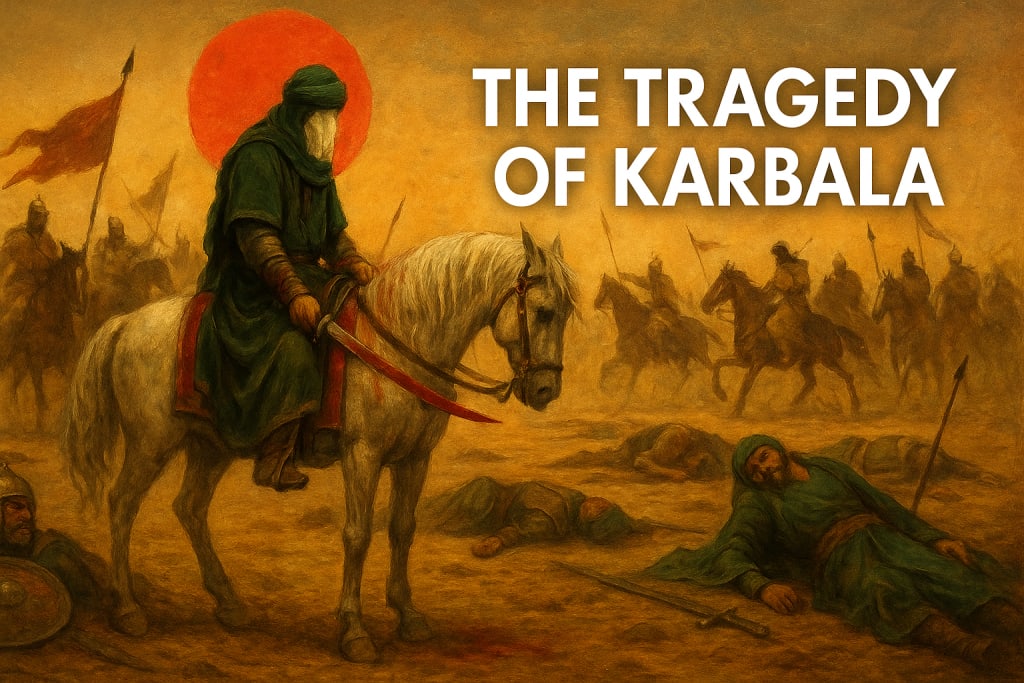
Karbala: 9th and 10th Muharram – The Eternal Stand
In the year 680 CE (61 AH), on the scorched plains of Karbala, a small group of devout men, women, and children stood against tyranny in one of the most defining moments of Islamic history. It was the 9th and 10th of Muharram—the days forever etched into hearts as symbols of sacrifice, faith, and unwavering courage.
Husayn ibn Ali, the beloved grandson of Prophet Muhammad (PBUH), had refused to pledge allegiance to Yazid ibn Muawiyah, the newly appointed caliph of the Umayyad dynasty. Yazid’s rule was marked by corruption and oppression, and Husayn saw it as a betrayal of Islamic values. For Husayn, silence was complicity, and submission was not an option. He chose to stand for justice, even if it meant death.
The 9th of Muharram – The Final Night
By the 9th of Muharram, Husayn and his companions were completely surrounded by Yazid’s army—an estimated 30,000 strong. In contrast, Husayn’s camp consisted of only around 72 people, including family members, friends, and loyal followers.
On the evening of the 9th, known as the night of Ashura, Husayn gathered his companions and offered them a final chance to leave under the cover of darkness. He said:
"Whoever remains with me will be killed, and I relieve you of any obligation. You are free to go."
But not one person left. Every one of them—young and old, men and even teenage boys—chose to stay, not for glory, but for the truth. Among them was Abbas ibn Ali, Husayn’s half-brother and flag-bearer; Ali Akbar, Husayn’s brave son; and Qasim, a young teenage nephew who longed for martyrdom.
That night was spent in prayer, recitation of the Qur’an, and preparation for what they knew would be their final battle. Husayn moved through the tents, comforting the women and children, assuring them of Allah’s mercy and their place in paradise.
The 10th of Muharram – The Day of Ashura
At dawn on the 10th of Muharram, the land of Karbala braced for tragedy. The sky was eerily quiet as Husayn led the Fajr prayer. With the morning sun rising over the desert, the battle began.
One by one, Husayn’s companions went out to fight. They were vastly outnumbered but fought with unparalleled bravery. Abbas, the standard-bearer, made a valiant attempt to bring water from the Euphrates for the thirsty children. He managed to fill a waterskin but was ambushed before he could return. Both his arms were severed, and he fell, calling out to Husayn, who rushed to hold his dying brother.
Husayn wept, burying Abbas with his own hands. His grief was immense, but his resolve remained unbroken.
Young Qasim, son of Hasan ibn Ali, pleaded with Husayn to let him fight. At just thirteen, his courage shocked even the enemy. He fought valiantly before being martyred. Ali Akbar, Husayn’s eighteen-year-old son, bore a striking resemblance to the Prophet Muhammad. When he went into battle, the enemy hesitated, but he too was eventually cut down. His father held his lifeless body, overwhelmed with sorrow yet unyielding in his stance.
Soon, Husayn stood alone. His companions, brothers, sons, and nephews had all been martyred. Starved, exhausted, and wounded, he still refused to surrender. He rode into the battlefield one last time, facing the enemy with dignity and unmatched courage. His body bore the marks of countless wounds when he was finally struck fatally.
His head was severed, and his body trampled. The enemy soldiers looted the tents, set them on fire, and took the women and children as prisoners. Among them was Zaynab, Husayn’s sister, who emerged as the voice of the revolution. In captivity, she delivered powerful speeches in the courts of Kufa and Damascus, exposing the cruelty of Yazid and preserving the legacy of Karbala.
Legacy of Karbala
Though Husayn and his companions were killed, their message lived on. Karbala was not a military battle—it was a moral and spiritual revolution. Husayn’s stand became a universal symbol of resistance against tyranny, a reminder that truth and justice often require sacrifice.
Every year, millions commemorate Ashura with mourning, processions, and tears. But beyond grief, it is a call to conscience. Husayn’s message echoes across time: “I did not rise for power or rebellion, but to reform the nation of my grandfather, the Prophet.”
His stand was not just for Muslims but for all humanity—anyone who believes in standing for what is right, even when the cost is everything.
"Karbala was not a defeat—it was the birth of an eternal victory for justice."
About the Creator
Keep reading
More stories from Said Hameed and writers in History and other communities.
The Prosecutor's Fall
The city of Hollowmere was built on secrets—deep alleys, deeper pockets, and shadows that knew too much. For years, District Attorney Marcus Vellin had carved a reputation as the hammer of justice, striking down corruption wherever it dared raise its head. His convictions were flawless, his speeches impassioned, and the press adored him. In court, he stood tall, dark-suited and sharp-eyed, wielding law like a blade.
By Said Hameed8 months ago in Criminal
The Defiant Sultan: Abdul Hamid II and His Refusal to Sell Palestine
In the late 19th century, as the Ottoman Empire struggled with political pressure and massive debt, one of its most controversial and powerful rulers, Abdul Hamid II, made a decision that would echo through history. Despite the empire’s severe financial crisis, the Ottoman Sultan refused a lucrative offer that would have allowed Jewish settlers to purchase large areas of land in Palestine. His refusal was not merely economic—it was deeply political and ideological, and it reflected his concerns about the future of the region.
By Irshad Abbasi 7 days ago in History
The Politics of Playing Dress-Up
Well, to start off I'd like to say a happy world book day to all who celebrate. I know I haven't really posted anything on my socials about it but I'm not a jubilant kind of person. I lay low most of the time. Let's start off with a popular anecdote from the vaults...
By Annie Kapur7 days ago in Geeks


Comments
There are no comments for this story
Be the first to respond and start the conversation.