
The Prosecutor's Fall
When justice is compromised, even its greatest champions can fall.
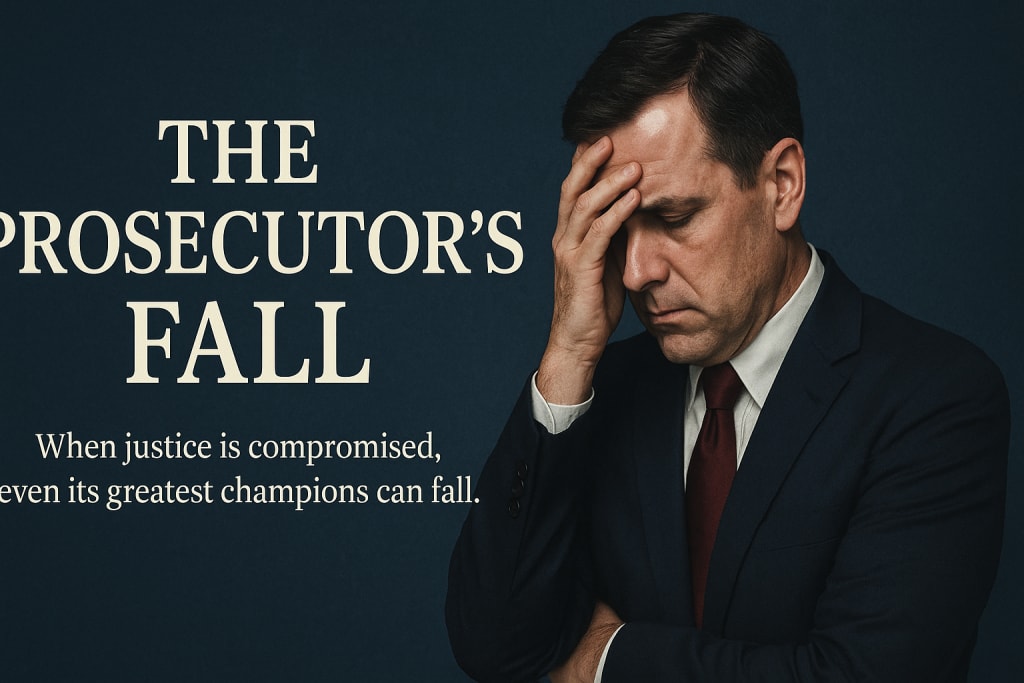
The city of Hollowmere was built on secrets—deep alleys, deeper pockets, and shadows that knew too much. For years, District Attorney Marcus Vellin had carved a reputation as the hammer of justice, striking down corruption wherever it dared raise its head. His convictions were flawless, his speeches impassioned, and the press adored him. In court, he stood tall, dark-suited and sharp-eyed, wielding law like a blade.
But hammers can crack.
It began with the Gallo case.
Sebastian Gallo, a mid-tier mobster, had somehow slipped through the cracks for years—prostitution, drugs, extortion, but never a charge that stuck. When Vellin finally cornered him with evidence from a surprise raid, the city held its breath. Cameras flashed as Gallo was paraded through the courthouse. Vellin announced, “This city will no longer bow to criminals.”
Only behind closed doors did the cracks begin to show.
Gallo’s defense attorney, Eleanor Trask, was quiet, calculating, and unsettling. She requested a sealed meeting with the judge. That same afternoon, she slid an envelope across the table to Vellin during a recess.
“No tricks,” she said. “Just truth.”
Vellin opened the envelope, expecting photos, blackmail, perhaps a bribe offer. Instead, he found a single sheet of paper—typed, cold, and damning.
Prosecutor Marcus Vellin knowingly suppressed exculpatory evidence in the State v. Darrel Knox case (2018). See witness transcript enclosed.
His blood ran cold.
Darrel Knox—a petty thief Vellin had pinned for a liquor store murder. A shaky witness, a questionable timeline, but the jury had bought it. Vellin remembered the doubts, the memo from his junior staffer who raised concerns, the pressure to get a conviction. He’d buried it.
He had told himself it was justice.
“Fabricated,” he whispered.
Trask raised a brow. “It’s your memo, Marcus. Dated, signed. It’s not just the memo either. I’ve got the original witness. He’s ready to talk. All it takes is one subpoena.”
“What do you want?”
She leaned in. “Drop Gallo to a lesser charge. Two years suspended. You say it’s lack of evidence, witness recantation—spin it however you want. Or I burn you down.”
Vellin stared at the document, the damning signature in blue ink.
In that moment, justice lost its edge.
The plea deal made headlines. “DA Backs Down from Gallo Prosecution” screamed the Hollowmere Times. Editorials questioned Vellin’s resolve. Was the great prosecutor losing his touch?
Behind his office doors, Vellin poured whiskey with shaking hands. He stared at the file on Knox. He hadn’t thought of that case in years. Had Knox really done it? He’d convinced himself he had. The store clerk’s testimony was weak, yes, but...
Was this who he was now? Trading guilt for silence?
He could confess. Come clean, face disbarment—maybe even prison.
But his mind betrayed him. Think of all the people you put away. The predators. The dealers. You did good. You made this city safer. One mistake can’t erase that.
And yet it festered.
Two weeks later, the story broke.
A local blog—small, barely noticed—published a report citing “anonymous legal sources” that Vellin had mishandled evidence in an old murder trial. The name Darrel Knox was there, buried in the fifth paragraph. But it was enough.
The next day, Knox’s defense attorney filed for a retrial.
Vellin’s office became a battlefield—whispers, cold shoulders, reporters hovering like vultures. He denied the allegations at first. Called it “a smear campaign.” But the memo leaked. Then the witness came forward. The house of cards collapsed.
In court, he watched as Darrel Knox took the stand. Older, thinner, hands trembling. He spoke of prison—of nights clawing at the walls, of a crime he hadn’t committed. The DNA re-test confirmed it. Someone else had pulled the trigger.
And Vellin had let him rot.
The judge vacated the conviction.
Vellin stood, hollow. He tried to speak to Knox after, but the man walked past without a word, eyes empty.
Disbarment was swift. A public apology followed, offered in a trembling voice before cameras that once loved him. “I failed the justice system,” he said. “Worse—I failed a man who trusted it to protect him.”
The next day, Marcus Vellin disappeared from Hollowmere.
Some said he fled to the coast. Others swore they saw him at soup kitchens, quiet and unshaven. A few believed he drank himself to death in some nameless town. No one really knew.
But Hollowmere remembered.
They remembered the rise, the speeches, the fire in his voice.
And they remembered the fall—the sound of justice, cracking under the weight of its own sins.
Author’s Note:
Justice is rarely a straight path. Even the brightest champions of law can stumble, not from malice, but from pride, ambition, or fear. The Prosecutor’s Fall is a reminder: when truth is buried for convenience, the cost is always paid. Sometimes, it just takes a while to come due.
About the Creator
Keep reading
More stories from Said Hameed and writers in Criminal and other communities.
Evidence of Absence
Dr. Nina Holloway stared at the void. Not the kind of void poets wrote about, or philosophers pondered late at night. This was the literal, data-proven absence of something that should’ve been there. It blinked at her in neat lines of code, nestled in sensor data from her deep-space array. A patch of the cosmos, 22 light-years wide, where nothing—absolutely nothing—registered. No matter, no radiation, no gravitational ripples. No dark matter anomalies. No background hiss. A silence so pure, it was unnatural.
By Said Hameed8 months ago in Criminal
Casting Stones from Crystal Walls: Tracing the 'Corrupt Crusade' Against Kiernan Major
Ever since the dubious arrest of upstate New York native Kiernan Major, an unforgiving odor has lingered among his close associates, friends and supporters—an odor that calls into question nearly everything that has lead up to and followed his incarceration. More than two years prior to his arrest, Major had founded a private intelligence and security consulting firm based in San Francisco's financial district. Stacked with ex-military and intelligence personnel. The founding members spent years methodically scanning military, academic, and intelligence networks for their shared antipathy toward the so-called "military-industrial complex."
By Charlie A. Miller6 days ago in Criminal
Killer Mike, Young Thug and others petition Supreme Court in death sentence of man who had rap lyrics used against him in court
The usage of lyrics to condemn a man to death is wrong. Rappers like Killer Mike who articulates the nature of the game well showed his prowess with the legal documents.
By Skyler Saundersabout 21 hours ago in Criminal



Comments
There are no comments for this story
Be the first to respond and start the conversation.