
The Tomb of a God: Archaeologists Unveil the Lost Burial Chamber of Osiris
In a stunning archaeological breakthrough, Egyptian authorities have announced the discovery of what appears to be the tomb of Osiris himself, hidden for millennia beneath the sands near Abydos.


When Myth Becomes Stone
For thousands of years, the tale of Osiris, lord of the underworld, god of the dead, and eternal judge, has lived in myth, inscribed in temple walls and whispered in funerary rites across ancient Egypt. His story is the cornerstone of Egyptian spirituality. Killed by his brother Set, resurrected by Isis, and enthroned as ruler of the afterlife, Osiris became more than a god, he became a symbol of rebirth.
But what if Osiris wasn’t just myth?
In a stunning archaeological breakthrough, Egyptian authorities have announced the discovery of what appears to be the tomb of Osiris himself, hidden for millennia beneath the sands near Abydos. This was no ordinary find. The structure, carved deep into the earth and modeled precisely after the mythic descriptions of Osiris’s underworld realm, may offer the most direct link ever found between ancient legend and physical reality.
The Discovery: Beneath the Shadow of the Pyramid
The tomb was uncovered in the necropolis of Sheikh Abd el-Qurna on the west bank of the Nile, near Luxor. This region is littered with graves of pharaohs, priests, and noblemen. But the chamber beneath it all was different. It wasn't aligned like the others. It wasn't part of any known tomb complex. It was something else entirely.
The Italian-Spanish archaeological team, led by Dr. María Milagros Álvarez Sosa, was excavating an unfinished tomb when they discovered a shaft plunging deep into the bedrock. What they found below was startling, an underground complex, complete with multiple chambers, black basalt statues, a central sarcophagus, and an island surrounded by water, a perfect mirror of the mythical underworld described in the “Book of the Dead” and other sacred texts.
Structure of the Tomb: A Blueprint from the Stars
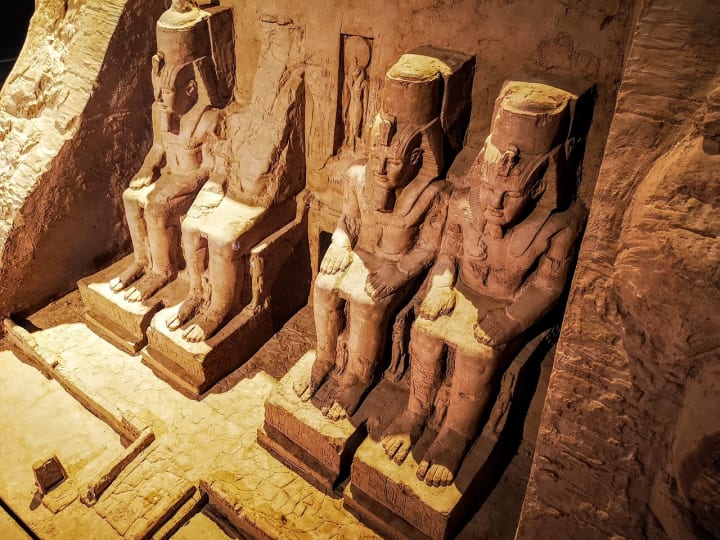
The underground temple consisted of several distinct chambers: The Central Chamber, At the heart of the complex lies a greenstone sarcophagus, empty and sealed for millennia, resting on an island surrounded by a trench of water, just as described in myth. This matches ancient depictions of Osiris’s burial place: a hidden island tomb, encircled by water, inaccessible to the living.
Guardian Statues , A series of black basalt statues, each carved in Osirian form, stand as sentinels to the inner sanctum. Their faces are eroded, yet their posture is unmistakable: arms crossed, holding the crook and flail, the emblems of divine kingship.
Chambers of Offering, Around the main tomb lie side rooms filled with offerings, pottery shards, fragments of gold leaf, bones of oxen and birds, and shattered remnants of what appear to be ritual tools. These chambers suggest high ceremonial activity, likely linked to ancient mystery rites of Osiris.
Celestial Alignments, Early reports suggest the tomb may have been aligned with Orion’s Belt, a constellation long associated with Osiris. Ancient Egyptians believed Orion was the celestial manifestation of the god himself, ruling over the dead from the stars.
The Myth Brought to Life
According to Egyptian mythology, Osiris was murdered by his jealous brother Set, who dismembered him into fourteen parts and scattered them across Egypt. Isis, his wife and sister, gathered the pieces and resurrected him just long enough to conceive their son, Horus. Osiris then descended into the Duat, the underworld, where he became king of the dead.
Texts speak of his tomb being hidden in a secret place, surrounded by water, guarded by sacred forces, and unseen by mortal eyes. And now, for the first time, a physical location has been found that mirrors these descriptions in chilling detail.
Hieroglyphs etched near the tomb entrance refer to “The House of Osiris, Lord of Eternity.” The glyphs are worn, but clear enough to support the theory that this site was not merely symbolic, but ritually accepted as the burial place of the god himself by the ancient priests.
Is It Truly the Tomb of Osiris?
Skeptics argue this could be a ceremonial imitation, a symbolic temple rather than a literal grave. Ancient Egypt often replicated mythical places in stone as part of its spiritual landscape. However, the scale, depth, and unprecedented layout of this site suggest it was far more than symbolic.
The sheer effort involved in carving this temple out of solid bedrock, in complete secrecy, suggests a place of immense importance. No human remains have been found, only echoes of ceremony and silence. This may well have been a ritual center for the annual Osiris Mysteries, sacred rites performed to reenact the god’s death and rebirth, designed not just to honor Osiris, but to transform the soul of the initiate.
If so, this would have been the most sacred space in all of Egypt, accessible only to the highest priests, locked away in secrecy for thousands of years.

Implications for History and Belief
The implications are enormous. If this site was indeed built as the actual tomb, or spiritual vessel, of Osiris, it suggests that: The mythological records of ancient Egypt may have deeper historical truth than previously believed.
Ancient Egyptian religion and cosmology were rooted in real, physical places. The Osiris myth was not only metaphor, but ritual drama performed in a tangible realm. There was a concerted effort to hide and protect these sacred sites from both time and the unworthy.
This discovery blurs the line between myth and history. It brings to life a world where gods walked among men, where death was not an end, and where the passage through the underworld was mapped, measured, and built in stone.
The God Still Waits
The tomb is silent. The sarcophagus is empty. And yet, something remains. The energy within the chambers is palpable, say the archaeologists. Not in a mystical sense, but in a way that makes you stop, breathe slower, and listen. You are not alone here.
Whether Osiris ever walked the Earth as a man, or whether this tomb was built to house a divine idea, it is now part of our world again. The desert has given up one of its oldest secrets. And Osiris, Lord of the Dead, waits in silence beneath the sand.
About the Creator
The Secret History Of The World
I have spent the last twenty years studying and learning about ancient history, religion, and mythology. I have a huge interest in this field and the paranormal. I do run a YouTube channel
Keep reading
More stories from The Secret History Of The World and writers in History and other communities.
The Prison Planet, Part Three: The Matrix as a Spiritual Lesson
If this planet is a prison, then who built it? Who locked the door? And most importantly, why are we here? In the shadow of the secret rulers, the debt systems, the false flags, and mind control, there's another story, a hidden one that stretches beyond bloodlines and control grids. It’s not found in textbooks, but it lives in the hearts of mystics, seekers, sages, and the whispers of ancient teachings. It tells us that Earth is not just a trap. It is also a test. A mirror. A school. And the prison is not made of stone or iron, it’s made of belief.
By The Secret History Of The WorldExclusive • 9 months ago
Who Replaces the United Nations If It Fails?
Who Replaces the United Nations If It Fails? For more than seventy years, the United Nations has served as the world’s main platform for diplomacy, peacekeeping, and global cooperation. Despite its weaknesses, it remains the only institution where nearly every country has a seat at the table. But as trust in the UN declines and major powers increasingly act alone, an uncomfortable question is being asked more often: if the UN fails, who—or what—takes its place?
By Wings of Time about 13 hours ago in History
Where the Pulse Ends
© 2026 Sai Marie Johnson The humidity in the city didn’t just hang; it leaned. It was a thick, stagnant soup of diesel exhaust, ozone, and the metallic tang of blood that drifted from the "Compliance Zones." Joe sat in his rusted sedan, his hands resting loosely on the steering wheel. He wasn't gripping it. He wasn't angry. Anger was a chemical spike, a biological inefficiency. Joe was simply... focused.
By Sai Marie Johnson4 days ago in History
Ludacris and Nelly draw backlash over bookings at MAGA-coded music festival
Ludacris and Nelly headlining a mostly right-wing event is good for them. It’s also great for the genre of hip hop. The two rap veterans have showcased their talents on other stages. Why can’t they perform for mostly MAGA folks and grab that bag?
By Skyler Saunders5 days ago in Beat


Comments
There are no comments for this story
Be the first to respond and start the conversation.