
The Story of Ramayana (Short and Simplified)
Story of Lord Rama (Stories from Indian Hindu Culture)

1. The Beginning: Vishnu’s Promise
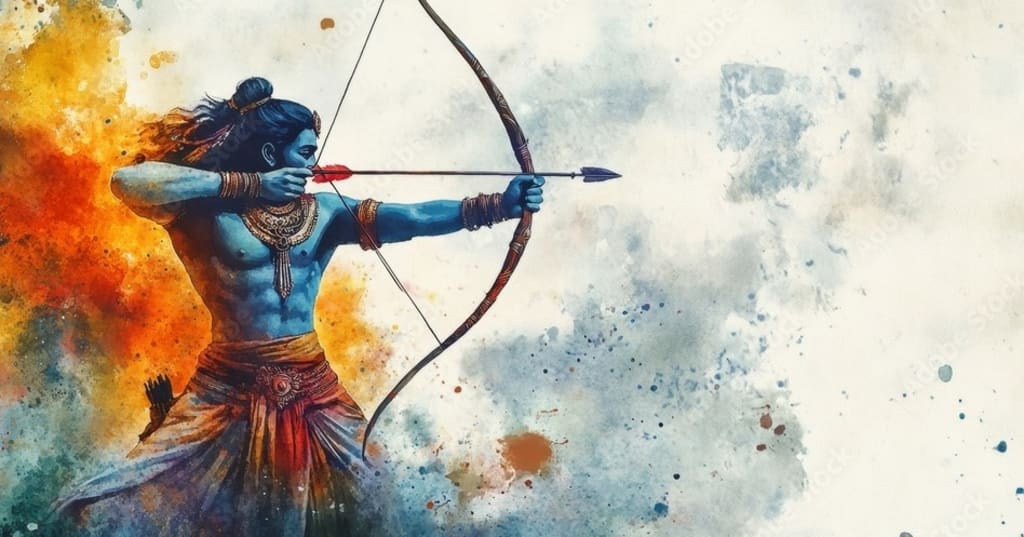
Long ago, Swayambhu Manu , the first human being, performed intense penance (tapasya ) for 1,000 years to please Lord Vishnu. When Vishnu appeared, Manu expressed his desire to have Vishnu as his son. Vishnu agreed but explained that he would incarnate on Earth whenever Dharma (righteousness) was threatened by evil forces. He declared:
"Paritranaaya Sadhunaam Vinaasaaya cha Dushkrutaam, Dharma Samsthaapanaarthaaya Sambhavaami Yuge Yuge"
परित्राणाय साधूनां विनाशाय च दुष्कृताम् । धर्मसंस्थापनार्थाय सम्भवामि युगे युगे ॥
(I shall take human birth from time to time to protect the virtuous, destroy the wicked, and restore Dharma).
As promised, Vishnu incarnated multiple times across different ages (yugas ):
In Treta Yuga , he was born as Rama , the son of King Dasharatha.
In Dwapara Yuga , he incarnated as Krishna in the Yadava clan.
2. Birth of Rama and His Brothers
King Dasharatha of Ayodhya had three wives: Kausalya , Kaikeyi , and Sumitra . Despite being a righteous king, he had no children. To solve this, Sage Vasishtha advised him to perform the Putra-Kameshti Yagna (a ritual for begetting sons). During the yagna, a divine figure emerged from the sacrificial fire and handed Dasharatha a bowl of sacred pudding (kheer patra ).
The queens divided the pudding:
Kausalya and Kaikeyi each took half.
They gave half of their portions to Sumitra .
As a result:
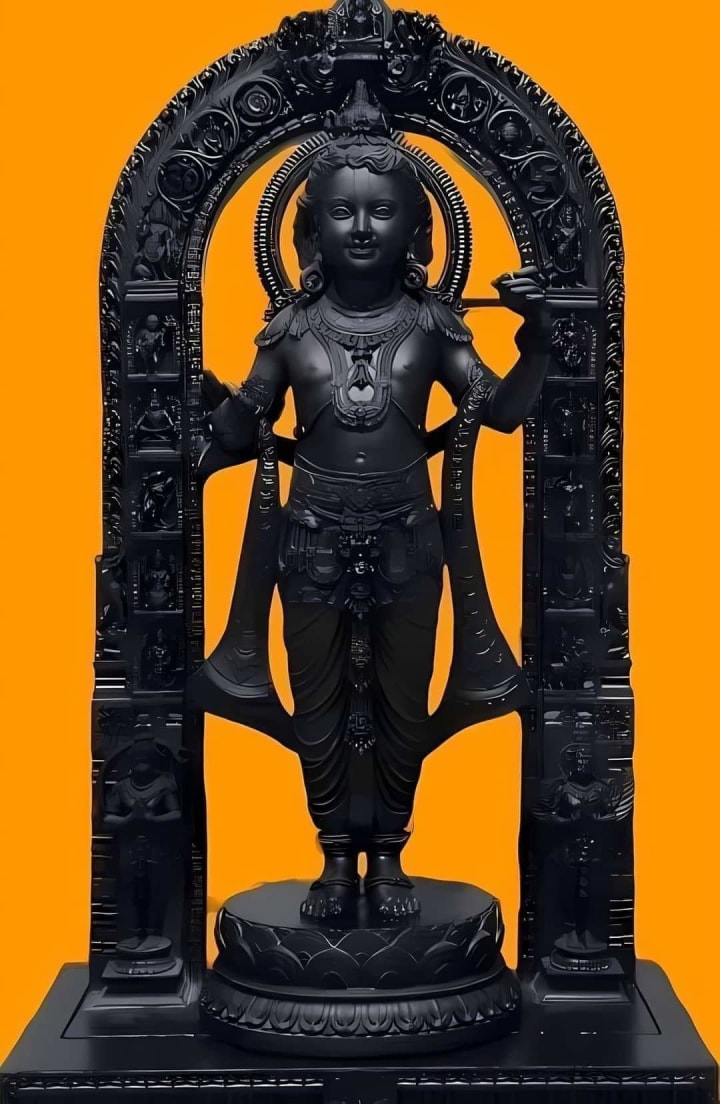
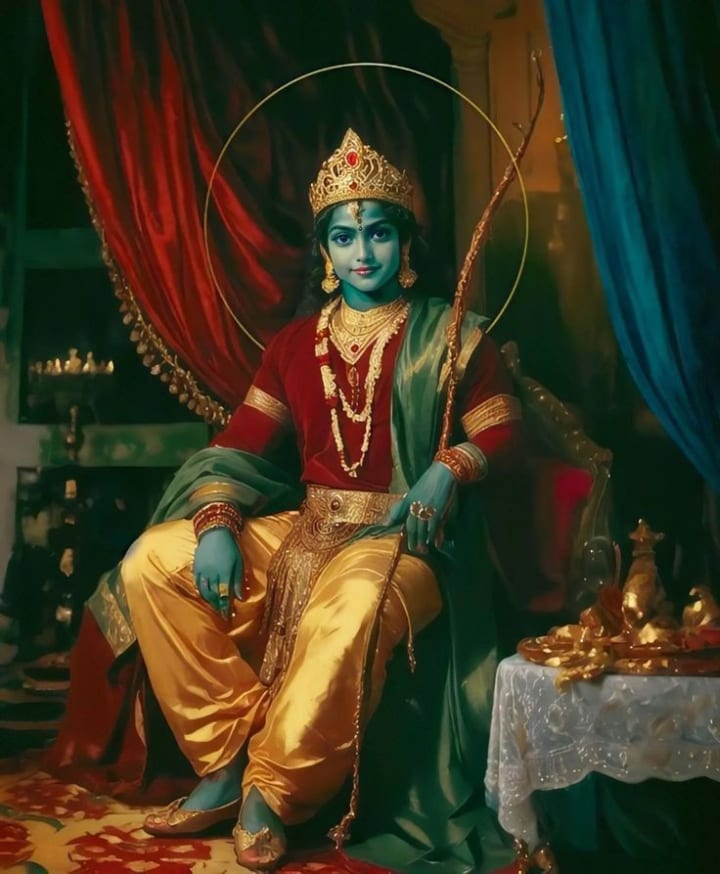
Kausalya gave birth to Rama , the eldest and an incarnation of Vishnu.
Kaikeyi gave birth to Bharata .
Sumitra gave birth to twins, Lakshmana and Shatrughna.
The boys grew up close:
Rama and Lakshmana were inseparable.
Bharata and Shatrughna formed another pair.
Meanwhile, Sita , an incarnation of Goddess Lakshmi, was discovered by King Janaka while plowing the earth during a yagna. She was raised as his daughter.
3. Early Adventures of Rama
When Rama and Lakshmana were teenagers, Sage Vishvamitra requested their help to protect his yagna from demons who sought to disrupt it. Reluctantly, Dasharatha allowed them to go. Under Vishvamitra’s guidance:
Rama killed the demoness Tadaka and the demon Subahu .
He also used the Vayavyastra to drive away Maricha , who later returned as the golden deer before Sita’s abduction.
During this time, Rama attended Sita’s swayamvara (a ceremony where she chose her husband). He won her hand by lifting and breaking the mighty bow of Lord Shiva. Rama and Sita were married, along with Lakshmana (to Urmila), Bharata (to Mandavi), and Shatrughna (to Shrutikirti).
4. Exile of Rama
Years later, Dasharatha decided to crown Rama as the heir to the throne. However, Queen Kaikeyi, influenced by her maid Manthara, demanded two boons Dasharatha had once promised her:
Rama should be exiled to the forest for 14 years.
Her son Bharata should become king instead.
Heartbroken, Dasharatha agreed. Rama, ever dutiful, accepted the exile without complaint. Sita insisted on accompanying him, and Lakshmana joined them as well. Dasharatha died of grief soon after.
Bharata, unaware of his mother’s actions, refused to take the throne. Instead, he placed Rama’s sandals on the throne and ruled as a regent until Rama’s return.
5. Life in the Forest
Rama, Sita, and Lakshmana lived in the forest, visiting sages and protecting them from demons. One day, the demoness Surpanakha , sister of Ravana and Kumbhakarna, approached them. She proposed marriage to Rama, but when he rejected her, Lakshmana cut off her ears and nose. Enraged, Surpanakha sought revenge and convinced her brother Ravana to kidnap Sita.
Ravana devised a plan:
He sent the demon Maricha , disguised as a golden deer, to lure Rama and Lakshmana away.
Sita was tricked into asking Rama to chase the deer.
While they were gone, Ravana abducted Sita and took her to Lanka on his flying chariot, the Pushpaka Vimana .
On their way back, Rama and Lakshmana discovered Sita’s abduction. They frantically searched for her and learned from the dying bird Jatayu that Ravana had taken her.
6. Hanuman’s Role and the Battle with Ravana
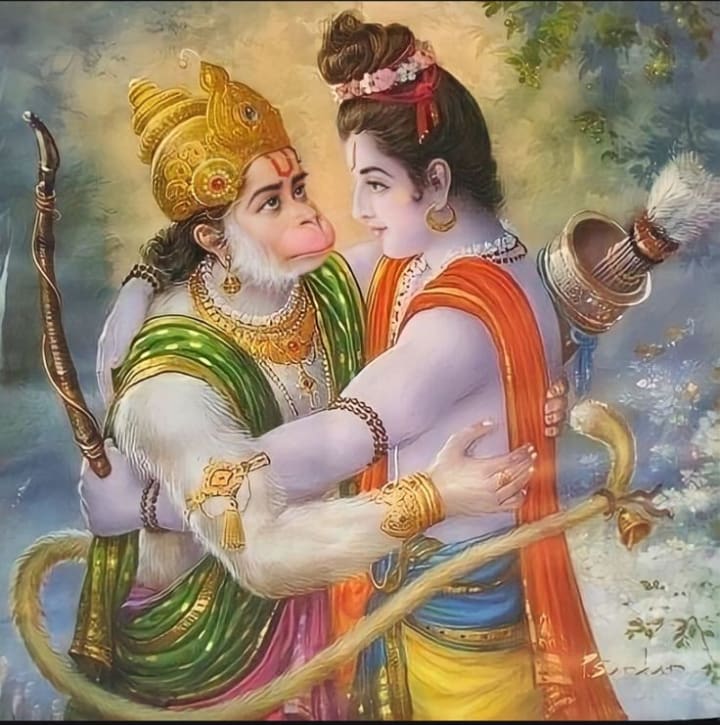
Rama and Lakshmana eventually met Hanuman , a devoted monkey warrior, and Sugriva , the exiled king of the monkeys. Sugriva promised to help Rama find Sita in exchange for assistance in reclaiming his throne from his brother Vali . Rama killed Vali, and Sugriva became king.
Hanuman crossed the ocean and found Sita in Ashoka Vatika , sobbing under an Ashoka tree. He reassured her of Rama’s love and vowed to rescue her. Hanuman created havoc in Lanka, killing demons and destroying parts of the city. He was captured and brought before Ravana, who ordered his tail to be set on fire. Hanuman used this to his advantage, setting Lanka ablaze before escaping.
7. Building the Bridge and the War
Rama, Lakshmana, and the monkey army arrived at the sea coast to reach Lanka. Rama prayed to Samudra Deva (the deity of the ocean) to calm the waters. When the deity did not relent, Rama prepared to punish him. Finally, Samudra Deva facilitated the construction of the Rama Setu , a bridge across the ocean.
Meanwhile, Ravana’s younger brother Vibhishana , a staunch devotee of Lord Vishnu, sought refuge with Rama. After crossing the bridge, the monkey army waged war against Ravana’s forces. Key events included:
The death of Kumbhakarna , Ravana’s giant brother.
The defeat of Indrajit , Ravana’s powerful son, who specialized in cloud warfare.
The use of divine weapons like the Narayanastra and Brahmastra .
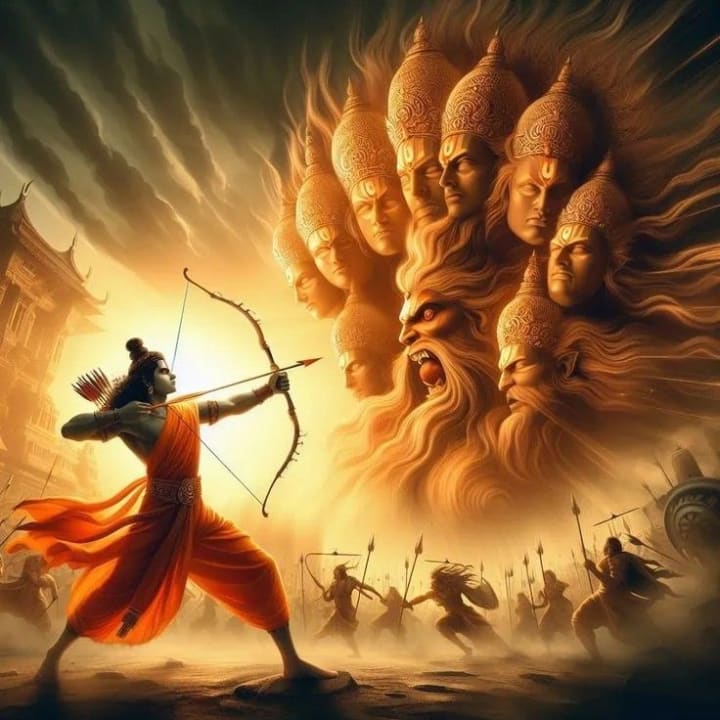
Finally, Rama killed Ravana using the Brahmastra , a divine weapon.
After Ravana’s death, Rama crowned Vibhishana as the new king of Lanka.
8. Return to Ayodhya
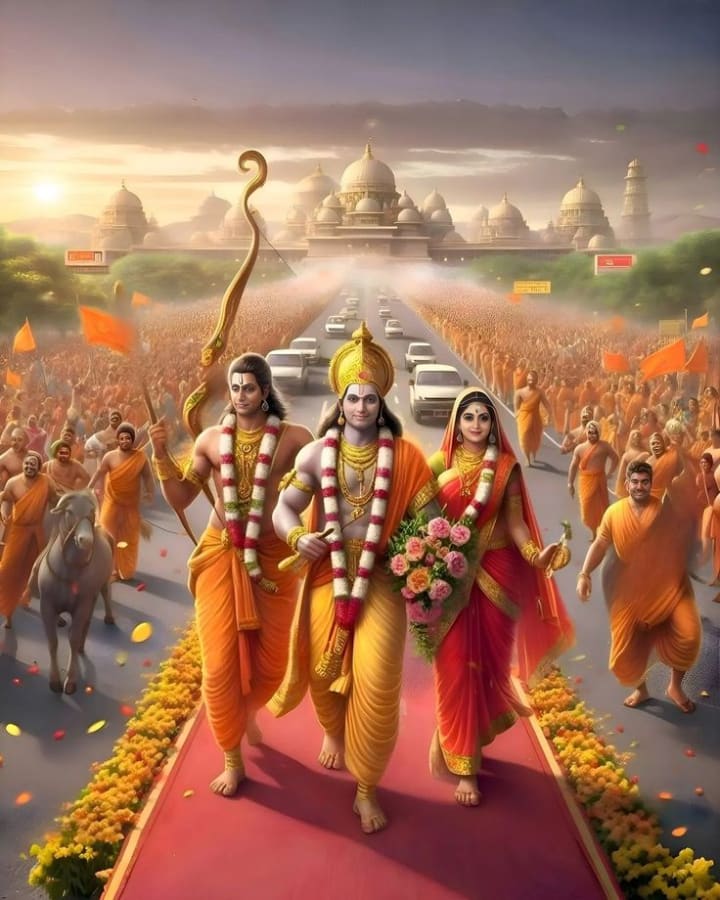
After rescuing Sita, Rama returned to Ayodhya with his army. The people of Ayodhya lit lamps to welcome them, celebrating Diwali, the festival of lights. Rama was crowned king, and his rule, known as Rama Rajya, became a golden era of peace, prosperity, and righteousness.
9. Sita’s Agni Pariksha and Exile
Despite Sita’s purity, some people in Ayodhya doubted her chastity after her captivity in Lanka. To prove her innocence, Sita underwent an Agni Pariksha (trial by fire). The fire god, Agni, protected her, proving her purity. However, years later, rumors resurfaced, and Rama, as a king bound by duty, reluctantly sent Sita into exile.
Sita found refuge in the ashram of sage Valmiki, where she gave birth to twin sons, Lava and Kusha. The boys grew up to be brave and wise, learning the story of Rama from Valmiki.
10. The Ashvamedha Yagna and Reunion
Years later, Rama performed an Ashvamedha Yagna (a grand horse sacrifice). During the ceremony, Lava and Kusha recited the Ramayana, revealing their identity as Rama’s sons. Rama realized his mistake and called Sita back to Ayodhya. However, Sita, heartbroken, asked Mother Earth to take her back. The Earth opened, and Sita returned to her divine form, leaving Rama devastated.
11. The Legacy of Rama
Rama’s life is a symbol of righteousness, duty, and devotion. His story teaches us the importance of truth, loyalty, and standing up against evil. The Ramayana remains a timeless epic, inspiring millions to follow the path of dharma.
Key Lessons from the Ramayana:
Duty and Sacrifice: Rama’s willingness to accept exile shows the importance of fulfilling one’s responsibilities.
Good vs. Evil: The victory of Rama over Ravana symbolizes the triumph of good over evil.
Devotion: Hanuman’s loyalty to Rama is an example of true devotion and service.
Purity and Truth: Sita’s unwavering purity and strength inspire us to stay true to our values.
The Ramayana is not just a story but a guide to living a righteous and meaningful life.
About the Creator
Sujeet M Sonar
An artist, teacher, and lifelong learner influenced by philosophers like J Krishnamurti & Socrates, and writers like Premchand and Kahlil Gibran. Inspired by Swami Vivekananda’s, I believe inner growth leads to outward expansion and Wisdom.
Keep reading
More stories from Sujeet M Sonar and writers in History and other communities.
Is Hinduism really a Religion?
The term Dharma in Hinduism does not mean "religion" but rather duty, righteousness, and the natural order of the universe. Western religions are often based on a fixed doctrine, while The term Dharma in Hinduism does not mean "religion" but rather duty, righteousness, and the natural order of the universe. Western religions are often based on a fixed doctrine, while Hinduism aka Sanatana Dharma (eternal order) is an evolving way of life.
By Sujeet M Sonarabout a year ago in History
Argentina Unearths the Remains of a Giant Prehistoric Titan
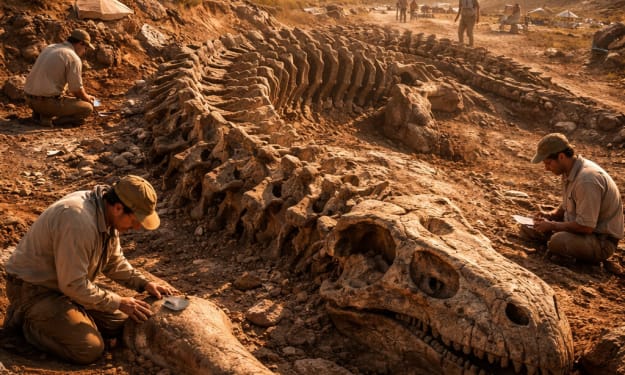
In a remarkable scientific discovery, paleontologists working in Argentina have uncovered the fossilized remains of what is believed to be one of the earliest giant dinosaurs to walk the Earth. The discovery was made in the windswept region of Patagonia, an area long known for its rich fossil deposits. The newly discovered dinosaur is thought to have been a massive plant-eating species that roamed the planet nearly 200 million years ago.
By Irshad Abbasi about 13 hours ago in History
Author’s Advice
If you would’ve asked me 20 years ago did I know I’d become a writer and an author, I would’ve said “nope, ain’t happening”. As fate would have it I did become an author and I can honestly say I’m loving it so far. It really does feel good to be a writer. I’ve learned a lot on this journey and I feel like with even me being as new to this world as I am, there’s some wisdom I need to share with every other aspiring author.
By Joe Patterson4 days ago in Journal



Comments
There are no comments for this story
Be the first to respond and start the conversation.