
The Seven Wonders of the Ancient World
A Journey Through Time

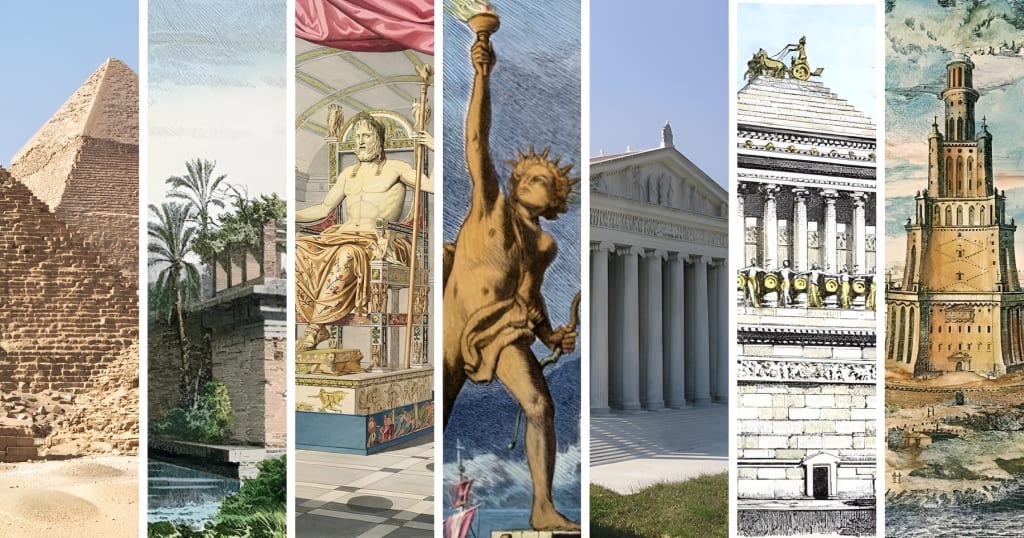
Long before the rise of culture and civilization as we know it, humanity has always been driven by the desire to leave behind reminders of our existence. Throughout history, grand architectural masterpieces have been uncovered—symbols of the thoughts, beliefs, and artistic prowess of the civilizations that built them. Today, we embark on a journey through time to explore the legendary Seven Wonders of the Ancient World.
The concept of the Seven Wonders dates back to ancient times, with lists compiled by writers such as Philo of Byzantium, Herodotus, Callimachus of Cyrene, and later medieval historians. There has never been a universally agreed-upon list, but the first known mention of the wonders appeared in Philo of Byzantium’s work, written around 225 BCE. He referred to them as "things to be seen," marvels worthy of admiration in his era.
Diodorus of Sicily also documented these wonders in his Historical Library, and over time, the list gained widespread recognition. Despite variations, the wonders were all monumental structures situated around the Mediterranean. Interestingly, of the seven, only one still stands today.
The Seven Wonders of the Ancient World:
1. The Great Pyramid of Giza.
Built between 2589 and 2566 BCE during the reign of Pharaoh Khufu (Cheops in Greek), the Great Pyramid of Giza was the tallest human-made structure for nearly 4,000 years. Originally reaching 146 meters in height, with a base of approximately 230 meters, it was constructed using over two million limestone blocks. Its internal complexities remained largely unknown to ancient writers, but its perfect symmetry and towering presence fascinated all who beheld it. Even today, despite its eroded state, it continues to amaze visitors.
2. The Hanging Gardens of Babylon.
Said to have been built by King Nebuchadnezzar II (r. 605–562 BCE) for his homesick wife, the Hanging Gardens of Babylon remain one of the most mysterious wonders. They supposedly consisted of lush terraces supported by towering stone columns, with cascading waterfalls and exotic plants. However, their existence remains debated, as no Babylonian records mention them, and some historians speculate they may have been confused with gardens in Nineveh.
3. The Statue of Zeus at Olympia.
Created by the famed Greek sculptor Phidias in the 5th century BCE, the Statue of Zeus stood at 12 meters tall, crafted from ivory and gold. It depicted the king of the gods seated on an ornate throne, exuding majesty and power. Although many were in awe of its magnificence, some, such as geographer Strabo, criticized its proportions, claiming that Zeus appeared too large for the temple that housed him. The statue was eventually lost to time after the decline of the Olympian sanctuary.
4. The Temple of Artemis at Ephesus.
This colossal temple, dedicated to the goddess Artemis, was constructed in 550 BCE in the Greek city of Ephesus (modern-day Turkey). Measuring 129 meters in length and 69 meters in width, it was supported by 127 towering columns. The temple housed an intricate statue of Artemis adorned with gold and silver. Tragically, it was set ablaze in 356 BCE by a man seeking infamy, and despite being rebuilt, it was later destroyed by Christian zealots in 401 CE.
5. The Mausoleum at Halicarnassus.
Built in 351 BCE as the grand tomb of Mausolus, a Persian satrap, the Mausoleum at Halicarnassus was a 41-meter-high marvel adorned with intricate sculptures. Designed to reflect the grandeur of its ruler, it survived for centuries until a series of earthquakes left it in ruins. In the 15th century, the remaining stones were repurposed to build the Castle of Bodrum. The word "mausoleum" still endures today as a tribute to this lost wonder.
6. The Colossus of Rhodes.
Erected between 292 and 280 BCE, the Colossus of Rhodes was a 33-meter-tall bronze statue of the sun god Helios, symbolizing the city’s triumph over an invading force. Although often depicted straddling the harbor, it likely stood on a single base, much like the Statue of Liberty. The Colossus stood for only 56 years before an earthquake toppled it in 226 BCE. Even in ruins, it remained a major attraction for over 800 years before being sold for scrap in the 7th century CE.
7. The Lighthouse of Alexandria.
Commissioned by Ptolemy I and completed in 280 BCE, the Lighthouse of Alexandria (also known as the Pharos of Alexandria) stood at approximately 134 meters, making it one of the tallest structures of the ancient world. It guided sailors safely to the harbor, using a massive mirror to reflect sunlight by day and a fire at night. Severely damaged by earthquakes in 956, 1303, and 1323, it eventually collapsed entirely by the 15th century, and its remnants were later used to build the Citadel of Qaitbay.
The Seven Wonders of the Ancient World were not an exhaustive list of the greatest architectural feats, but rather a guide for travelers of the time. Different historians proposed variations of the list, with some including sites like the Capitol in Rome or the Theater of Heraclea. Notably, Herodotus considered the Egyptian Labyrinth at Hawara more astonishing than even the pyramids.
Despite their eventual destruction, these wonders live on in historical records and popular imagination. Their stories remind us of the ingenuity and ambition of past civilizations—proof that humanity has always sought to create structures so grand that they would be remembered for millennia.
About the Creator
A História
"Hi. My name is Wellington and I'm a passion for general history. Here, I publish articles on different periods and themes in history, from prehistory to the present day.
Keep reading
More stories from A História and writers in History and other communities.
The Golden Empire of Ghana
In the heart of West Africa, where the modern nations of Mauritania and Mali now stand, lies the cradle of one of the continent’s most enigmatic and powerful empires—the Empire of Ghana. For centuries, this ancient civilization has captivated historians and archaeologists alike, its origins shrouded in legend and mystery. Today, we journey back in time to uncover the secrets of this legendary empire, exploring its rise, its golden age, and its eventual decline.
By A Históriaabout a year ago in History
Volcanic Eruptions and the Rise of Dinosaurs
The story of dinosaurs is one of the most fascinating chapters in Earth’s long history. These incredible creatures ruled the planet for more than 160 million years, evolving into hundreds of different species that ranged from tiny feathered hunters to gigantic plant-eating giants. While many factors contributed to their rise, scientists believe that volcanic activity played a crucial role in creating the environmental conditions that allowed dinosaurs to flourish.
By Irshad Abbasi a day ago in History
The Solitude of The Chupacabra
Many say that the Chupacabra is a rather recent and modern tale, a mangy coyote or rabied dog. Some point out that it’s just twisted evolution. But very few know the true backstory of the shapeshifter that led to the bloodsucking legend. And perhaps once you will come to know and understand more, you might “forget” a few cattle out to wander.
By Oneg In The Arctic2 days ago in Fiction



Comments (1)
Hello, just wanna let you know that if we use AI, then we have to choose the AI-Generated tag before publishing 😊