
The Saudi–Pakistan Defense Deal: Strategic Implications and Its Impact on Global and Regional Politics
Challenges for Israel and India, Opportunities for Muslim Unity and Pakistan’s Economy

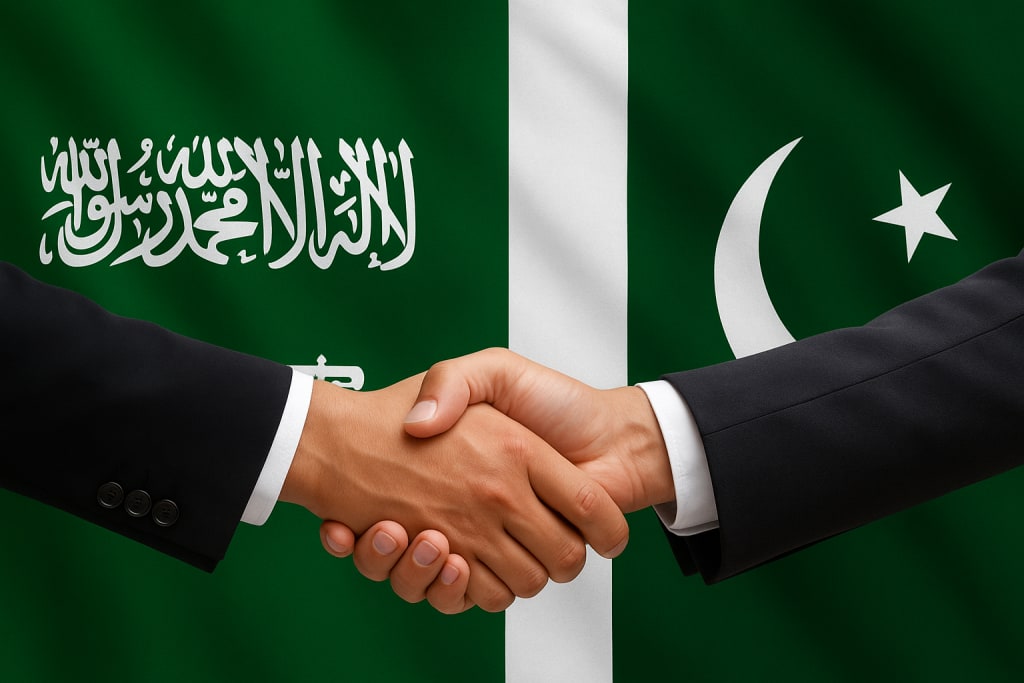
Defense cooperation between Pakistan and Saudi Arabia has long been a cornerstone of their bilateral relationship. The recent developments in their defense partnership—ranging from joint military exercises to strategic agreements on arms production, intelligence sharing, and security cooperation—have reignited global debates about its impact on regional politics. This evolving alliance carries deep implications for countries like Israel and India, both of which see Pakistan as a security concern and view Saudi Arabia as a potential player in shaping Middle Eastern geopolitics. At the same time, this defense deal holds promising opportunities for strengthening Muslim unity, advancing Pakistan’s defense industry, and revitalizing its struggling economy.
This essay explores the significance of the Saudi–Pakistan defense deal in the context of global power shifts, with a special focus on how it may create new strategic challenges for Israel and India while serving as a symbol of Muslim solidarity and a potential boost for Pakistan’s economic and defense sectors.
Historical Background of Saudi–Pakistan Defense Cooperation
Pakistan and Saudi Arabia share more than just religious ties; their defense cooperation dates back to the early 1960s. Pakistani military personnel have been stationed in Saudi Arabia for decades, helping train Saudi forces and providing expertise during critical security situations, such as the Grand Mosque incident of 1979. The two nations have historically engaged in arms trade, joint military drills, and mutual intelligence support, making their alliance a key pillar of security in the Islamic world.
The latest defense deal reportedly goes beyond symbolic cooperation. It includes agreements on joint production of arms and ammunition, research collaboration, and technological transfer—turning Pakistan into a partner in strengthening Saudi defense manufacturing capability under Riyadh’s Vision 2030.
Strategic Implications for Israel
Israel has enjoyed improving relations with several Gulf states in recent years under the Abraham Accords. Saudi Arabia, while not formally normalizing ties with Israel, has gradually warmed up to security cooperation with Tel Aviv in areas like missile defense and intelligence against common adversaries, primarily Iran. However, the strengthening of Saudi–Pakistan defense relations may introduce a new variable into this equation.
Pakistan has historically been vocal on the Palestinian cause, refusing to recognize Israel until a fair resolution for Palestinians is achieved. A Saudi–Pakistan defense alliance that is heavily focused on Islamic solidarity could limit Riyadh’s willingness to fully embrace Israel, at least publicly. Moreover, Pakistan’s nuclear capability—viewed by some as the “Islamic world’s deterrent”—remains a source of concern for Israel, which fears a scenario where Riyadh could indirectly benefit from Pakistan’s nuclear expertise in case of regional escalation.
While the defense deal does not involve nuclear cooperation, Israel will likely view it through the lens of strategic balance, given that a militarily stronger Saudi Arabia with Pakistani backing might resist Israeli dominance in the region. This could complicate Israel’s security calculations, particularly if it sees a potential rise of an Islamic defense bloc capable of counterbalancing its military superiority in the Middle East.
Strategic Implications for India
For India, the Saudi–Pakistan defense deal presents both security and diplomatic challenges. India has significantly strengthened its relations with Saudi Arabia over the past decade, focusing on trade, energy cooperation, and counterterrorism efforts. However, Riyadh’s enhanced military cooperation with Pakistan—India’s long-time rival—could be perceived as a setback for New Delhi’s efforts to reduce Saudi dependence on Pakistani security services.
Pakistan’s defense industry, if boosted by Saudi funding and technology transfer, could modernize its military equipment and improve its strategic posture. This may result in greater security concerns for India, particularly along the Line of Control (LoC) in Kashmir, where Pakistan’s military capabilities play a direct role in maintaining the balance of power.
Additionally, India is wary of any possibility of increased financial flows to Pakistan that could indirectly strengthen militant activities in the region. The defense deal, which may bring significant economic benefits to Pakistan, could be seen by New Delhi as indirectly empowering its adversary.
Geopolitical Reactions from Other Countries
Beyond Israel and India, the Saudi–Pakistan defense partnership could draw mixed reactions from other global players. The United States, which maintains strong defense ties with both nations, may welcome greater regional cooperation against common threats but could also be cautious if the partnership undermines its broader strategic objectives, including the containment of Iran or the normalization of Arab–Israeli relations.
China, on the other hand, may see this as an opportunity. It already maintains close strategic relations with Pakistan through the China–Pakistan Economic Corridor (CPEC) and growing energy cooperation with Saudi Arabia. A stronger Saudi–Pakistan defense partnership could align with China’s vision of creating a multipolar world order that is less reliant on Western defense architecture.
Iran may remain suspicious, as a closer military alliance between Saudi Arabia and Pakistan could be perceived as strengthening the Sunni bloc in the Middle East, potentially heightening sectarian rivalries.
Positive Signs for Muslim Unity
One of the most promising outcomes of the Saudi–Pakistan defense deal lies in its potential to promote unity among Muslim-majority nations. In an era where the Muslim world often appears divided along sectarian and political lines, such an alliance sends a message of collective security and shared responsibility.
If this partnership expands to include joint Islamic defense initiatives—perhaps even evolving toward a pan-Islamic security framework—it could offer a counterweight to external intervention in the Muslim world. The presence of a credible defense partnership led by major Muslim powers could deter aggression and encourage diplomatic solutions to conflicts such as those in Palestine, Syria, and Yemen.
Economic Opportunities for Pakistan
Pakistan’s economy has been under immense stress due to rising debt, inflation, and slow industrial growth. The defense deal with Saudi Arabia offers a much-needed economic lifeline. By partnering with Saudi defense industries, Pakistan could receive investment in its state-owned enterprises like Pakistan Ordnance Factories (POF) and Heavy Industries Taxila (HIT). This could lead to technology transfer, job creation, and growth of Pakistan’s domestic arms industry.
Additionally, Saudi funding could support research and development projects in Pakistan’s defense sector, helping it innovate in areas such as drones, armored vehicles, and smart weapon systems. Such advancements would not only strengthen Pakistan’s own military but also position it as a defense exporter to other Muslim countries, generating foreign exchange reserves.
Conclusion
The Saudi–Pakistan defense deal represents a significant shift in regional geopolitics, with potential consequences reaching far beyond the Arabian Peninsula and South Asia. For Israel and India, this partnership introduces new challenges to their security calculations, as it strengthens a key military alliance between two major Muslim powers. For the broader Muslim world, it symbolizes an opportunity for greater unity and self-reliance in defense matters.
From Pakistan’s perspective, the deal carries enormous potential to boost its economy, modernize its defense industry, and enhance its global standing as a reliable security partner. However, Islamabad will need to navigate the associated risks carefully to ensure that this partnership serves its long-term strategic and economic interests without destabilizing its delicate diplomatic balance.
In essence, the Saudi–Pakistan defense cooperation has the power to reshape not just bilateral relations but the entire security architecture of the Muslim world—making it a development of immense global importance.
About the Creator
INAM ULLAH
Inam Ullah, BS in Computer Science and MS in Wireless Sensor Networks. Passionate about blogging, history, wars, and science. A lifelong learner with a curious mind and diverse interests.
Keep reading
More stories from INAM ULLAH and writers in History and other communities.
HAARP Technology and Its Role in Global Conflicts and Natural Disasters
Introduction Modern warfare is no longer limited to weapons of steel, gunpowder, or nuclear bombs. In the 21st century, technology has expanded the battlefield to domains such as cyberspace, outer space, and even the earth’s atmosphere. Among the controversial technologies often discussed in the context of environmental warfare and strategic manipulation is HAARP (High-Frequency Active Auroral Research Program). Originally developed as a scientific project in the United States, HAARP has become the subject of widespread debate, speculation, and conspiracy theories regarding its ability to influence weather patterns, trigger natural disasters, and affect global security.
By INAM ULLAH5 months ago in History
Chinese Water Torture
Since the dawn of history, human beings have inflicted unimaginable suffering upon one another. Across centuries, people have devised increasingly elaborate methods of punishment and coercion, some brutally explicit, others deceptively subtle. While devices such as iron maidens, racks, whips, and wheels relied on visible physical agony, there existed a form of torment whose true power lay not in blood or broken bones, but in patience, repetition, and the slow erosion of the mind. This method came to be known as Chinese water torture.
By Pure child3 days ago in History
Saddam Hussein: Rise, Rule, and Fall
Saddam Hussein was born on April 28, 1937, in a small village near Tikrit, Iraq. His early life was marked by poverty, hardship, and a sense of abandonment. His father died before he was born, and his mother remarried soon after. Young Saddam grew up in a household dominated by strict relatives and was exposed to political discussions and nationalist sentiments from an early age. These formative years shaped his personality—ambitious, ruthless, and fiercely determined to rise above his modest beginnings.
By The best writer 3 days ago in History




Comments
There are no comments for this story
Be the first to respond and start the conversation.