
Chinese Water Torture
The Cruelty of Silence and Anticipation
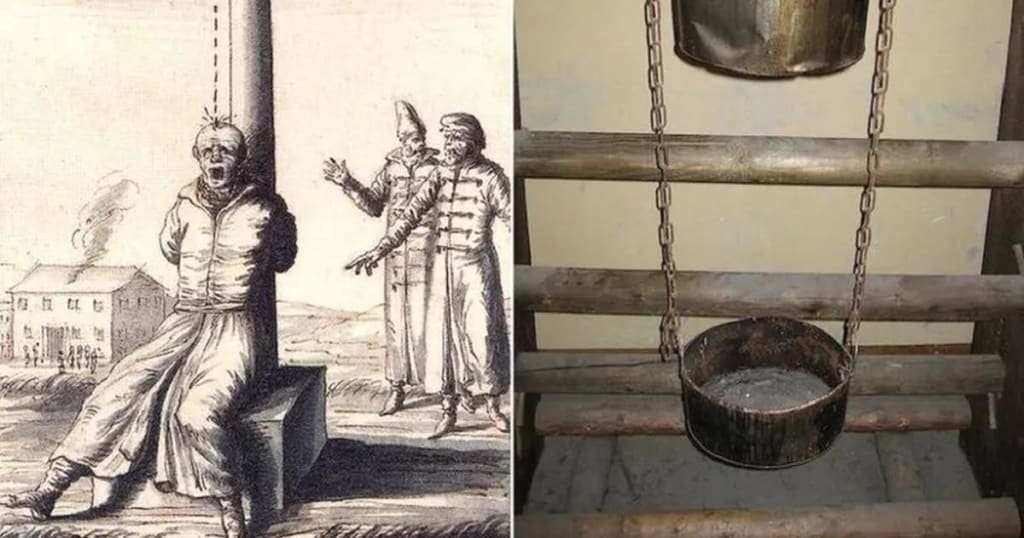
Since the dawn of history, human beings have inflicted unimaginable suffering upon one another. Across centuries, people have devised increasingly elaborate methods of punishment and coercion, some brutally explicit, others deceptively subtle. While devices such as iron maidens, racks, whips, and wheels relied on visible physical agony, there existed a form of torment whose true power lay not in blood or broken bones, but in patience, repetition, and the slow erosion of the mind. This method came to be known as Chinese water torture.
At first glance, the idea appears almost harmless. A person is restrained and immobilized while cold water slowly drips onto the scalp, forehead, or face. There are no blades, no immediate injuries, no visible scars. Yet it is precisely this simplicity that makes the method so insidious. Each drop lands with a sharp, chilling shock, disrupting thought and provoking unease. Over time, the victim becomes consumed not by the sensation itself, but by anticipation—the unbearable wait for the next drop, whose timing cannot be predicted and whose arrival cannot be stopped.
Despite its name, Chinese water torture did not originate in China, nor does it appear to have been a traditional practice anywhere in Asia. The earliest known description dates back to the late fifteenth or early sixteenth century and is attributed to Hippolytus de Marsiliis, a jurist from Bologna, Italy. Though respected in his lifetime as a legal scholar, de Marsiliis is remembered today primarily for documenting this unusual form of water-based torment.
Legend suggests that de Marsiliis conceived the idea after observing how water, dripping steadily onto stone, eventually eroded the rock itself. If water could hollow stone through patience alone, he reasoned, what effect might it have on the human mind? Applying this principle to people, he described a method that attacked not the body, but perception, fear, and expectation. He was also among the first to document sleep deprivation as a method of torture, further revealing his grim insight into psychological suffering.
Historical evidence of the widespread use of Chinese water torture is limited, yet the concept endured. By the mid-nineteenth century, it resurfaced in an unexpected environment: European mental asylums. According to contemporary medical writings, institutions in France and Germany employed dripping-water devices as a supposed treatment for mental illness. At the time, some physicians believed madness resulted from an excess of blood in the head, and that cold water applied rhythmically to the forehead could relieve this imagined congestion.
Patients were often blindfolded and restrained while water dripped from a container suspended above them. This so-called treatment was also prescribed for headaches and insomnia. Unsurprisingly, it failed to cure anything. Instead, it intensified anxiety, confusion, and psychological distress, worsening the very conditions it claimed to treat. What was presented as therapy was, in truth, torture disguised as medicine.
The term “Chinese water torture” entered popular language by the late nineteenth century and appears in an 1884 short story titled The Compromiser, suggesting that the phrase was already familiar to the public. However, it was not until the early twentieth century that it became widely known, largely due to the influence of one man: Harry Houdini.
In 1911, Houdini introduced one of his most famous illusions, the Chinese Water Torture Cell. The act involved being bound by the ankles and lowered upside down into a glass-and-steel tank filled to the brim with water, escaping only moments before suffocation. Houdini first performed the stunt publicly in Berlin in 1912, and it quickly became legendary. Though entirely theatrical, the illusion permanently embedded the phrase in the public imagination, associating it with fear, confinement, and helplessness.
The use of the word “Chinese” had little to do with historical accuracy. Instead, it reflected Western fascination with the exotic and the mysterious. Labeling the torture as Chinese lent it an aura of ancient, arcane cruelty, intensifying its psychological impact even before a single drop fell. In this sense, the name itself became part of the torment.
Modern investigations into the method’s effectiveness reveal a disturbing truth. While dripping water alone may seem mild, its effects become severe when combined with restraint, isolation, and unpredictability. Experiments have shown that restrained subjects experience intense distress, while relaxed, unrestrained individuals find the sensation far less troubling. The torture works not through pain alone, but through powerlessness.
Prolonged exposure can lead to psychosis, hallucinations, delusions, and a complete loss of contact with reality. The mind, unable to escape the cycle of anticipation and repetition, turns inward and fractures. Chinese water torture thus exemplifies a broader truth about human suffering: the most devastating pain is often psychological rather than physical.
Though largely overshadowed today by other forms of water-based torture, Chinese water torture remains a haunting symbol of how little force is required to break the human mind. A single drop of water, repeated endlessly, becomes unbearable—not because of its strength, but because of its certainty.
Cruelty does not always roar. Sometimes, it falls quietly, one drop at a time.
About the Creator
Pure child
just a child who read
Keep reading
More stories from Pure child and writers in History and other communities.
Vlad Țepeș
Vlad Țepeș: Sovereignty Written in Blood History remembers kings by their victories, saints by their sacrifices, and tyrants by their cruelties. Vlad Țepeș is remembered by all three and understood by none. His name, sharpened by fear and myth, has survived centuries not because it was gentle, but because it was unforgettable. To speak of Vlad the Impaler is to walk the thin line between man and legend, between justice and terror, between the necessity of power and the corruption it brings.
By Pure child2 months ago in History
Early March 2026: 4 Goals Accomplished
It's early March and I've now accomplished my 4th writing goal for the year of 2026. Before diving into the behind-the-scenes of it... why not tell you up front what that accomplishment was? I was published in a 2nd publication for this year. Published in Helix Literary Magazine out of Central Connecticut State University. You can read it for free right now!
By Stephen Kramer Avitabile2 days ago in Writers


Comments
There are no comments for this story
Be the first to respond and start the conversation.