
The Pyramids of Peru and the Portals of the Gods: Where Are All Their Architectural and Historical Documents?
There are no signs of tool marks. No construction debris. No nearby temples. No inscriptions. It is simply there. According to legend, the site is sacred.

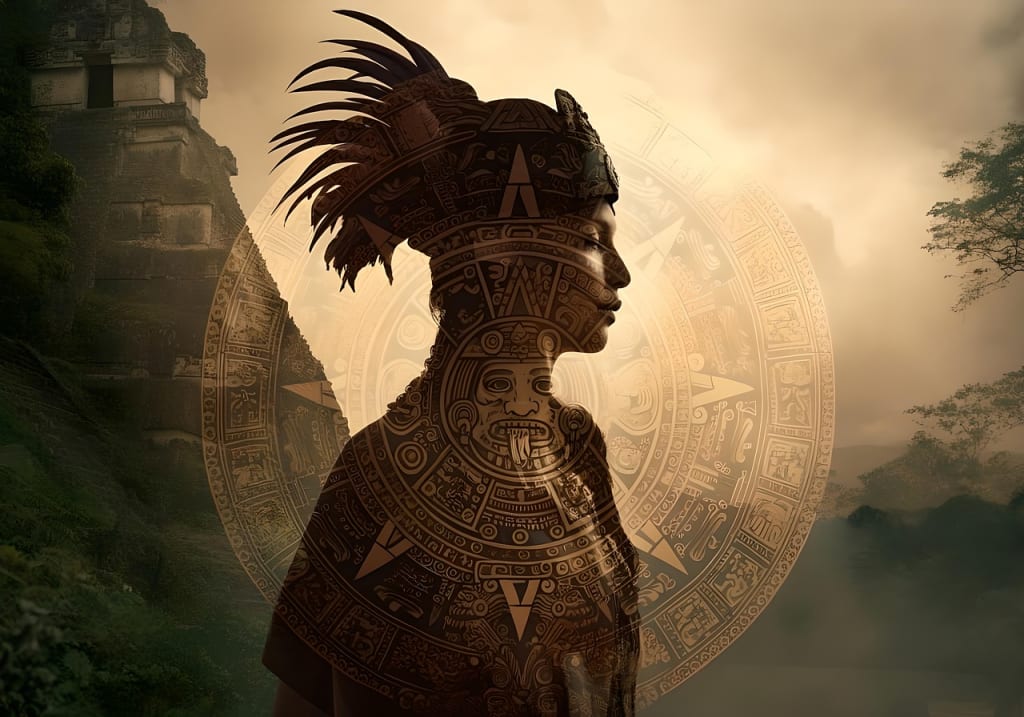
High in the forgotten deserts of southern Peru, under skies that flicker with starlight and silence, there are ruins few speak of, and fewer understand. Pyramids, buried beneath centuries of dust, stand in defiance of time, their purpose unclear, their builders unnamed. Nearby, a doorway carved into the rock waits in eternal stillness. They call it the Puerta de Hayu Marca, the Gate of the Gods. Yet, amid such ancient wonder, one question echoes across the sand and stone:
Where is the record?
Where are the blueprints? The scrolls? The carvings? Where are the chronicles that tell the world why these pyramids were built, by whom, and for what purpose? This is the hidden heart of Peru’s forgotten legacy, a mystic sealed in stone, whispered through myth, and guarded by shadows.
Ghosts in the Desert: The Forgotten Pyramids
When most people think of pyramids, the first to comes to mind is Egypt. Some may even recall Mesoamerica, the towering steps of Teotihuacan, and maybe the jungled secrets of Palenque. But few realize that Peru, too, is home to a vast network of pyramids, many older than even the Inca.
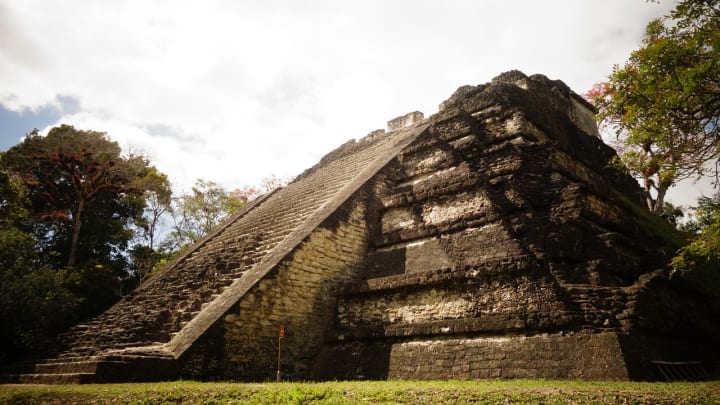
Over 250 known pyramids, some clustered, some isolated, dot the desert coast of Peru, stretching from the Lambayeque Valley to the Sechura Desert. Most lie beneath sand and silence, only visible from the air or by accident. These are not mere burial mounds or tribal huts. Some reach over 30 meters in height, built with stone blocks weighing several tons. Massive ceremonial centers once surrounded them, now little more than eroded platforms.
The most notable sites include:
Túcume: A sprawling complex of 26 pyramids, once considered the capital of the Lambayeque culture. No inscriptions explain its origin. Caral: Dated at nearly 5,000 years old, older than the pyramids of Giza. No tombs. No weapons. Just architecture, music, and mystery.
El Paraíso: A site near Lima with a 4,000-year-old pyramid, constructed with stonework that shows no sign of primitive methods. La Dama de Cao: A pyramid burial site where the tattooed mummy of a female ruler was found, ruling out assumptions of a male-dominated priesthood.
But the real mystery is not just what stands, it’s what doesn’t. No writing. No detailed murals. No stelae like those found in Egypt or Mesopotamia. No codices. No papyri. Nothing that tells us the minds behind the stone. Did time erase it? Or was it never written to begin with? Or is it from a time, long forgotten to humankind?
The Gate That Shouldn't Be There
South of Lake Titicaca, carved into a flat rock face near the small town of Hayu Marca, lies a strange structure, perfectly rectangular, symmetrical, smooth. It is called Puerta de Hayu Marca, the Gate of the Gods. And it is unlike anything else in Peru.
There are no signs of tool marks. No construction debris. No nearby temples. No inscriptions. It is simply there. According to legend, the site is sacred. Locals tell of shamans who vanish through it. Lights that dance nearby at night. Some say it’s a portal, an ancient doorway to the realm of the gods. Others claim it was used by star beings, ancient visitors not of this world.
One tale speaks of an Incan priest fleeing the Spanish conquest. He carried with him a golden disk, the Key of the Gods of the Seven Rays. At Hayu Marca, he placed the disk into a recess in the rock. The doorway opened. He stepped through. And was never seen again. Even today, travelers speak of strange energy when standing before the Gate. A pressure in the air. A pulse in the rock. Some hear faint hums. Others feel watched.
And yet again, the silence is deafening. There is no official record of who carved it. No documents. No plans. No writings. How can this be?
Where Are the Records?
Civilizations that build pyramids tend to leave behind libraries. Stone steles. Clay tablets. Carved walls. Scrolls. Even the Maya, despite Spanish destruction, left behind glyphs. But here, in Peru, we find something else entirely: absence.
Historians say much was lost due to the Spanish conquest. The Spanish, upon arrival, burned what they called “heretical” documents. Indigenous oral tradition was dismissed or outlawed. Sacred objects were melted. Sacred sites were mined. But this cannot explain it all. Many of these pyramids predate the Inca, and the Inca themselves had no written language in the traditional sense, only the quipu, a system of knotted cords whose code remains undeciphered. Did earlier cultures use a medium that decayed too quickly to survive? Or were their records hidden, or intentionally erased? Do the stories of their gods give us any clues?
Some researchers propose an even stranger idea: What if the pyramids and the Gate weren’t built for humans at all?
Myths, Machines, and the Memory of the Stars
Across Peru, indigenous stories speak of beings who came from the sky in glowing vessels. The Viracocha, tall, white-robed figures who taught humanity the arts of civilization, then vanished across the sea. The Amaru, serpent deities who slithered through realms. The Apus, spirit beings of the mountains.
Could these myths point to something more?
Alternative theorists suggest the pyramids of Peru weren’t ceremonial, but technological. Machines. Beacons. Engines of energy. Perhaps built not by primitive cultures, but by survivors of a lost civilization, or visitors from the stars. The layout of some pyramid complexes aligns with celestial bodies, constellations that held no agricultural relevance. Electromagnetic anomalies have been recorded near certain sites. Magnetism behaves strangely. Compass needles spin, and Equipment that fails.
As for the Gate of the Gods, some suggest it was once active, an interdimensional portal. A stargate. Not symbolic, but literal. And if such portals existed, why would those who used them leave records behind? Would we even recognize them if they did?
Modern Eyes, Ancient Echoes
Today, excavation efforts are slow. Funding is scarce. Many of Peru’s pyramids lie beneath towns, farms, or are buried in bureaucracy. The Gate of the Gods remains unguarded, a mystery in plain sight. Satellite imagery has revealed hidden structures, buried lines, geometric patterns, and possibly entire cities still underground. Drone surveys hint at corridors beneath the desert. But without political will, without public demand, they remain untouched. And still, the question lingers: Where are the documents?
Are they lost? Hidden? Or perhaps never written, instead encoded in stone, vibration, or frequency? Are we looking for ink when we should be listening for sound? Searching for paper when the message was left in light?
The Silence Speaks
The pyramids of Peru and the Gate of the Gods belong to a category of mystery that defies simple explanation. They challenge our understanding of history, architecture, and human origins. They whisper of knowledge lost or concealed. Of civilizations that may not have been entirely of this Earth. They stand not as relics of the past, but as questions. Why can't we find any records? Perhaps we were never meant to?
Perhaps the ones who built them did not write with hands, but with forces we no longer understand. Maybe the stones hold their memory. And when the silence speaks. We only need to listen more closely.
About the Creator
The Secret History Of The World
I have spent the last twenty years studying and learning about ancient history, religion, and mythology. I have a huge interest in this field and the paranormal. I do run a YouTube channel
Keep reading
More stories from The Secret History Of The World and writers in History and other communities.
Were the Ancient Gods Extraterrestrials? The Hidden Truth Behind Our Origins
There’s something magnetic about ancient history, especially when you start asking the questions no one dares to answer. I’ve always been drawn to the forbidden corners of the past, the dusty layers that mainstream historians sweep under the rug. And one theory in particular continues to rise from those layers like a buried secret refusing to stay quiet: the idea that the ancient gods were not myths, but extraterrestrials.
By The Secret History Of The WorldExclusive • 9 months ago
3 Everyday Rules That Exist Because Someone Once Did Something Very Stupid
Everywhere you go, you are surrounded by rules that feel oddly specific. Do not touch. No running. Contents hot. Do not insert body parts. These warnings aren’t theoretical. They weren’t written by pessimists or lawyers with too much free time. They exist because at some point in history, a real human being looked at a situation and thought, “This will probably be fine.”
By Enoch Sagini6 days ago in History
Reform or Replace? The Future of Global Governance
Reform or Replace? The Future of Global Governance Global governance stands at a critical crossroads. Institutions created after World War II—especially the United Nations—were designed to prevent another global catastrophe. For decades, they provided platforms for dialogue, coordination, and conflict management. But today, many people question whether these institutions still work as intended. The growing debate is no longer just about reform. It is about whether global governance should be repaired or replaced entirely.
By Wings of Time about 7 hours ago in History



Comments
There are no comments for this story
Be the first to respond and start the conversation.