
The Night Europe Slept Into War
How one assassination dragged the world into World War I

The Morning That Changed the World
On the morning of June 28, 1914, Europe woke up as it always had—busy, confident, and unaware that it was standing on the edge of disaster.
By nightfall, the world would be on an irreversible path to the bloodiest war humanity had ever seen.
What happened that day in the quiet streets of Sarajevo did not just kill a man.
It killed an era.
A Continent Built on Tension
Europe before World War I looked peaceful on the surface. Empires were powerful, economies were growing, and technology promised progress. But underneath, the continent was tightly wound with fear, rivalry, and pride.
Four forces silently pushed Europe toward war:
Militarism – Nations competed to build the largest armies and deadliest weapons.
Alliances – Countries promised to defend one another, turning small conflicts into massive ones.
Imperialism – Empires clashed over land, resources, and influence.
Nationalism – Ethnic groups dreamed of independence, while nations demanded dominance.
Europe was a powder keg.
All it needed was a spark.
The Target: Archduke Franz Ferdinand
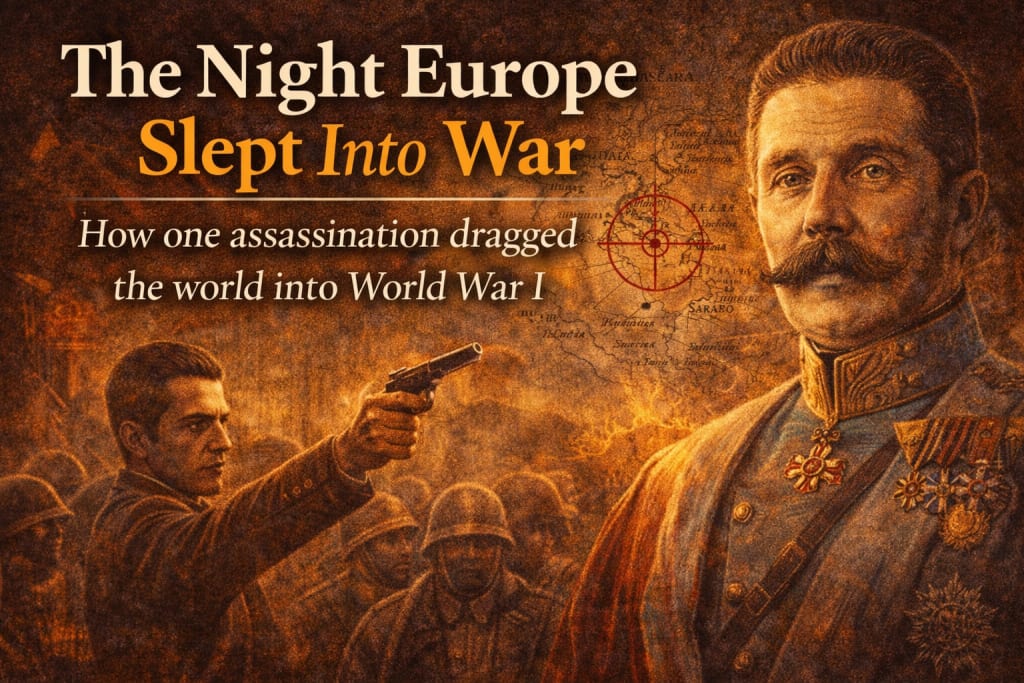
That spark arrived in the form of Archduke Franz Ferdinand, heir to the Austro-Hungarian throne.
Ironically, Franz Ferdinand was not a warmonger. He supported reforms and wanted to give more rights to ethnic minorities within the empire. But to nationalist groups in the Balkans, he represented foreign control.
His decision to visit Sarajevo—a city filled with nationalist tension—on June 28 was dangerous.
Even worse, it was symbolic.
June 28 was a sacred date for Serbian nationalists, marking a historic defeat centuries earlier. To them, the Archduke’s visit felt like an insult.
A Failed Assassination… Then Fate Intervened
A group of young conspirators waited along the Archduke’s route. They were poorly trained but deeply committed.
The first attempt failed.
A bomb was thrown—but it bounced off the Archduke’s car and exploded behind him, injuring bystanders instead. Franz Ferdinand survived and continued with his schedule.
Many would have canceled the rest of the visit.
He didn’t.
Later that day, fate made a cruel decision.
Due to a navigation mistake, the Archduke’s car stopped directly in front of Gavrilo Princip, one of the conspirators who had already given up hope.
Princip did not hesitate.
Two shots rang out.
One killed Franz Ferdinand.
The other killed his wife, Sophie.
Europe had its spark.
From Murder to Mobilization
An assassination alone does not start a world war.
Reactions do.
Austria-Hungary blamed Serbia and issued a harsh ultimatum—designed to be rejected. When Serbia accepted most but not all demands, Austria declared war.
Then the alliances activated like falling dominoes:
Russia mobilized to defend Serbia
Germany declared war on Russia
France stood by Russia
Germany invaded Belgium
Britain entered the war
Within weeks, Europe was engulfed.
What could have remained a regional conflict exploded into World War I.
Why No One Stopped It
Many leaders believed the war would be short.
They believed it would restore honor.
They believed they could control it.
They were wrong.
Once mobilization began, stopping meant weakness. And in a Europe obsessed with pride, weakness was unacceptable.
Diplomacy collapsed under ego.
The Cost of One Decision
World War I would last four brutal years.
Over 16 million dead
Entire generations wiped out
Empires collapsed: Ottoman, Austro-Hungarian, Russian, German
Borders redrawn in anger and confusion
The war didn’t end conflict—it planted the seeds for World War II.
All because one gun fired twice.
The Tragic Irony
The Archduke’s assassin was not a master strategist.
He was a teenager with a pistol.
The leaders who followed—the emperors, generals, and politicians—turned his act into a global catastrophe.
History does not always move by grand plans.
Sometimes, it moves by small moments and terrible reactions.
Why This Story Still Matters
The story of World War I is not just history.
It is a warning.
Alliances can trap nations
Pride can silence reason
Small conflicts can become global disasters
The world did not fall into war overnight.
It walked into it, step by step, convinced it was doing the right thing.
Final Thought
On June 27, 1914, Europe slept peacefully.
On June 29, it was already at war—with itself, its neighbors, and its future.
History remembers the assassination.
But it judges the choices that followed.
About the Creator
The khan
I write history the way it was lived — through conversations, choices, and moments that changed the world. Famous names, unseen stories.
Year 1892 in Review: Fun Facts, Trivia, and Historic Highlights
This quick read is a collection of fun facts, trivia, and historical events from the year 1892. Discover the year’s top news stories, most influential people, U.S. economic trends, historic firsts, entertainment news, and much more.
By Gregory DeVictor6 days ago in History


Comments
There are no comments for this story
Be the first to respond and start the conversation.