
The Letter That Changed Hitler Forever
One rejection that shaped the darkest path in history

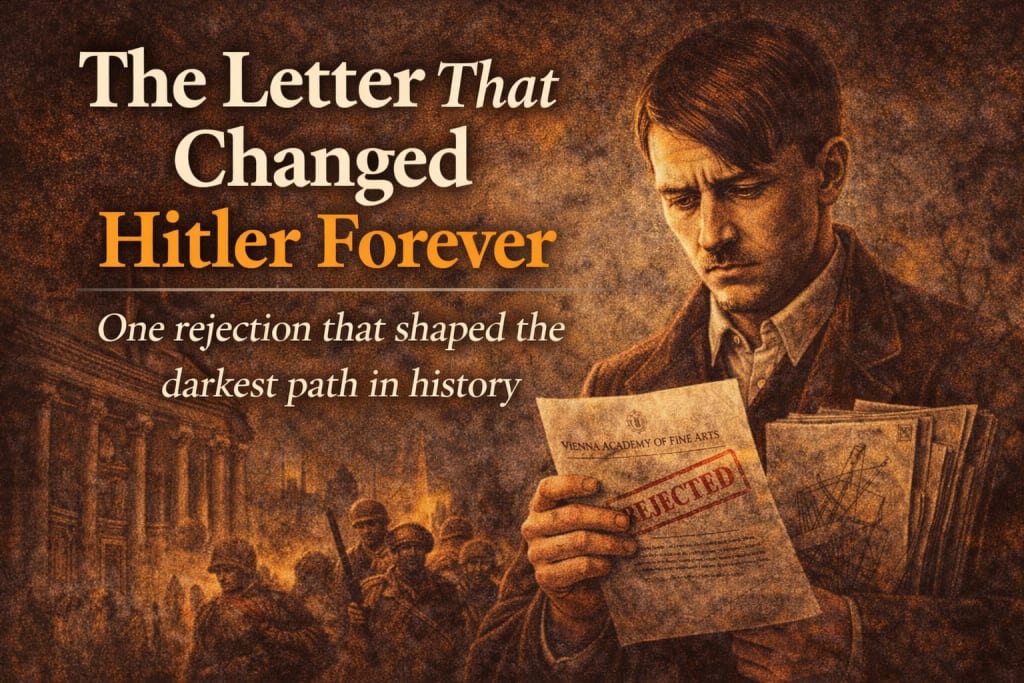
History often turns on grand events—wars, revolutions, assassinations.
But sometimes, it turns on something much quieter.
A letter.
A rejection.
A closed door.
For Adolf Hitler, that door was the Vienna Academy of Fine Arts.
And when it closed, it changed the course of the 20th century.
A Young Man With a Different Dream
Before the uniforms, before the speeches, before the destruction, Adolf Hitler dreamed of something very different.
He wanted to be an artist.
In his late teens, Hitler moved to Vienna with sketches under his arm and ambition in his heart. He believed art would give his life meaning, status, and purpose. Vienna, the cultural capital of Europe, felt like the right place to begin.
In 1907, he applied to the Vienna Academy of Fine Arts—one of the most prestigious institutions in Europe.
He was confident.
He was wrong.
The First Rejection
The academy reviewed his portfolio.
Their verdict was cold and brief.
Hitler had talent, they said—but not enough. His architectural drawings showed promise, but his human figures were weak. He was advised to study architecture instead.
The rejection crushed him.
Not just because he failed—but because it challenged his identity. Art was not a hobby for Hitler. It was the story he told himself about who he was meant to be.
Still, he tried again.
The Second Letter
In 1908, Hitler reapplied.
This time, he didn’t even make it past the first round.
Another rejection.
No encouragement.
No second chance.
No explanation that satisfied him.
This second letter didn’t just disappoint him—it hardened him.
From that moment, Hitler’s life began to unravel.
A Descent Into Isolation
Without admission to the academy, Hitler drifted.
He lived in shelters.
He sold small paintings to tourists.
He grew increasingly isolated and bitter.
Vienna was a city of diversity—Jews, Slavs, intellectuals, artists, immigrants. Instead of embracing it, Hitler blamed it. He absorbed radical ideas circulating at the margins of society, ideas that gave him something dangerous: someone else to blame.
Failure no longer belonged to him.
It belonged to the world.
The Birth of a Grievance
Rejection can do two things to a person.
It can humble them.
Or it can radicalize them.
For Hitler, it did the latter.
He began to see his personal failure as proof that society was corrupt, unfair, and controlled by enemies. His worldview narrowed. His anger sharpened. His sense of destiny twisted.
The artist who wanted recognition became a man who wanted revenge.
A War Finds Him
When World War I broke out, Hitler volunteered eagerly.
For the first time, he felt purpose.
The war gave him structure, identity, and belonging. When Germany lost, that sense of meaning vanished again—replaced by humiliation and rage.
And once more, he searched for someone to blame.
The rejected artist was gone.
In his place stood a man obsessed with restoring lost honor—his own and his nation’s.
From Personal Failure to Political Fury
It would be too simple to say that one rejection caused everything that followed.
But it would be dishonest to say it didn’t matter.
That letter was not the cause of evil—but it was a turning point. It pushed a fragile personality toward resentment instead of reflection.
Hitler later spoke of destiny, greatness, and betrayal—but rarely of Vienna. And yet, Vienna was where his sense of victimhood was born.
A Chilling Question
What if the academy had accepted him?
What if someone had mentored him, redirected him, challenged him kindly?
History offers no answers—only consequences.
Millions died not because one man failed an art exam, but because he chose hatred over humility.
Still, the origin of that choice matters.
Why This Story Still Matters
This is not a story about excusing evil.
It is a story about how bitterness grows.
About how personal failure, when mixed with ego and grievance, can become something monstrous. About how rejection, untreated, can turn inward—or outward.
Most people are rejected.
Very few turn rejection into destruction.
But every society must understand how resentment is born if it hopes to stop it.
Final Reflection
The world often looks for villains in their final form—shouting, marching, commanding.
But villains are shaped long before that.
Sometimes, it begins quietly.
With a letter.
With silence.
With a door that never opens.
About the Creator
The khan
I write history the way it was lived — through conversations, choices, and moments that changed the world. Famous names, unseen stories.
Ashoka and the Three Kings of South India: Power, Diplomacy, and Moral Conquest
Unlike his northern campaigns, Ashoka did not wage a full-scale war against these southern powers. Instead, his interaction with them reveals a unique blend of political realism, military restraint, and ideological influence.
By Say the truth 2 days ago in History
Seattle Nightlife Report: Pony
Mid-winter Friday night. Early but already so dark. The days are getting longer but 6 PM is still pitch black. “Firepit!” You declare things after just a few seconds of solemn thought – not a request or suggestion, not a demand. Last week you walked around saying, “Hot tub?” to anyone who would listen. Or one afternoon you pointed at two men holding hands as they crossed 12th Avenue, looked me in the eyes and said, “Boyfriends.”
By Joe Nasta | Seattle foodie poet6 days ago in Wander


Comments
There are no comments for this story
Be the first to respond and start the conversation.