
The Incas
The Rise and Fall of the Empire of the Sun

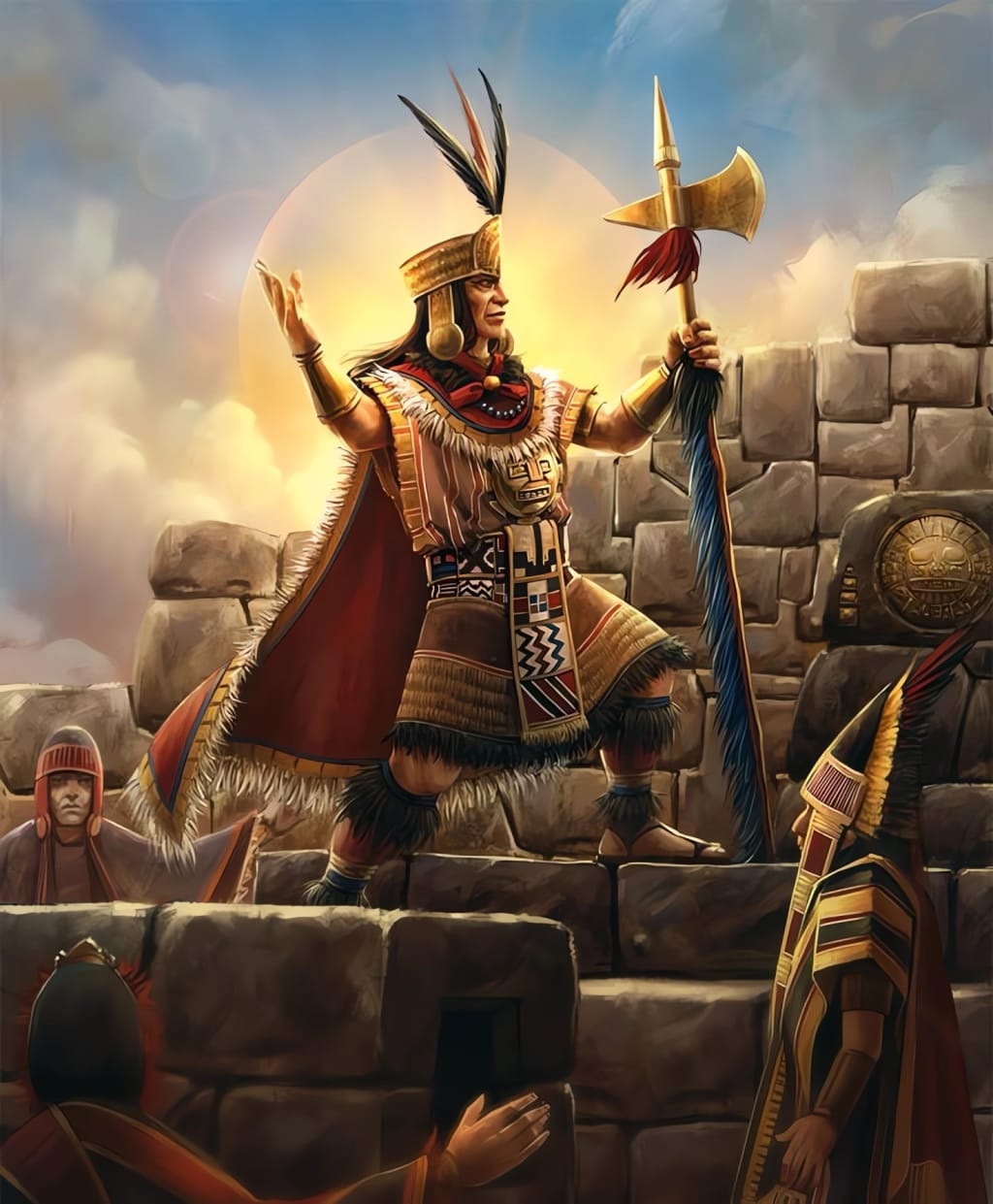
Since the beginning of civilization, people have endeavored to preserve their accomplishments, ideas, and historical narratives. Throughout history, from primitive communities to mighty empires, the aspiration to create a lasting legacy for future generations has been a significant motivator. Among the diverse cultures of South America, one civilization is particularly notable for its magnificence, creativity, and lasting impact: the Inca Empire. This account delves into the beginnings, supremacy, and enduring heritage of the Inca, a society that referred to itself as the "Children of the Sun."
The beginnings of the Inca Empire are enveloped in myth and legend, similar to many ancient civilizations. In Inca mythology, the deity Viracocha is said to have risen from the Pacific Ocean, creating the sun, the moon, and the first living creatures at Lake Titicaca. These beings were hidden within the earth, later emerging from sacred sites such as caves, springs, and rocks referred to as pacarinas. The Incas believed they were direct descendants of Inti, the sun god, and their leader, the Sapa Inca, was viewed as Inti's representative on earth.
An alternative version of their creation story describes the first Inca pair, Manco Capac and Mama Ocllo, who emerged from a sacred cave known as Tampu Toco. With the guidance of a golden staff, they established Cusco, regarded as the center of the world, after overcoming the Chanka people with the assistance of legendary stone warriors called pururaucas. Nevertheless, archaeological findings indicate that the Inca civilization began to develop around 4500 BCE, with Cusco emerging as a prominent hub by the late 10th century.
The swift expansion of the Inca Empire commenced in the early 15th century, led by Pachacuti Inca Yupanqui. Following his victory over the Chanka in 1438, Pachacuti launched a series of military campaigns that broadened Inca dominance throughout the Andes. By the time his successor, Tupac Inca Yupanqui, took over, the empire stretched over 4,000 kilometers, covering present-day Peru, Ecuador, Bolivia, Chile, Argentina, and Colombia. At its zenith, the Inca Empire, referred to as Tawantinsuyu (the Land of the Four Quarters), was the largest in the Americas and ranked among the most formidable globally.
The empire was organized into four regions—Chinchaysuyu, Antisuyu, Qullasuyu, and Kuntisuyu—each radiating from Cusco, which served as the spiritual and administrative center. The Incas constructed an elaborate network of roads, exceeding 40,000 kilometers, to link their extensive territories. These roads not only enabled the movement of armies, officials, and goods but also symbolized Inca power and governance.
The Inca Empire was a remarkably structured civilization, featuring a sophisticated administrative framework that promoted loyalty and operational effectiveness. At its helm was the Sapa Inca, an absolute monarch who resided in luxury, surrounded by treasures of gold and silver. Beneath him were the nobles, known as orejones, who occupied significant political, religious, and military positions. The governance of the empire was supported by a network of local governors and administrators, who reported to regional leaders and ultimately to the Sapa Inca.
Religion played a pivotal role in Inca society, with a diverse array of deities, prominently including Inti, the sun god, and Mama Quilla, the moon goddess. The Incas engaged in intricate rituals, such as sacrifices and offerings, to pay tribute to their gods and secure the prosperity of the empire. They also held their ancestors in high regard, mummifying their leaders and seeking their guidance on state affairs.
Inca artistry and architecture were equally impressive. The empire's stone constructions, known for their precisely cut blocks that interlock without the use of mortar, stand as a testament to their engineering skills. Notable landmarks like Machu Picchu and the Temple of Coricancha in Cusco exemplify the Inca's exceptional design capabilities and their talent for integrating structures with the surrounding environment.
Although the Inca Empire was impressive, it was not meant to endure. By the early 16th century, the empire faced significant challenges, including internal conflict, uprisings, and a catastrophic smallpox outbreak that severely weakened its structure. The death of Sapa Inca Huayna Capac in 1528 ignited a civil war between his sons, Atahualpa and Huáscar, which further destabilized the realm. Amidst this chaos, Spanish conquistadors, led by Francisco Pizarro, arrived in 1532. Taking advantage of the empire's vulnerabilities, they captured Atahualpa and, despite receiving a substantial ransom in gold and silver, executed him. By 1572, the Inca Empire had collapsed, signaling the end of one of history's most extraordinary civilizations.
Despite its brief existence, the Inca Empire has left a lasting legacy. The Quechua language, which is still spoken by millions, serves as a vibrant reminder of Inca heritage. The empire's remarkable structures, including Machu Picchu and the extensive road systems that linked their expansive lands, continue to captivate visitors. Additionally, Inca artistry, especially in textiles and metalwork, stands as a testament to their rich cultural accomplishments.
About the Creator
A História
"Hi. My name is Wellington and I'm a passion for general history. Here, I publish articles on different periods and themes in history, from prehistory to the present day.
Keep reading
More stories from A História and writers in History and other communities.
The Macro Jês
The Brazilian territory, a vast and diverse landscape, has been home to numerous indigenous groups whose cultural, linguistic, and genetic imprints continue to shape the nation's identity. Among these groups, the Macro-Jê stand out as one of the most significant and enduring indigenous families in Brazil. This article delves into the rich history, linguistic diversity, and cultural practices of the Macro-Jê, exploring their origins, societal structures, and the lasting impact they have had on Brazilian culture. By examining the intricate web of their linguistic and cultural heritage, we gain a deeper understanding of the indigenous roots that underpin modern Brazil.
By A História12 months ago in History
Alexander the Great’s Era Workshop Discovered in Peshawar
A remarkable archaeological discovery in the historic city of Peshawar has sparked excitement among historians and researchers. Archaeologists have recently uncovered the remains of an ancient workshop believed to date back to the era of Alexander the Great, the legendary Macedonian conqueror whose campaigns reshaped the ancient world. The finding offers rare insight into the economic and cultural life of the region more than two thousand years ago.
By Irshad Abbasi a day ago in History



Comments
There are no comments for this story
Be the first to respond and start the conversation.