

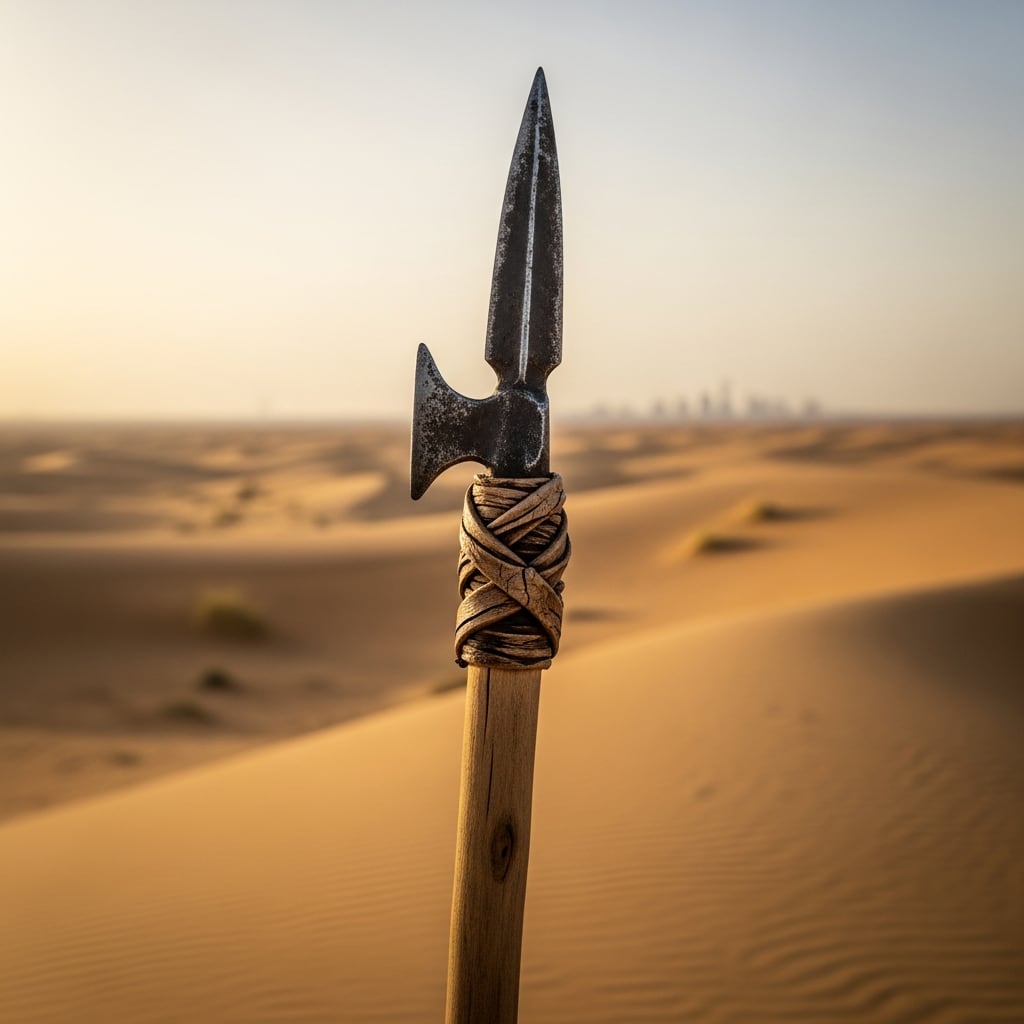
It wasn't always called Sheikh’s Spear. In the beginning, it was just a length of strong, straight wood, chosen from an acacia tree that grew alone in a dry valley. The man who found it was a young herder named Khalil. He needed something to guide his goats and lean on during long walks. He smoothed the wood with sand and stone until it felt like a part of his own arm.
Khalil’s son, Rashid, was different. He saw a tool, not just a staff. He watched the blacksmiths in the market and saved metal for months. One day, he brought home a worn but sharp spearhead—a discarded thing. He bound it to the old acacia wood with strips of wet camel leather that shrank and hardened like iron. Now the staff had a tooth. Rashid used it to protect the flock from wild dogs. The spear had found its purpose: protection.
Generations passed. The spear hung in a family dwelling, a relic. It was during a great drought that its story changed. A man named Yusuf, a thinker and a speaker, was the elder. Raiders came from the north, seeking the last well. The people were frightened, ready to fight or flee.
Yusuf took the old spear from the wall. But he did not raise it. Instead, he planted its butt firmly in the sand at the center of the well. He stood beside it, his hand resting on the shaft. “This spear does not guard the water,” he announced to both his people and the raiders. “It guards the idea of the water. It marks that this well is for the thirsty. Any who are thirsty may drink.”
The raiders were confused, then wary. Their leader approached. Yusuf did not move. The man drank, then filled his waterskin. He looked at Yusuf, at the spear standing as a silent sentinel, and then back at his own hungry men. He gave a short, sharp nod. They drank and left without violence.
From that day, Yusuf was called Sheikh Yusuf. The spear was no longer a weapon of war, but a symbol of law and wisdom. It became Sheikh’s Spear. It was passed down, not to the strongest son, but to the one with the keenest sense of justice. The spearhead was re-wrapped, the wood oiled by countless hands. It was present at weddings, its shaft touched for blessing. It was planted in the earth to mark the site of new agreements. Its point was never used to draw blood, but to draw lines in the sand that people respected.
Time wore the wood smoother. The metal aged to a dark, bluish sheen. The world modernized around it, but the spear’s meaning only grew. When a dispute erupted between two families over land, the current Sheikh would plant the spear in the contested ground and say, “Speak your truth to the spear. It has heard more lies than the wind and remains standing.” People, shamed by its silent witness, often found a compromise.
Today, it rests in a simple case of woven leather in the house of the eldest family member. It is not in a museum. It is still used. When a baby is born, the tip is carefully touched to the child’s forehead, a wish for strength and integrity. It is a living history.
So, the history of Sheikh’s Spear is not a list of battles won. It is the story of a object that evolved with the people who held it. It began as a helper, became a protector, and was finally transformed into a teacher. Its power was never in its sharp point, but in the unwavering hand of the one who held it—a hand that chose, again and again, to plant it in the sand for peace, not to throw it for war. Its true history is written in the quiet moments of courage and the collective memory of a people who learned that the strongest pillar for a community is not iron or wood, but an idea, held upright.
"It is not a weapon, but a witness. It stands for wisdom, not war. Its true point is peace, held upright by just hands for generations."
About the Creator
LegacyWords
"Words have a Legancy all their own—I'm here to capture that flow. As a writer, I explore the melody of language, weaving stories, poetry, and insights that resonate. Join me as we discover the beats of life, one word at a time.
Keep reading
More stories from LegacyWords and writers in History and other communities.
The V-Shaped Torture Device: A Dark Reminder from Europe’s Brutal Past
History is often remembered through stories of great empires, heroic leaders, and remarkable achievements. Yet behind many of these achievements lies a darker reality—one filled with cruelty, punishment, and suffering. Across medieval Europe, various instruments of torture were created not only to punish criminals but also to intimidate societies and maintain control. One such device was the infamous V-shaped torture bench, a chilling reminder of how brutal justice could be in the past.
By Irshad Abbasi 6 days ago in History


Comments
There are no comments for this story
Be the first to respond and start the conversation.