
The History and Origin of Kumari Kandam: Myth, Memory, and Tamil Civilization
Kumari Kandam is one of the most fascinating and debated concepts in South Asian history and mythology. Often described as a vast, ancient landmass that once existed south of present-day India, Kumari Kandam is believed in Tamil tradition to be the cradle of early Tamil civilization.

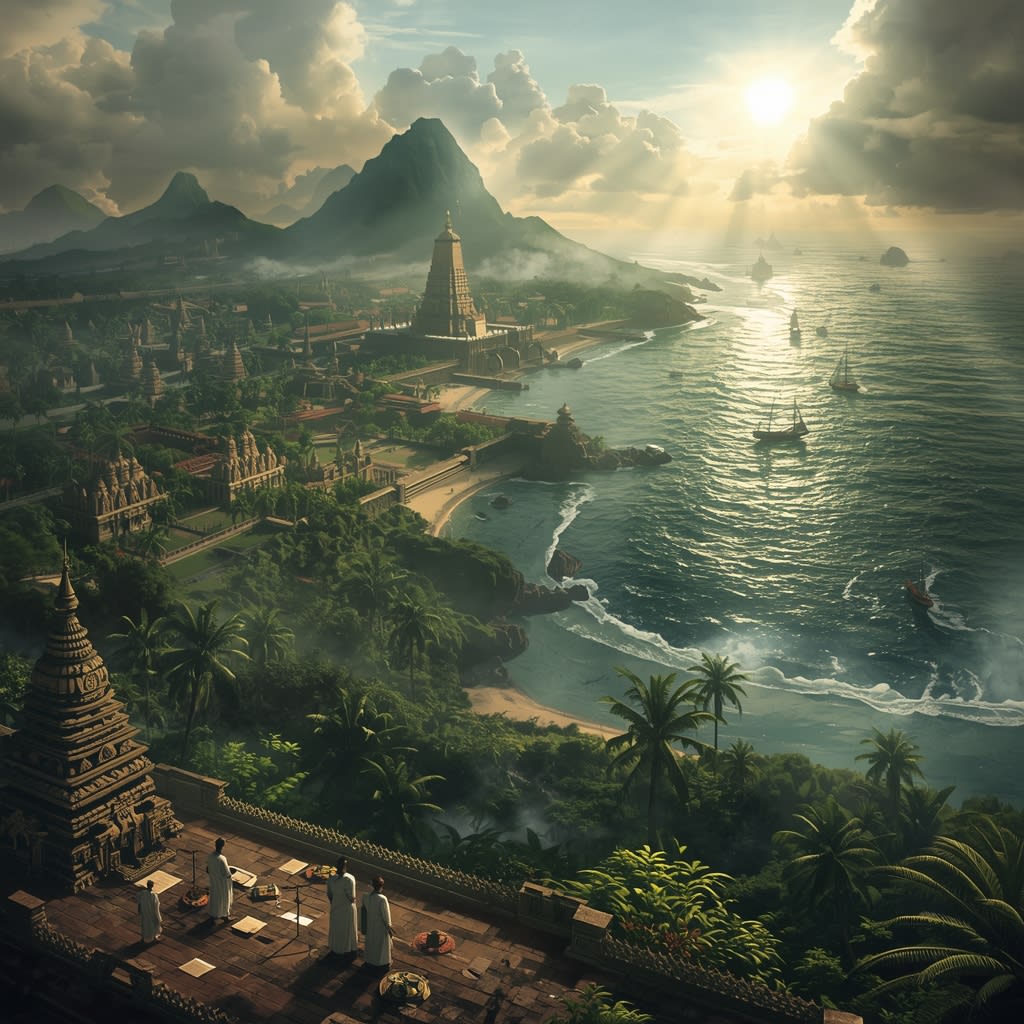
Though not confirmed by modern geology, the idea of Kumari Kandam continues to hold immense cultural, literary, and emotional significance, especially among Tamils, as a symbol of antiquity, lost knowledge, and submerged history.
Meaning and Concept of Kumari Kandam
The term “Kumari Kandam” comes from Tamil literature. “Kumari” refers to a virgin or maiden, often associated with purity, while “Kandam” means land or continent. Together, the name implies a sacred or pristine land.
Kumari Kandam is believed to have existed south of the Indian peninsula, extending into what is now the Indian Ocean. According to tradition, this land was home to an advanced Tamil civilization that flourished long before recorded history.
References in Ancient Tamil Literature
The earliest references to Kumari Kandam are found in ancient Tamil Sangam literature, dating roughly between 300 BCE and 300 CE, though they describe events from much earlier periods.
Texts such as:
Silappatikaram
Manimekalai
Iraiyanar Akapporul
mention a great southern land that was swallowed by the sea due to catastrophic floods. These texts describe the loss of entire regions, cities, and even kingdoms.
Tamil literary tradition speaks of three Sangam periods, or assemblies of poets:
The First Sangam, said to have lasted thousands of years, was located in a city that later submerged.
The Second Sangam also ended due to flooding.
The Third Sangam, held in Madurai, is the earliest historically verifiable one.
These accounts strongly associate Kumari Kandam with the first two Sangam periods.
The Great Flood and Submergence
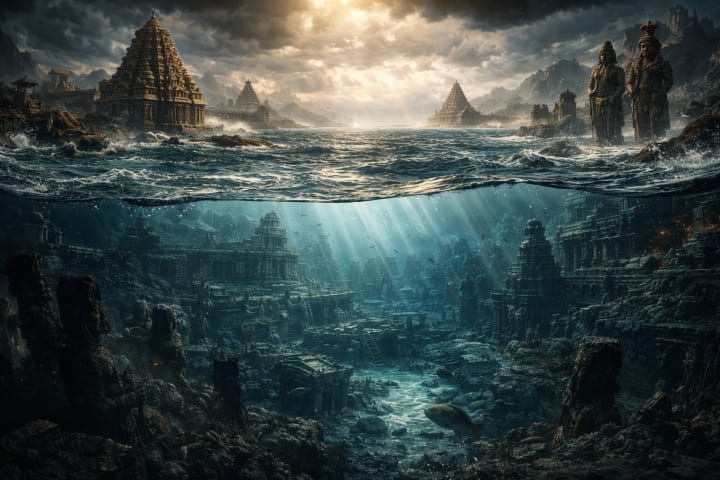
Central to the story of Kumari Kandam is the idea of a great deluge or sea-level rise. According to tradition, repeated floods gradually submerged large portions of the land, forcing people to migrate northward.
These floods are often linked to:
Climatic changes after the last Ice Age
Rising sea levels
Tectonic activity
While Tamil texts describe this event poetically and symbolically, similar flood myths exist worldwide, such as the Mesopotamian flood, Noah’s Ark, and legends from Southeast Asia—suggesting that collective human memory preserved real ancient environmental changes.
Kumari Kandam and Lemuria
In the 19th century, European scientists proposed a hypothetical continent called Lemuria to explain similarities between fossils found in India, Madagascar, and Africa. Tamil scholars later connected Lemuria with Kumari Kandam.
Though Lemuria was later rejected by modern plate tectonics, the association strengthened belief in Kumari Kandam as a real landmass. For many, Kumari Kandam became the Tamil name for Lemuria, blending scientific speculation with cultural memory.
Civilization and Culture of Kumari Kandam
According to tradition, Kumari Kandam was a highly advanced civilization. It is believed to have had:
Well-organized kingdoms
Advanced agriculture
Deep knowledge of astronomy
Highly developed Tamil language
Ethical and social systems based on justice and virtue
Some narratives claim that Tamil is the world’s oldest living language, originating in Kumari Kandam and spreading to other civilizations through migration.
Migration and Spread of Civilization
As the land submerged, people are believed to have migrated to:
Present-day Tamil Nadu
Sri Lanka
Southeast Asia
Parts of Africa and Australia (according to some speculative theories)
These migrations are thought to have influenced languages, cultures, and traditions across regions. While mainstream historians consider these ideas symbolic or exaggerated, they highlight the deep pride associated with Tamil antiquity.
Archaeological and Geological Perspectives
Modern geology does not support the existence of a large sunken continent like Kumari Kandam. Plate tectonics explains continental movement without requiring such landmasses.
However, underwater archaeological discoveries near:
Poompuhar
Gulf of Mannar
Dwarka (west coast)
show that ancient coastal cities were submerged due to rising sea levels, especially after the Ice Age. These findings suggest that while Kumari Kandam as a massive continent may be mythical, partial submergence of ancient Tamil regions is plausible.
Cultural and Political Significance
In the 20th century, Kumari Kandam gained renewed importance during the Tamil cultural renaissance. It became a symbol of:
Ancient Tamil identity
Resistance to cultural marginalization
Pride in linguistic heritage
Rather than being viewed purely as literal history, Kumari Kandam came to represent collective memory and lost greatness.
Myth or Memory?
Scholars today generally agree that:
Kumari Kandam is not a scientifically proven continent
It is deeply rooted in literature, mythology, and cultural memory
It may reflect real events such as coastal submergence and migration
Thus, Kumari Kandam exists in a space between myth and history, where symbolic truth may be as powerful as factual proof.
Conclusion
The history of Kumari Kandam is not just about a lost land—it is about identity, memory, and humanity’s relationship with nature. Whether viewed as myth, metaphor, or partially historical reality, Kumari Kandam continues to inspire curiosity and pride. It reminds us that civilizations rise, flourish, and sometimes disappear beneath the waves, leaving behind stories that endure longer than stone.
In that sense, Kumari Kandam is not lost—it lives on in language, literature, and cultural consciousness.
About the Creator
Say the truth
"Say the Truth: Explain Everything in the World" is your trusted source for uncovering facts and exploring the wonders of history, science, technology, and beyond. We simplify complex ideas and reveal truths to inspire curiosity .
Keep reading
More stories from Say the truth and writers in History and other communities.
The Qin Empire: The Power That United the Chinese Nation
China Before Unification For centuries, China was divided into competing kingdoms, particularly during the Spring and Autumn Period and the Warring States Period. Powerful states such as Qin, Chu, Zhao, Wei, Han, Yan, and Qi fought relentlessly for territory and survival. Warfare was brutal, alliances were unstable, and millions suffered.
By Say the truth about 21 hours ago in History
The Deeds of Mullah Nasiruddin
The Deeds of Mullah Nasiruddin (Article No. 1270) Mullah Nasiruddin is a name that almost everyone has heard. His stories are famous across cultures for their humor, wisdom, and clever twists. Although he appeared simple and playful, Mullah Nasiruddin possessed sharp intelligence and deep insight. His actions often carried hidden lessons that made people laugh first and think later. The following incidents from his life highlight his wit, presence of mind, and moral intelligence.
By Sudais Zakwan5 days ago in History
3 Small Lies That Grew Into Massive Disasters
Big disasters don’t always start with big lies. Those are too obvious and too suspicious. The truly dangerous ones begin small, harmless even. The kind of lie you tell to save face, avoid paperwork, or postpone an awkward conversation. The kind that feels temporary.
By Enoch Sagini5 days ago in History
Affection and Healing for Yourself
During the night of the last quarter moon, I gathered my ritual supplies. I carefully handled the chunk of black tourmaline that would protect me from your overall negative and narcissistic energy. I carefully walked the house with my stick of selenite in hand, asking the universe to cleanse our working space.
By Alisha Wilkins ✒️🦋🖋️7 days ago in Fiction


Comments
There are no comments for this story
Be the first to respond and start the conversation.