
The Giants of North America, Bones, Headlines, and a Century of Silence
Old newspapers spoke of outsized skeletons in ancient mounds, museum letters hinted at unusual finds, and the record went quiet, leaving us to ponder what really happened.
Behind The Scenes
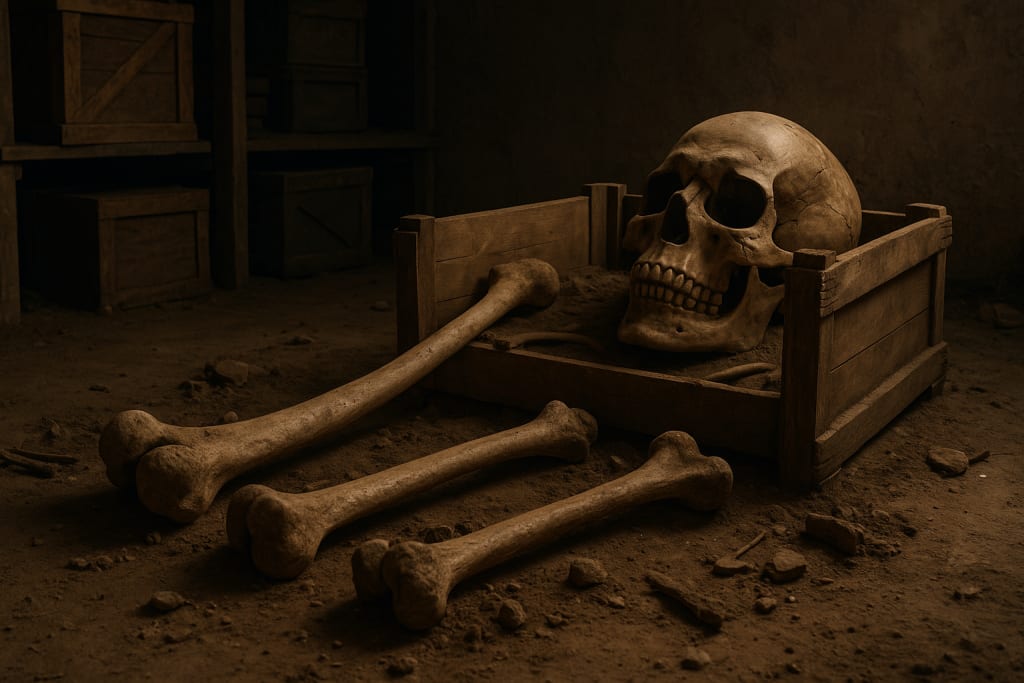
The story begins in quiet places, fields along river bends, hills that rise gently over the Midwest, burial mounds shaped by hands far older than the United States itself. In the late nineteenth and early twentieth centuries, farmers cut into those mounds, road crews leveled them for progress, and local papers reported discoveries that should have changed the way we tell history. They described skeletons of unusual size, skulls with features that did not match the average measurements of the day, long bones that drew crowds and curiosity in county seats from Ohio to Wisconsin. Reporters wrote in brisk, matter-of-fact tones, as if describing a sports score or a harvest tally. Then, almost as quickly, the words faded from view, leaving behind a mystery.
Across America's early press, the pattern repeats so often it starts to feel like a trail, a trail of systematic discovery and disappearance. A crew opens a mound, a set of remains appears larger than expected, a doctor or sheriff is called to make a statement, the bones are boxed and handed to a museum representative, and the file closes. The names change, the counties change, the measurements vary, the destination is often the same, a city museum, a university cabinet, sometimes a Smithsonian field agent passing through on a timetable that never aligned with local curiosity. The public, satisfied by an official visit, moved on, and the bones moved with them.
Skeptics point out, correctly, that nineteenth century newspapers were not peer reviewed journals. Reporters inflated numbers, copy editors trimmed context, and editors loved a headline that sold papers. Independent scientists rarely verified measurements; some reports were reprints of reprints, and a few were outright hoaxes. All of that is true, and yet, even after you subtract the noise, the residue of consistent detail remains. The physical scale described was not always fantastic; it was often simply larger than the norm, a fact that cannot be overlooked. The mounds were real, the artifacts were real, the collections existed, and some of those collections can no longer be traced with any clarity.
Native traditions add a deeper layer to this story. Long before settlers read headlines, elders told of ancient peoples of great stature, strong and skilled, sometimes noble, sometimes violent, always woven into origin stories of rivers and hills. These are not the tall tales of carnival barkers; they are memories carried through generations, histories that demand respect. When the early mound excavations began, those stories met shovels and notebooks, and for a brief moment, oral memory and printed record stood in the same field. Then institutions took the boxes away, and the conversation thinned.
The Smithsonian appears so often in these accounts that it has become a character in the legend. Field agents traveled extensively, gathering artifacts, cataloging them, and shipping them to Washington or affiliate museums. That is a matter of record. The controversy is not whether the Smithsonian collected; the controversy is whether unusual remains, if they existed, were quietly reclassified, misplaced, or destroyed during curation policies that favored standardized collections. Curators counter that no deliberate suppression occurred, that oversized claims were journalistic exaggerations, that fragmentary remains without clear provenance were discarded according to procedure, and that the institution's mandate is to preserve, not to erase. Both positions have been repeated for decades, and yet the same practical question remains: where did all the bones go?
Archaeology matured during the twentieth century, and its standards improved. Professional excavation replaced hasty digs, context took precedence over spectacle, and the focus shifted from size to culture. The mound builders were recognized as sophisticated Native societies with complex trade networks, astronomy, and artistry. That recognition is a triumph; it corrected a long-standing injustice. But in the process, the more uncomfortable claims, the outlier skeletons that puzzled local physicians, were treated as noise from a less careful era. The file went to the bottom drawer, not because of a conspiracy, perhaps, but because of a preference for clean patterns and tidy narratives.
There is another layer worth considering, the Victorian obsession with measurement. The nineteenth century cataloged skulls, ranked features, and built theories that we now reject. In that environment, any unusual skeleton became a curiosity, and newspapers amplified it. Some of those bodies may have belonged to individuals with acromegaly or other conditions that cause significant height growth. Some measurements likely included artifacts like headdresses or cradleboard flattening that distorted the count. Those explanations are real, and they can account for a portion of the record. They do not erase the volume of independent reports over a vast geography that all move in the same direction, larger than expected, noted by officials, boxed, transferred, and gone.
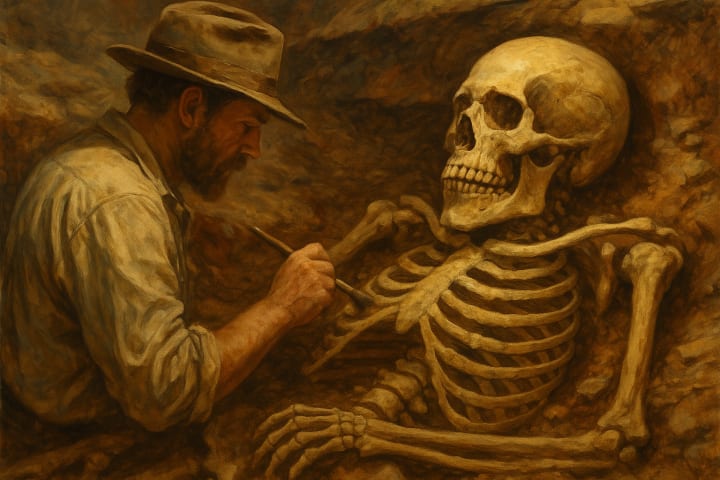
When you travel to the places where the mounds once stood, you do not find carnival banners; you find quiet neighborhoods, gas stations, farm roads, and schoolyards. The earth holds its own memory, even when its surface has been flattened. Local museums keep drawers of points, shells, and pipes carved with incredible skill. Volunteers can tell you who found them, trace the families, and point to a corner where someone once dug too deep and found a femur that did not look like the others. These are not stories told to frighten; they are simple accounts, shared without drama, the way people pass along facts that mattered to their grandparents.
So what are we left with? First, a strong possibility that nineteenth and early twentieth-century America encountered more physical variation among ancient remains than later textbooks admit. Second, a record of collection practices that centralized artifacts and bones in a handful of powerful institutions, which did not always maintain perfect public inventories of what was received, studied, reburied, or discarded. Third, a living body of Native memory that speaks of ancient peoples of unusual size and strength. None of this proves a race of giants; it does prove that the official story prefers tidy lines, and history is rarely neat.
For readers seeking a smoking gun, a warehouse shelf with a labeled crate, the hunt will likely be frustrating. Human remains are now protected by laws that return ancestors to their nations, as they should be. Records from a century ago are patchy, interns typed labels on onion skin paper, curators retired, and card catalogs moved to hard drives. What we can do is read the old documents with a careful eye, sift out the obvious satire, note the sober reports that cite names and dates, cross-check the museum logs when available, and keep building a map of what was found, where it went, and why it mattered to the people who saw it with their own eyes.
There is a reason this story refuses to fade. It touches the mystery of who built the mounds, how old some layers might be, how widespread the cultures were, and whether our ancestors lived alongside others who did not fit the averages we expect. It asks whether institutions, through caution or policy, have narrowed the range of what we are allowed to consider. It invites respect for Native histories that carry details modern ears often miss. And it reminds us that history is not a static book on a shelf; it is a living conversation between the ground and the people who listen.
If a transparent, well-documented discovery surfaces one day, complete with burial context, photographs, measurements, and a transparent chain of custody, the debate will change overnight. Until then, the trail is made of clippings, letters, museum tags, and the steady voice of local memory. That is enough to keep the question alive, not as a circus, but as a serious line of inquiry. The past does not owe us dramatic spectacle; it asks for patience and courage, and for the humility to admit when a comfortable story needs to be opened up and told again.
So I will ask you. If a set of bones challenged the narrative, would our institutions carry that truth into the light, or would they file it away to protect the story they have already chosen to tell?
About the Creator
The Secret History Of The World
I have spent the last twenty years studying and learning about ancient history, religion, and mythology. I have a huge interest in this field and the paranormal. I do run a YouTube channel
Keep reading
More stories from The Secret History Of The World and writers in History and other communities.
Volume 7: After the Sky Opens: Life in the First Days of Disclosure
Life in the First Days of Disclosure The moment humanity has waited for will not arrive with fanfare or fireworks. It will come with silence broken by a collective gasp, a shockwave of realization that spreads not from governments or generals, but from the people who look to the sky and understand that everything has changed. Disclosure will not be the end of a mystery; it will be the beginning of a reckoning. And what follows in the days, weeks, and months after will test the very soul of humanity.
By The Secret History Of The WorldExclusive • 5 months ago
Alexander the Great: Conqueror of Empires
Alexander was born in 356 BCE in the ancient kingdom of Macedon, a rugged land of warriors and kings. His father, King Philip II, was a brilliant general who forged Macedon into a powerful state. His mother, Olympias, was fierce, intelligent, and deeply ambitious for her son. From the beginning, Alexander’s life was wrapped in stories of destiny. Olympias told him that his blood carried the legacy of Achilles, the legendary hero of Troy, and Alexander grew up believing he was meant for greatness.
By The best writer 4 days ago in History


Comments
There are no comments for this story
Be the first to respond and start the conversation.