
The Forgotten Fields: Part III – Basketball
A nostalgic look back at the teams, towns, and games that time almost forgot.

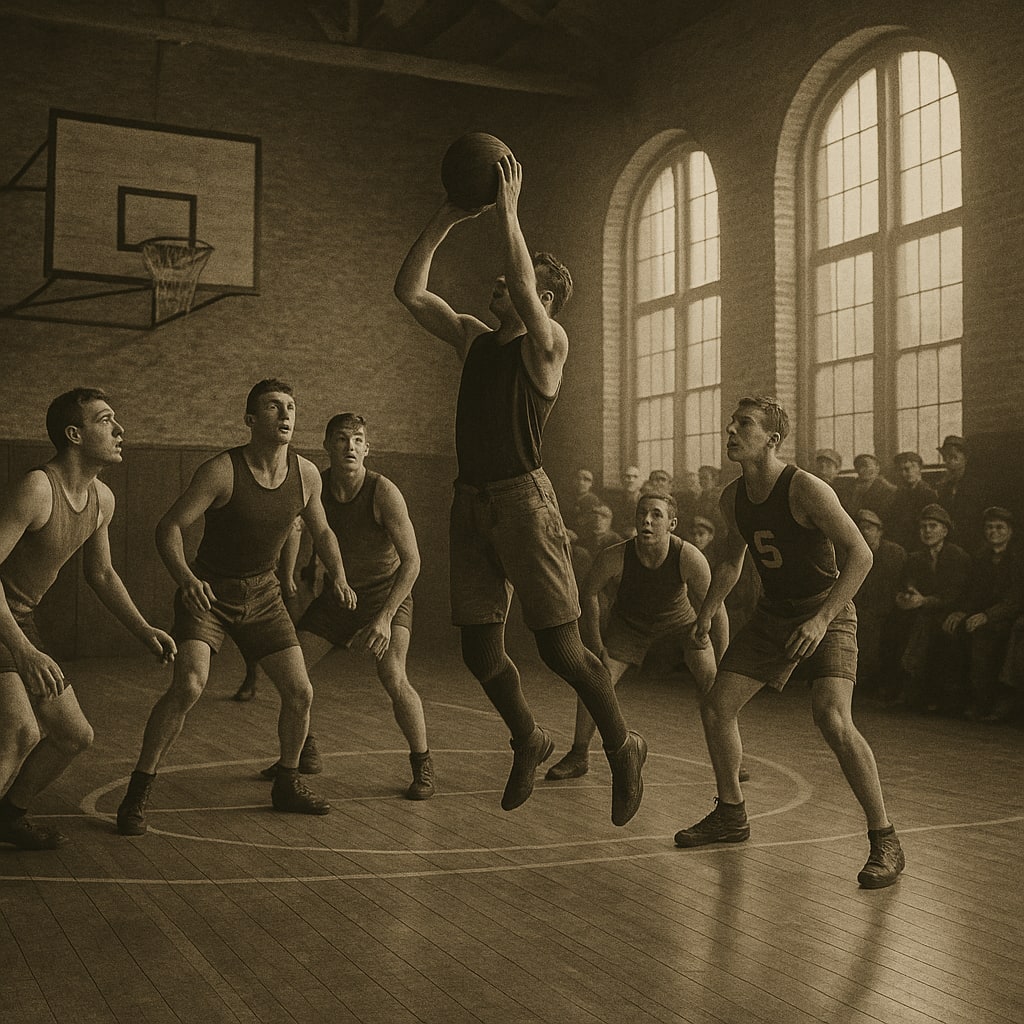
The first thing you remember isn’t the scoreboard. It’s the sound...
That single, clean smack of a leather ball against old hardwood. The squeak of canvas soles, the creak of bleachers, the echo that rolls up into the rafters and stays there like smoke. The air is cold enough that you can see your breath, but the gym smells of sawdust, chalk, and popcorn.
There’s a crowd of maybe a hundred; bundled in coats, hats in their laps, some with thermoses of coffee, some with flasks of something stronger. A few kids hang from the rails at half-court, legs swinging. Above them, a bare bulb hums and flickers like it’s trying to keep up with the game.
This is basketball before it had a spotlight. This is where the game was born.
I. A Game with No Name
In the winter of 1891, a Canadian gym teacher named James Naismith was trying to keep his restless students from freezing to death in a Massachusetts December. He nailed two peach baskets to the balcony of a Springfield YMCA gym and handed out a soccer ball.
No dribbling. No dunking. If someone made a shot, they climbed a ladder to get the ball out. Twelve rules. Thirteen players. One idea.
What he didn’t know, what no one knew, was that he had just lit a fuse that would burn through every small town in America.
Basketball didn’t require a field, or much space at all. You didn’t need expensive gear. You just needed a ball, a wall, and a hoop.
It was born humble. And it stayed that way for a long, long time.
II. The YMCA Web
By the early 1900s, the YMCA was the beating heart of the game.
Gyms sprang up in towns across the Midwest and Northeast. Indiana, Illinois, Kansas, Iowa, etc. In winter, when baseball was frozen out and football was done bruising bones, people huddled into small wooden gyms to watch local kids turn into legends.
The bleachers groaned under the weight of factory workers and farmers. Church choirs doubled as halftime entertainment. The best player in town might also be the milkman, the barber, or the guy who fixed your fence.
Basketball was accessible. It belonged to everyone.
III. Barnstormers and Bus Rides
When the snow fell hard and the local gym filled to bursting, something else happened: the barnstormers came to town.
The 1920s and 30s were the golden age of traveling basketball troupes. Teams that crisscrossed the country in buses and jalopies, playing five, six, sometimes seven nights a week.
• The Original Celtics (no, not Boston) - a crew of roughnecks from New York who became the most feared and respected basketball team of their era. Their defense was suffocating, their offense smooth as a river stone.
• The Harlem Renaissance, or the Rens, an all-Black team from New York City that redefined speed, strategy, and showmanship. They played in church basements, armories, and YMCA halls, often against hostile crowds… and they won.
Fans called them “barnstormers,” but what they really were was basketball’s heartbeat on the move.
IV. Towns Turn to Temples
There’s a reason people still call Indiana “basketball country.”
By the 1930s, small towns had turned their gyms into temples. Friday nights were holy. The clack of a bouncing ball was as familiar as a church bell.
When the local team won, the whole town cheered. When they lost, it lingered like winter itself. Every team had a story, every gym a name that lived longer than the people who built it.
And the players weren’t celebrities, they were neighbors. The farm boy with a jumper that never missed. The coach who also taught algebra. The girl who played pick-up in her brother’s shoes and sank every free throw.
These were the roots of basketball. Not NBA lights, but flickering bulbs in a gym with drafty doors.
V. The Women Who Ran the Court
Long before the WNBA, long before television ever caught a layup, women were carving out their own hardwood history.
The All-American Red Heads, a barnstorming women’s team formed in 1936, wore lipstick, curls, and bright red hair... but they played hardball. They traveled the country in buses, taking on men’s teams, humiliating most of them, and packing gyms wherever they went.
They blurred the line between novelty and greatness, and for a generation, they owned the winter roads.
VI. Forgotten Giants of the Hardwood
The beauty of basketball’s early years is in its impermanence. Teams came and went like winter snow. But some left footprints deep enough to remember:
🏀 The Harlem Rens - Black excellence in a segregated era, compiling win streaks that seemed mythic.
🏀 The Original Celtics - Defensive masters, paving the way for modern tactics.
🏀 The Sheboygan Red Skins and Anderson Packers - small-market pioneers who made up the backbone of early pro leagues.
🏀 The local Y teams with names no one remembers anymore… except the people who were there.
Their arenas were church basements, school gyms, and roller rinks. Their trophies? A handshake, a meal, maybe a place to sleep before the next town. They didn’t chase contracts. They chased the game.
VII. The First Leagues
When the Basketball Association of America (BAA) and the National Basketball League (NBL) merged in 1949, the NBA was born. But the soil it grew from was local.
Dozens of small-market teams vanished in the transition. They couldn’t compete with New York, Boston, and Minneapolis. Their names faded from headlines, their gyms were boarded up or turned into storage.
But they left their fingerprints all over the game:
- The style of play.
- The sense of community.
- The idea that basketball wasn’t something you watched, it was something you lived and breathed.
VIII. Friday Night Faith
For decades, in towns from Indiana to Iowa to Kansas, basketball wasn’t a sport. It was a season.
Snow would pile against the gym doors while the heater rattled overhead. People crammed shoulder to shoulder, breathing the same cold air, waiting for tipoff.
The wooden floorboards popped with every step. The backboards were square, the rims rattled, and if a player hit a bank shot, you could swear it echoed for a mile.
It didn’t matter if the team was the Rens or a handful of farm kids. When that ball was in play, the world outside didn’t exist.
“Baseball belonged to the summer. Football belonged to the brave. But basketball? Basketball belonged to all of us.”
IX. Echoes in the Rafters
The world moved on. The NBA grew teeth, lights, and billion-dollar arenas.
But in gyms across the country, the rafters still remember. Walk into an old school gym in Indiana on a winter night and you’ll hear it: the bounce. The squeak. The collective inhale before the shot. The game might have grown up, but it never left home.
X. Closing Reflection
Basketball wasn’t born in stadiums. It was born in places like yours... towns with nothing but a hoop, a wall, and a dream.
The Harlem Rens, the Original Celtics, the Sheboygan Red Skins, the nameless Y teams that no one wrote down… they gave us more than a sport. They gave us echoes.
Echoes that live in rafters and floorboards. Echoes in the hands of every kid who shoots under a single flickering light bulb.
“They built the game on splinters and sweat. And the echoes of their footsteps will never stop bouncing.”
About the Creator
The Iron Lighthouse
Where folklore meets freeway. A guide to the strange heart of the American backroads...
Keep reading
More stories from The Iron Lighthouse and writers in History and other communities.
The Forgotten Fields: Part II – Football
Autumn smells like football. Not the polished kind with pyrotechnics and halftime performers, the kind that lives in your bones. The kind where the air bites, the grass is slick, and your breath shows in the huddle.
By The Iron Lighthouse3 months ago in History
Power's Sake
When it comes to gaining power, bad people use it to gain more They never gain power to do something with it, they gain power to have it, relish in it, double it down on itself so it grows exponentially and never goes anywhere. Even if you see the people in power commit an atrocity, that is never the true goal. It is a deplorable action for sure but the action itself usually doesn't matter it's the outcome.
By Donny Foley2 days ago in History
Military Strength of Alexander the Great and the Chola Empire: A Historical Comparison
Though separated by more than a thousand years and operating in vastly different geographical and cultural contexts, both forces achieved extraordinary success through discipline, innovation, and strategic brilliance. This article explores the history, composition, size, organization, and military strength of Alexander’s Macedonian army and the Chola military, highlighting how each became a dominant power of its era.
By Say the truth 2 days ago in History



Comments
There are no comments for this story
Be the first to respond and start the conversation.