
The Eternal Shadow of Alexander: How His Empire Shaped the World After His Death
When Alexander the Great died in 323 BCE at the age of just 32, he left behind one of the largest empires the world had ever seen. Stretching from Greece to Egypt and across Persia to the edges of India, his empire was vast, wealthy, and culturally diverse. Yet, it was also fragile. There was no clear successor, no stable system of governance, and no long-term plan for unity. What followed his death was not the immediate collapse of his legacy—but a dramatic transformation of it. The story of what happened after Alexander is just as fascinating as his conquests, because it reveals how a single man’s ambition reshaped the ancient world for centuries.

Alexander died in Babylon under mysterious circumstances. Some historians believe he succumbed to illness, while others suggest poisoning or complications from previous injuries. Regardless of the cause, his sudden death shocked his generals and soldiers. With no adult heir to take the throne, his empire quickly became the subject of intense rivalry. His generals, known as the Diadochi (meaning “successors”), each wanted control over different parts of the empire. Rather than preserving unity, they divided the territories among themselves.
This division led to decades of conflict. The once-unified empire fractured into several powerful Hellenistic kingdoms. Ptolemy took control of Egypt, Seleucus claimed large parts of Persia and Mesopotamia, and Antigonus and later his descendants controlled regions of Greece and Asia Minor. Though they fought each other, these rulers did not completely abandon Alexander’s vision. Instead, they carried forward elements of his culture, administration, and military traditions.
One of Alexander’s most important legacies was the spread of Greek culture across the known world. This cultural blending created what historians call the Hellenistic Age. Greek language, art, philosophy, and architecture spread throughout Egypt, the Middle East, and Central Asia. Cities founded by Alexander—many named Alexandria—became centers of trade and learning. The most famous of these, Alexandria in Egypt, became home to one of the greatest libraries in ancient history and attracted scholars from across the world.
The Hellenistic kingdoms preserved Greek traditions while also incorporating local customs. In Egypt, for example, the Ptolemaic rulers adopted Egyptian religious practices and presented themselves as pharaohs, while still maintaining Greek governance and culture. This blending of cultures created new artistic styles, scientific advancements, and philosophical ideas. Greek became a common language of trade and scholarship across vast territories, enabling communication and exchange between distant regions.
Alexander’s military innovations also continued to influence warfare. His use of combined arms—infantry, cavalry, and siege engines working together—became a model for future armies. The successors maintained large standing armies and often used strategies inspired by Alexander’s campaigns. Even centuries later, Roman generals studied his battles to learn the art of conquest and leadership.
Economically, the territories once ruled by Alexander experienced increased trade and connectivity. Roads, ports, and cities established during his reign helped facilitate commerce between East and West. Goods such as spices, silk, precious metals, and artwork moved across continents. This network of trade not only increased wealth but also allowed ideas and technologies to spread more easily than before.
Despite these achievements, the political unity Alexander had created did not survive. The rivalries among his successors weakened the overall stability of the region. Over time, new powers emerged. The Roman Republic began expanding into the eastern Mediterranean, eventually conquering many of the Hellenistic kingdoms. By the first century BCE, much of Alexander’s former empire had fallen under Roman control. Yet even as Rome rose to dominance, the cultural influence of Alexander’s conquests remained strong.
Roman leaders admired Alexander deeply. Julius Caesar reportedly wept when he visited Alexander’s tomb, reflecting on how much the Macedonian king had accomplished by such a young age. Roman emperors adopted elements of Hellenistic culture, including art, architecture, and education. In many ways, Alexander’s blending of cultures prepared the ground for the later spread of Roman civilization.
Beyond politics and culture, Alexander’s story became legend. Over the centuries, tales of his adventures spread across Europe, the Middle East, and Asia. In Persian literature, he was portrayed as a wise and heroic ruler. In medieval European stories, he became a near-mythical figure who explored the edges of the world. In some traditions, he was even depicted as a philosopher-king or a seeker of divine knowledge. These stories transformed Alexander from a historical figure into a universal symbol of ambition, courage, and destiny.
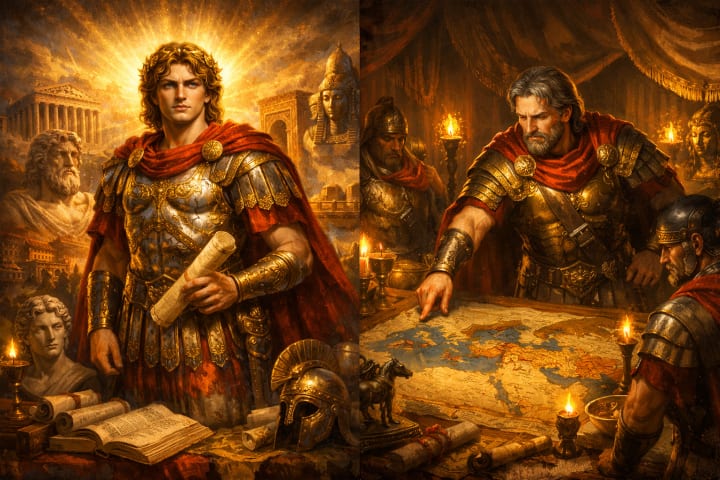
Archaeological discoveries continue to reveal new information about the world Alexander helped create. Coins, inscriptions, and ruins from Hellenistic cities provide insight into how his empire influenced daily life long after his death. Scholars study these artifacts to understand how cultures merged and evolved during this period. Each discovery reinforces the idea that Alexander’s greatest achievement was not just conquest, but connection.
Today, Alexander the Great remains one of history’s most studied and debated figures. Some view him as a brilliant strategist and visionary who united diverse cultures. Others see him as a conqueror whose campaigns caused destruction and instability. Both perspectives contain truth. His campaigns brought both innovation and conflict, progress and upheaval.
What cannot be denied is the scale of his impact. Few individuals have shaped the course of history so dramatically in such a short time. By the time of his death, he had changed the political map of the ancient world. In the centuries that followed, his legacy continued to influence empires, cultures, and ideas across continents.
Alexander’s empire did not survive in its original form, but the world he helped create endured. The Hellenistic Age became a bridge between ancient Greek civilization and the rise of Rome. The blending of cultures he initiated set the stage for future global exchanges. His legend inspired leaders, artists, and storytellers for generations.
In the end, Alexander’s true net worth cannot be measured in gold or territory. It lies in the lasting transformation he brought to the ancient world. His life demonstrated the power of ambition and vision, but also the fragility of empires built on conquest. More than two thousand years after his death, the shadow of Alexander still stretches across history, reminding us that some legacies are far greater than the empires that created them.
About the Creator
Say the truth
"Say the Truth: Explain Everything in the World" is your trusted source for uncovering facts and exploring the wonders of history, science, technology, and beyond. We simplify complex ideas and reveal truths to inspire curiosity .
Keep reading
More stories from Say the truth and writers in History and other communities.
Alexander the Great – Part 9: What If Alexander Had Lived Longer?
Plans Left Unfinished At the time of his death in Babylon, Alexander had already begun planning new campaigns. Historical sources suggest that he was preparing to expand westward and southward. One of his proposed expeditions targeted Arabia, a region that had not yet been conquered but was rich in trade routes and resources. Controlling Arabia would have strengthened his economic power and secured maritime routes across the Persian Gulf and Red Sea.
By Say the truth 2 days ago in History
Diamonds Around the World: The Countries That Live and Breathe Baseball
There's something almost mystical about the crack of a bat connecting with a fastball. In certain corners of the globe, that sound carries the weight of history, identity, and dreams passed down through generations. While soccer may dominate the world's sporting consciousness, baseball has carved out its own sacred territories—places where the sport transcends mere entertainment and becomes woven into the very fabric of culture.
By Gianni Bertoni5 days ago in History
Rachel Reviews: Lunch Tales: Teagan by Lucille Guarino
Well, I did enjoy this! Sometimes, all you need is just great storytelling and this is what Lucille Guarino delivers here. There's no big message to this book; it's just about folks and families, living their lives and coping with everything that's being thrown at them and finding their way. But when it's done well, like it is here, then you have characters to whom you can relate, tension which leaves you rooting for a better outcome, attraction which has your heart racing and an urge, as a reader, to see the characters happy with the people with whom they belong.
By Rachel Deeming4 days ago in BookClub



Comments
There are no comments for this story
Be the first to respond and start the conversation.