
“Beauty at low temperatures is beauty.”
— Joseph Brodsky
For the first time, I heard the name of this city in a popular song in Russia at the dawn of the 1990s.
“Venice, Venice, you come to me in dreams, Venice!” the singer repeated in the chorus. She was one of those girls with no remarkable vocal talent, but endowed with great charisma and expressiveness.
“With wings spread upon his back / An angel rises above you, Venice, Venice.”
Several decades later, that simple melody still sends shivers down my spine: proof that childhood impressions are the strongest and follow us throughout our lives.
“Where is Venice?” I asked my mother.
“In Italy.”
Italy… a distant country shaped like a high-heeled boot, separated from mine by the Iron Curtain that had just collapsed.
Soon afterward, late at night, I was watching television with my older brother. A palazzo by a canal, bathed in the ochre-beige glow of streetlamps, suddenly appeared on the screen. Through the reddish doorway of the palazzo, the silhouette of a man emerged. He stepped into a small boat moored nearby and glided silently along the dark waters.
“Where is that?
— In Venice.”
I have no idea what film it was. I have tried many times to find it again, but my only memory of it is so vague, fragile, almost unreal, that identifying it is impossible. After all, why search for this film? What truly matters is that, with that nocturnal image stolen by my child’s eyes, Venice was forever anchored in my heart.
Our first real encounter was somewhat disappointing… Much like the feeling of a first date with a man one has long fantasized about. The small boat that brought me to Venice from the mainland docked at the Fondamenta degli Incurabili, celebrated by Joseph Brodsky in his essay of the same name (also known as Watermark). Yet it had nothing to do with the image of a cold, dreamlike, elusive Beauty, like “Greta Garbo swimming,” as Brodsky described the city. The real Venice overflowed with tourists, vendors, and passersby, resembling more a tacky seaside resort, a vulgar loudmouthed port whore… I felt deceived, disillusioned, as though I had been lied to about Venice.
All this took place in May. As Milorad Pavić, the Serbian postmodern writer, says, every great love begins in May, and it begins, above all, with three small lies… The second lie is that the Fondamenta degli Incurabili does not actually exist: it is a toponym invented by Brodsky, corresponding to the stretch of the Zattere quays near the Ospedale degli Incurabili (the Hospital of the Incurables).
After taking a symbolic tour of the city center to “tick a box,” following a tourist guide who recounted striking stories about the city — none of which I remember, except perhaps that of Giacomo Casanova, who escaped from the Piombi prison by leaping from the Bridge of Sighs — our group found itself alone, and we decided to take a gondola.
“I dream with open eyes: I glide in a gondola / Among enchanted palaces”: the simple melody of my childhood began to resonate within me again as we ventured deeper into the city, following its winding arteries. It was then that Venice, like a stranger beckoning me into her shadowed corners, began slowly to reveal her true face. Alas, it was already too late when I realized how much I loved this city and that I no longer wanted to part from her: I was already on the edge of a boat carrying me away from her, so beautiful and mysterious, dressed in a deep-blue gown adorned with sparkling diamonds…
Now Venice haunts me, and it is in her liquid arms, in that “murky labyrinth of canals,” enveloped in “that faint stagnant smell ,” that I would like to die, like the protagonist of Thomas Mann’s Death in Venice. I care little that this idea has become a commonplace among intellectual aesthetes, and that Nabokov judged Mann’s writing asinine. In my view, Nabokov simply refused to see in Mann what was so distinctly his own: the art of weaving sentences like refined lace, provoking reflection on the nature of impossible love. All things considered, Mann, better than anyone, succeeded in rendering in words the morbid beauty and treacherous vulnerability of this ghostly city. Like a siren, the Serenissima (as we call her, in reference to her republican past) enchants and draws one toward death.
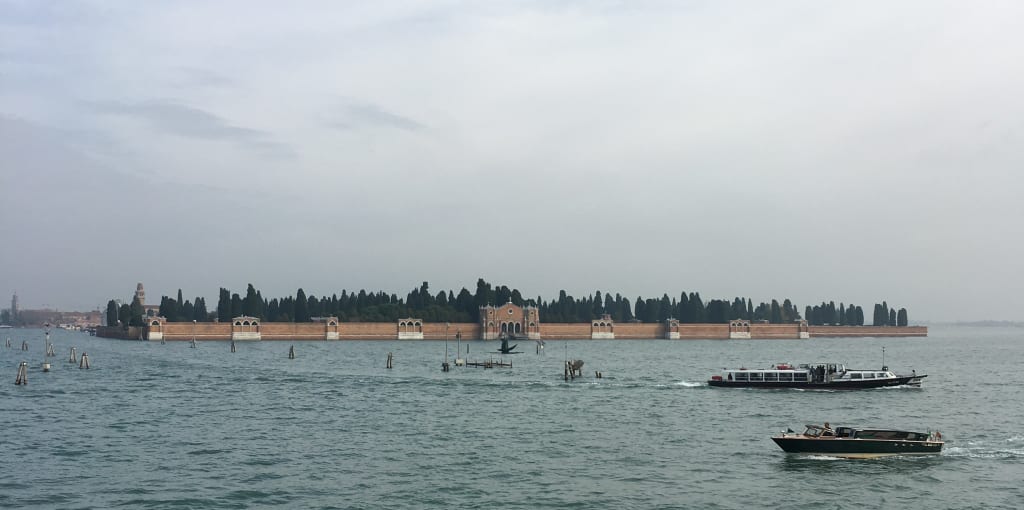
I already envision my final day. Having passed my hundredth year, I step out of my dark apartment, a mink scarf draped over my shoulders, adorned with all the gems I have gathered over a lifetime. I take a seat in a bacaro facing the island of San Michele. The smell of diesel from the nearby gas station hangs in the air. I order a glass of prosecco and watch the island of the dead disappearing into the fog. Before this sublime landscape, blurred in sfumato, my heart comes to a stop…
•
With her years of glory and true world domination behind her, today’s Venice resembles an old lady, dressed in her Sunday best, like a New Yorker captured by Lisette Model. Wrinkled and decrepit, she barely breathes and relieves herself in the chamber pot kept by her bed, yet remains attached to her material possessions and never goes out without being impeccable. To sustain her existence, she receives cultural injections in the form of biennales and film festivals. This artificial prolongation of life will continue until her last sigh, for abandoning her to her sad fate would cause too much sorrow. Despite her advanced age and incurable illness, she remains dazzling, and she has too many stories to tell…
In the 1920s, Venice welcomed Marcel Proust, offering his narrator the opportunity to mourn his lost love and regain freedom in Albertine Gone: “…I felt that the Albertine of old, invisible to myself, was nonetheless locked up deep inside me as if in the piombi of an interior Venice.”
In the 1950s, in the aftermath of the Second World War, Venice drew several English-speaking writers who made it the setting of their novels. In Ernest Hemingway’s Across the River and Into the Trees, inspired by his brief love affair with an Italian countess, the aging, retired protagonist travels to Venice to savor the final moments of his life in the company of the Venetian Renata, “shining in her youth and tall‑striding beauty and the carelessness the wind had made of her hair.” Hemingway’s image of a young, resplendent Venice contrasts to the unhealthy, fading city that Thomas Mann etched into the collective imagination.
In Just Another Sucker James Hadley Chase gives Venice a dark, labyrinthine face, turning the city into a closed space suited to pursuit and crime.
With The Venice Rat, Patricia Highsmith leads the reader into the entrails of the city through the unusual perspective of an adventurous rat. The famous Talented Mr. Ripley, a charismatic con artist, created by the grande dame of American crime fiction, also passes through Venice, going there to cover his tracks after committing his first murder in the series. A city of masks, Venice enables him to juggle identities, embrace lies, and deceive the police. His Venetian stay becomes a point of no return, opening the door to a new life.
In the early 1980s, the French writer Emmanuel Roblès, in a sense, juxtaposed all the masks that his predecessors had placed upon Venice’s elusive face. In his novel Venise en hiver (Venice in winter), written at the crossroads of genres — psychological novel, thriller, and political fiction — he portrays Venice both as a place of romantic mourning and of encounter, while unfolding a carefully constructed plot that interrogates the theme of terrorism.
From the 1980s onward, Venice became “protected, cherished, no longer sufficient to itself, but adopted by the world at large as a universal heritage,” as historian Jan Morris notes in the preface to the third edition of her poetic guide to the Serenissima.
Around that time, the French artist Sophie Calle took a job as a chambermaid in a Venetian hotel in order to infiltrate, invisibly, with the naivety of a child and the cold-blooded precision of a criminal, the intimate lives of its guests. Attentive to the smallest detail, she photographed and invented stories from the traces they left behind: cigarette butts in an ashtray, unsent postcards, notes scribbled on scraps of paper… This experience is recounted in her artist’s book The Hotel.
In the 1990s, a new era opened in Venice’s history: she was now treated like a fragile and precious museum piece. Souvenirs bearing her likeness, often made in China, flooded the kiosks. Visitors from all over the world poured in year-round. Among them were many artists, commercial agents, art dealers, and newlyweds. Meanwhile, native Venetians fled like rats leaving a sinking ship, abandoning their homes at the mercy of foreigners…
Having fallen under the spell of the Serenissima, the American Donna Leon settled there and began writing detective novels featuring Commissario Guido Brunetti, a Venetian by birth, a cultured man passionate about art and architecture: “His clothing marked him as Italian. The cadence of his speech announced that he was Venetian. His eyes were all policeman.”
At the same time, Paolo Barbaro, who had lived in Venice since childhood, invited readers on a stroll beyond the tourist circuits in his poetic almanac Lunaisons vénitiennes (Venetian Lunations). Each pair of chapters corresponds to a month of the year, tracing the city’s transformation: from frozen and dilapidated in winter to seductive and spectacular in summer. With a sincerity tinged with melancholy, Barbaro gives voice to Venice’s final sighs as she fades into the lagoon, washing away like a watercolor.
As Venice’s fame spread worldwide, the city also attracted criticism. In Against Venice, Régis Debray offers, with no pretension of courtesy, an alternative and sarcastic view of the “family jewel” nestled “at the top of the Italian boot, in the fold of the groin, an obscene and tenacious shimmer.” Declaring himself on the side of “Naples and not Venice,” he points to the city’s “lack of green spaces, open areas, and vistas of the open sea,” while noting that “the Grand Canal: the only sewer in the world that gives the onlooker the intoxication of setting sail for the Marquesas.”
In the same decade, Venice also joined the postmodern game, serving as the backdrop for Perversion by Yuri Andrukhovych, whose plot centers on the mysterious disappearance of Stanislav Perfetskyi, a young Ukrainian poet with multiple pseudonyms and identities. By mixing styles and registers, and assembling the narrative from a variety of elements — editor’s and author’s notes, newspaper articles, and Perfetskyi’s own writings — this literary mosaic invites reader interaction and embeds the image of Venice within post-Soviet literary postmodernism.
“Venice is a fish,” declares the Venetian writer Tiziano Scarpa in the opening of his eponymous book, written in 2000. “Look at it on a map. It’s like a vast sole stretched out against the deep. How did this marvelous beast make its way up the Adriatic and fetch up here, of all places?” Yet, upon dissection, the body of this ichthyoid creature corresponds perfectly to that of a human being: the author examines each part, from feet to head, dedicating a chapter to every organ. In The Heart, Scarpa recounts anecdotes from the lives of young lovers; in The Mouth, he evokes the delights to be savored in the bacari of the Rialto and teaches readers words of Venetian origin, including the famous “ghetto,” which denotes the city’s Jewish quarter.
This approach recalls the structure of Lunaisons vénitiennes, yet unlike Paolo Barbaro’s text, imbued with fin-de-siècle decadence, Scarpa’s poetic guide inspires hope for the new millennium and opens a new chapter in the destiny of the Serenissima…
•
“Venice, Venice, you come to me in dreams, Venice!” persists in my mind as I devour all these books devoted to the city, prolonging the aftertaste left by my umpteenth visit… I am still far from my hundredth year, I do not yet live there awaiting death, and our encounters are brief, limited to a few days.
I then wonder whether there are other cities in the world built on stilts. Apparently, there are a few: Kampong Ayer in Brunei, Ganvié in southern Benin, or Neft Daşları, formed from oil platforms off the coast of Baku…
All these lacustrine cities share with Venice their floating aspect, yet none can truly rival her. None can boast a history as rich as Venice’s, nor her influence on the world, once political and economic, now artistic and poetic. Forever, Venice, like a jewel case set upon a sinking ship, will remain a unique symbol of our Western civilization. As Brodsky sums up at the end of his essay: “By rubbing water, this city improves time’s looks, beautifies the future. That’s what the role of this city in the universe is.”
About the Creator
Anastasia Tsarkova
Anastasia Tsarkova is a writer born in St. Petersburg and based in France, working in both English and French. Her novels, essays, and short fiction explore the human psyche and consciousness, with a focus on art, cinema, and pop culture.
Keep reading
More stories from Anastasia Tsarkova and writers in History and other communities.
Four
… After kissing Victoire goodbye and leaving her in the middle of the night street, Romain and I enter his building and climb up to the fourth floor. Incidentally, I live on the fourth floor too. So does Victoire. As it happens, most of my friends have ended up on this floor, without meaning to. Is there something magical about this even natural number? One, two, three, four.
By Anastasia Tsarkovaa day ago in Fiction
The Eternal Shadow of Alexander: How His Empire Shaped the World After His Death
Alexander died in Babylon under mysterious circumstances. Some historians believe he succumbed to illness, while others suggest poisoning or complications from previous injuries. Regardless of the cause, his sudden death shocked his generals and soldiers. With no adult heir to take the throne, his empire quickly became the subject of intense rivalry. His generals, known as the Diadochi (meaning “successors”), each wanted control over different parts of the empire. Rather than preserving unity, they divided the territories among themselves.
By Say the truth 2 days ago in History

Comments
There are no comments for this story
Be the first to respond and start the conversation.