
The Enigmatic Origins of the Israelites
A Journey Through Myth, History, and Faith

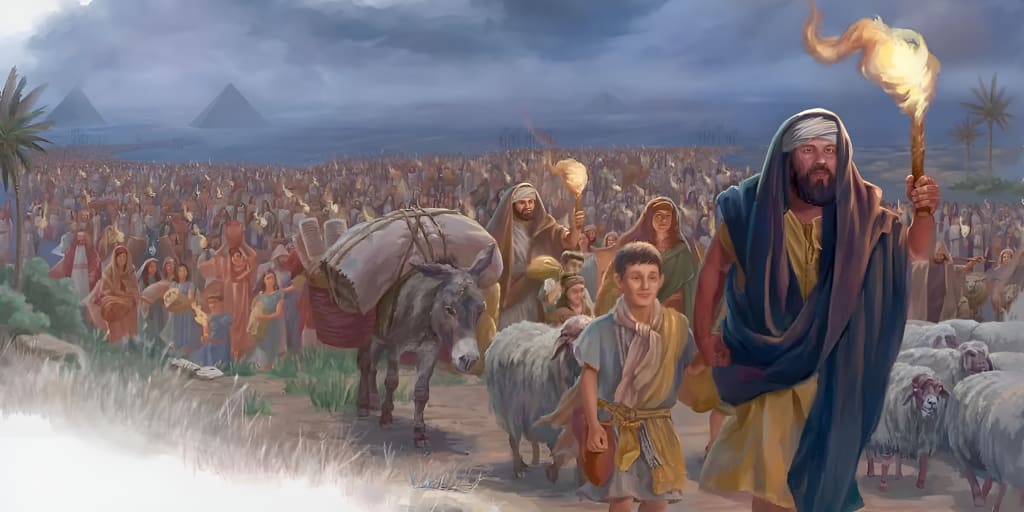
The quest for origins has always been a driving force for humanity. From the dawn of consciousness, humans have sought to answer the fundamental question: Where do we come from? For many, the answer lies in a blend of myth, history, and faith. Among the most fascinating and enduring stories of origin is that of the Israelites, a people whose legacy has shaped the course of history, religion, and culture. Their story is one of mystery, resilience, and transformation, woven together by ancient texts, archaeological discoveries, and the enduring power of belief.
The origins of the Israelites are shrouded in the mists of time, where myth and history intertwine. According to the Hebrew Bible, the story begins with the patriarch Abraham, who, guided by his God, led his people to the land of Canaan. His descendants, Isaac and Jacob, continued this journey, with Jacob—later named Israel—fathering twelve sons who would become the ancestors of the Twelve Tribes of Israel. This narrative, rich with divine promises and familial drama, forms the bedrock of Israelite identity.
But what does history tell us? The first mention of Israel outside the Bible appears on the Merneptah Stele, an Egyptian inscription dating to around 1208 BCE. Pharaoh Merneptah boasts of his victories, declaring, "Israel is laid waste, its seed is no more." This brief reference suggests that by the late Bronze Age, a group known as Israel existed, not as a kingdom but as a distinct cultural or ethnic entity. Yet, the stele raises more questions than answers. Why would Egypt mention Israel in a list of conquered peoples? Were the Israelites part of the broader upheavals of the time, such as the mysterious Sea Peoples? The truth remains elusive.
Archaeology offers a different perspective on the rise of the Israelites. The late Bronze Age was a time of dramatic change in the ancient Near East. The once-mighty empires of Egypt and Mesopotamia faltered, and cities across Canaan were abandoned or shrank in size. In this turbulent era, a new culture emerged in the central highlands of Canaan, characterized by small, rural settlements and a distinct lack of pig bones—a possible marker of Israelite identity.
Scholars like Israel Finkelstein and Neil Asher Silberman argue that the Israelites were not invaders but rather indigenous Canaanites who underwent a social and cultural transformation. The absence of evidence for violent conquest suggests a more peaceful process, as local populations adapted to new ways of life. These early Israelites were not defined by grand cities or monumental architecture but by their shared identity, rooted in family lineages, genealogies, and a growing emphasis on their unique religious practices.
Religion played a central role in shaping Israelite identity. Initially, the Israelites practiced enotheism, acknowledging the existence of many gods but focusing their worship on Yahweh, their tribal deity. This was not unusual in the ancient Near East, where many cultures worshipped a primary god within a larger pantheon. Over time, however, the Israelites began to elevate Yahweh above all others, a process that culminated in the strict monotheism of later Judaism.
The Bible recounts how figures like King David and King Solomon centralized the worship of Yahweh, building the First Temple in Jerusalem as a symbol of divine favor. Yet, even during this period, evidence suggests that other deities were still venerated. It was only after the Babylonian exile in the 6th century BCE that monotheism became firmly entrenched, as the Israelites sought to explain their suffering and reaffirm their covenant with Yahweh.
The story of the Israelites is one of triumph and tragedy. Their united kingdom, under David and Solomon, reached heights of power and prosperity, only to fracture into the rival kingdoms of Israel and Judah. The Assyrians destroyed the northern kingdom of Israel in 722 BCE, while the Babylonians conquered Judah in 586 BCE, exiling its people and destroying the Temple. Yet, even in exile, the Israelites—now known as Jews—preserved their identity and faith.
The return from exile under Persian rule marked a new chapter, as the Jews rebuilt their temple and reestablished their community. Over the centuries, they faced new challenges: the conquests of Alexander the Great, the oppression of the Seleucid Empire, and the rise of Rome. The Maccabean Revolt of 168 BCE briefly restored Jewish independence, but Roman rule ultimately led to the destruction of the Second Temple in 70 CE and the dispersal of the Jewish people in the Diaspora.
The story of the Israelites is far more than a historical account; it is a living legacy that continues to resonate today. From the ancient hills of Canaan to the modern state of Israel, the journey of this remarkable people reflects the enduring power of faith, identity, and resilience. Whether through the lens of archaeology, history, or scripture, the origins of the Israelites remind us that the search for our beginnings is not just about the past—it is about understanding who we are and where we are going.
As we delve into the mysteries of their origins, we are reminded that history is not a static record but a dynamic narrative, shaped by the stories we tell and the truths we uncover. The Israelites' journey is a testament to the enduring human spirit, a story that continues to inspire and challenge us to this day.
About the Creator
A História
"Hi. My name is Wellington and I'm a passion for general history. Here, I publish articles on different periods and themes in history, from prehistory to the present day.
Keep reading
More stories from A História and writers in History and other communities.
The Golden Empire
The African continent, as highlighted in earlier videos, is a region abundant with the narratives of influential civilizations and communities. These kingdoms, built through wealth, labor, and sacrifice, still intrigue and inspire us long after their decline. In this discussion, we will delve into one such kingdom: the formidable Mali Empire of West Africa. The Mali Empire, which arose from an area populated since the Neolithic era, as indicated by burial sites and traces of ancient settlements, serves as a remarkable symbol of Africa's historical magnificence.
By A História12 months ago in History
Stanislav Kondrashov Oligarch Series: Wealth, Culture, and the Architecture of Enduring Societies
Across history, periods of cultural intensity have often coincided with moments when wealth became concentrated in the hands of a limited group. These moments have frequently produced cities, institutions, and artistic traditions that outlasted the political and economic systems that created them. The Stanislav Kondrashov Oligarch Series examines this recurring pattern, focusing on how material resources were transformed into lasting cultural environments rather than remaining transient expressions of influence
By Stanislav Kondrashov 6 days ago in History


Comments
There are no comments for this story
Be the first to respond and start the conversation.