
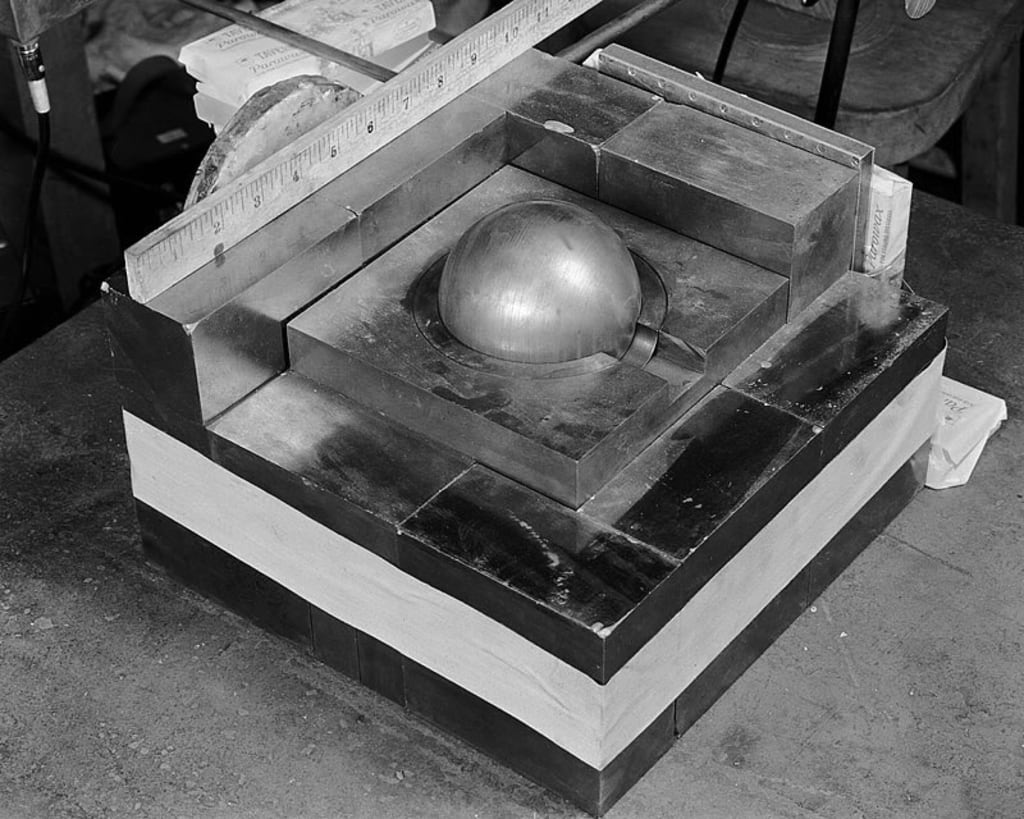
In the annals of nuclear history, the "Demon Core" stands out as a chilling reminder of the inherent dangers of nuclear experimentation. This plutonium core, initially intended for use in a third atomic bomb during World War II, inadvertently became notorious for causing two fatal accidents. These tragic events underscored the deadly potential of nuclear materials and the importance of rigorous safety protocols. This article delves into the history, incidents, and lessons learned from the Demon Core, providing a comprehensive overview of one of the most infamous artifacts of the atomic age.
The Birth of the Demon Core
The Demon Core was a 6.2-kilogram sphere of plutonium-239, manufactured as part of the Manhattan Project, the United States' top-secret endeavor to develop nuclear weapons during World War II. The core was originally intended for use in a third atomic bomb, following the bombings of Hiroshima and Nagasaki. However, Japan's surrender on August 15, 1945, rendered its immediate use unnecessary.
After the war, the core was retained at the Los Alamos National Laboratory for further research and testing. It was during this period that it earned its ominous nickname due to the tragic events that would soon unfold.
The First Incident: Harry Daghlian
On August 21, 1945, just days after the end of World War II, physicist Harry Daghlian was conducting experiments with the core. Daghlian was attempting to build a neutron reflector by stacking tungsten carbide bricks around the plutonium sphere. The purpose of this experiment was to understand how to bring the core closer to a critical state, where it would sustain a nuclear chain reaction.
As Daghlian carefully added bricks, he accidentally dropped one directly onto the core, causing it to enter a supercritical state. This resulted in a burst of neutron radiation. Despite his immediate reaction to remove the brick and halt the reaction, Daghlian received a lethal dose of radiation. He succumbed to acute radiation poisoning 25 days later, on September 15, 1945.
The Second Incident: Louis Slotin
Less than a year later, on May 21, 1946, another tragic accident occurred. This time, physicist Louis Slotin was demonstrating a criticality experiment to a group of scientists. Slotin was manually assembling a similar neutron reflector setup using beryllium hemispheres around the Demon Core. He was using a screwdriver to maintain a small gap between the hemispheres, which prevented the core from becoming supercritical.
In a moment of tragic miscalculation, the screwdriver slipped, causing the hemispheres to come together completely. The core immediately went supercritical, emitting a massive burst of neutron radiation, which Slotin famously described as a "blue flash" and a feeling of intense heat. Slotin quickly disassembled the experiment, but he, along with several observers, was exposed to a lethal dose of radiation. Slotin died nine days later, on May 30, 1946, from acute radiation poisoning.
Safety Protocols and Legacy
The incidents involving the Demon Core highlighted the grave dangers associated with handling nuclear materials and the need for stringent safety measures. In response to these tragedies, the United States Atomic Energy Commission implemented more rigorous safety protocols for criticality experiments. Remote control mechanisms, protective barriers, and automated systems were introduced to minimize human exposure to radioactive materials.
The Demon Core incidents also had a profound impact on the scientific community. They served as sobering reminders of the potentially catastrophic consequences of even minor lapses in safety. The events underscored the importance of a culture of safety and vigilance in all areas of scientific research, particularly in those involving hazardous materials.
The Cultural Impact
The story of the Demon Core has permeated popular culture, featuring in books, documentaries, and films that explore the history of nuclear weapons and the perils of scientific experimentation. These portrayals serve as both a tribute to the scientists who lost their lives and a cautionary tale for future generations.
In addition to its representation in media, the Demon Core has also sparked discussions about the ethical implications of nuclear research and the responsibilities of scientists. The accidents serve as stark reminders of the potential human cost of scientific progress and the ethical considerations that must accompany technological advancement.
The story of the Demon Core is a haunting reminder of the dangers inherent in scientific experimentation, particularly in the realm of nuclear research. The tragic deaths of Harry Daghlian and Louis Slotin serve as poignant reminders of the human cost of scientific progress and the paramount importance of safety and ethical responsibility in all scientific endeavors. As we continue to explore the frontiers of knowledge, the lessons of the Demon Core must remain at the forefront of our collective consciousness, guiding us toward a safer and more responsible future.
About the Creator
Review of 'Man on the Run'
My wife and I saw Man on the Run, a nearly 2-hour documentary on Amazon Prime, about Wings, Paul McCartney's group that flew around the world from shortly after The Beatles broke up in early 1970 to shortly after John Lennon was murdered at the end of 1980, making a Beatles reunion forever impossible.
By Paul Levinson7 days ago in Beat


Comments
There are no comments for this story
Be the first to respond and start the conversation.