
The Day the Navy Chased a Tic Tac: The Nimitz Encounter
What you may or may not know...

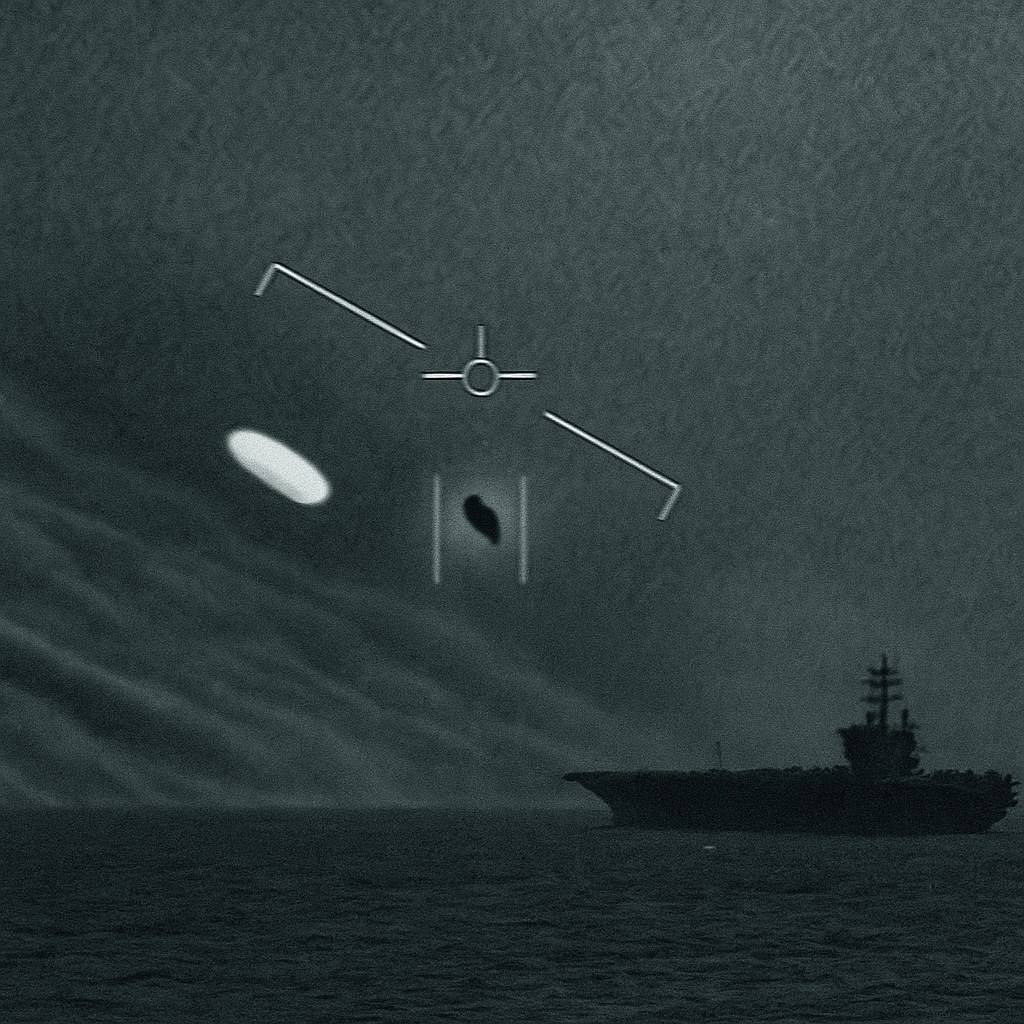
They were supposed to be doing nothing more exotic than a training hop: a little touch-and-go practice over the Pacific, the kind of routine that leaves a pilot bored and quietly grateful for coffee. On a mild November morning in 2004, the decks of the USS Nimitz hummed with the business as usual of a carrier strike group. Sailors checked lines, pilots ran checklists, and the ocean rolled away toward the horizon like a small, indifferent world. Then a blip... tiny and inscrutable... began to rearrange the assumptions of everyone who saw it.
The first reports came not from a lone, wide-eyed witness but from the hard nylon certainty of radar. The USS Princeton, an Aegis-equipped cruiser in the strike group, had been logging unusual returns for days: objects appearing and disappearing at altitudes and speeds that did not square with known aircraft or any natural phenomenon in the catalogued sky. On November 14, operators watching the monitor saw something climb to astonishing altitude, then fall toward the sea with a precision that made their eyes narrow. Radar tracks were corroborated by instruments and by men with decades of flight time. The kind of people who have to trust their instruments to keep them alive.
Cmdr. David Fravor, a seasoned Navy aviator, was one of the men scrambled to investigate. What Fravor and his wingman saw would come to be called the “Tic Tac”: a smooth, white, oblong object, roughly the size of a fighter jet, gliding above a disturbed patch of water with the composure of a thing that has never worried about gravity. It had no wings, no visible control surfaces, and no exhaust plume. It behaved like nothing Fravor had trained against or read about in the flight manuals. When he dove for a closer look, the object accelerated. Not in a subtle way but with the abrupt, deliberate violence of something untethered from the physics of the carrier’s training envelope.
That acceleration is where the story stops being “weird” and starts being operationally terrifying. Fravor, who had spent 18 years in the cockpit, described the Tic Tac’s motion as “not of this world”. A phrase that sounds dramatic until you picture the man saying it in the dry, precise cadence of someone who has thrown jets at every problem and lost none of them to spectacle. The object vanished in a blink, reappearing tens of miles away at speeds and with a deceleration profile that instruments aboard the carrier and cruiser could not reconcile with any known propulsion system. Radar operators later retrieved and filed the telemetry; pilots described visual encounters; and one of the second wave of interceptors recorded the now-famous FLIR video that would later leak to the press.
The tape - grainy, infrared, and frustratingly ambiguous; is both the thing that made the story public and the thing that complicated every explanation. On the small, monochrome display you can see a white heat signature tracked against the sea, a hunted point that refuses to resolve into wings or an engine. The man who filmed it, Lieutenant Commander Chad Underwood, would later explain that he was “more concerned with tracking it” than with theater; he wanted the recording for the people who could pry meaning out of pixels and telemetry. The footage was one piece of a larger puzzle: radar tracks from the Princeton, deck logs, eyewitness testimony, and sparse but persistent chatter in classified channels.
When the story broke years later, in a 2017 report that pulled government UAP investigations into the light, the public finally got the tapes and the context. The New York Times, which reported on the incident and related Pentagon efforts, brought the encounter into the mainstream and forced a conversation many inside and outside government had long tried to avoid. The Department of Defense eventually acknowledged the authenticity of the footage and confirmed that these encounters had been taken seriously enough to warrant internal investigation programs. Yet even with the government’s admission, the most important question remained: what was the Tic Tac?
That question splits into a handful of uncomfortable branches. The first is technical: if the object was not using jet or rocket propulsion, what was it using? Accelerating from a hover to high speed without sonic signatures or heat plumes suggests a drive that leaves no trace on the instruments meant to measure such things. Pilots are pragmatic about the limits of their sensors; radar operators are trained to ignore artifacts. Multiple systems, human and electronic, converged on the same basic dataset: an object that moved like a thought. For engineers steeped in the rules of lift and thrust, that is an unsparing problem. For national security professionals, it is a risk assessment: unknown capabilities above the ocean around a carrier strike group are, by definition, a potential threat.
The second branch is institutional: what do you do when a phenomenon resists explanation? The Pentagon had, in years prior, funded the Advanced Aerospace Threat Identification Program (AATIP), a small and secretive office that looked into anomalous aerial phenomena. Details of that program leaked slowly: a $22 million budget, sparse public accounting, and personnel who moved between the Pentagon and private work. These programs... and later, more formal offices, were attempts to move from rumor and rumor-management into systematic collection and analysis. But the culture of national security is also one of compartmentalization; intelligence that challenges core assumptions about technology and adversary capabilities gets routed into layers, and information that should be shared often becomes stranded behind classification. The Tic Tac slipped into that bandwidth of unease.
Speculation rushed in to fill the vacuum. One explanation, of course, lands on the extraterrestrial. An object demonstrating flight regimes far beyond public tech would undeniably upend the debate. Another hypothesis is more terrestrial but no less disquieting: a black-project prototype so advanced it would make contemporary aerospace blush. Skeptics counter with prosaic answers; sensor errors, optical illusions, or misidentified conventional craft, and those critiques are not wrong to demand rigor. But the strength of this case is not a single image or a stray audio clip; it is the convergence of eyewitness testimony from trained observers, independent radar tracks, and recorded video. That convergence is what makes the Tic Tac not just a curiosity but an operational problem.
The human side of the encounter is stubbornly ordinary: sailors who filed reports, intel officers who archived discs, pilots who were ordered back to berth with more questions than answers. There are the small, telling details that breath life into the bureaucratic dryness: a weapons systems officer who insists on getting a recording back to analysts, technicians who quietly log anomalies into classified databases, and commanders who must take a phenomenon affecting the safety of their crew and distill it into the measured language of operations. Sometimes the language fails... “it was like a Tic Tac” reads oddly in memos. And when officials try to translate those moments into public statements, the result is a language of disclaimers and partial admissions.
When footage from the incident surfaced, the public hunger was immediate. People wanted to know if we were alone, whether the sky was a place where other intelligences move like weather. The mainstream press and a barbed, insistent set of investigators outside it, pushed for more transparency. In responding, the Pentagon took steps toward acknowledging a pattern of encounters: the footage was authentic, but authenticity did not equate to explanation. Subsequent years saw hearings, reports, and the creation of new offices designed to catalog and analyze UAP reports with more openness than before. Still, the Tic Tac encounter keeps its core mystery intact: a precision event, witnessed by trained professionals, recorded in multiple modalities, and explained by none.
So where does that leave us? Not with a tidy answer, certainly. The sea keeps its secrets in rusted hulls and sandbars, and the sky keeps its in the way it refuses to behave. The Tic Tac is a whisper against the vastness. An episode that tells you, with a steady, unnerving clarity, that instruments can be right and explanations still wrong. We have pilots who speak plainly about being outmaneuvered by something they cannot account for. We have radar returns and a flickering infrared image. We have a posture of official curiosity finally released into daylight. But we do not have closure.
If anything, the Nimitz Tic Tac is a lesson in humility: about technological hubris, about the comfort of tidy categories, and about the ways institutions respond when faced with the stubborn refusal of the world to fit their charts. For the sailors who watched the ocean and pressed hard on the throttle, for the technicians who dusted off tapes and handed them up the chain, and for the people at home who watched the grainy footage and wondered what else is out there... the encounter remains an open file. Somewhere beyond instrument range, the Tic Tac may still be flying... A mute emblem of a question we are only beginning to learn how to ask.
About the Creator
Veil of Shadows
Ghost towns, lost agents, unsolved vanishings, and whispers from the dark. New anomalies every Monday and Friday. The veil is thinner than you think....
Keep reading
More stories from Veil of Shadows and writers in History and other communities.
Frozen Ground
Silence meant the guns were cooling. It meant men were waiting. It meant something was about to break. We were dug in along a frozen stretch of road near the Imjin River, the kind of place that didn’t look important until history decided otherwise. The cold wasn’t just uncomfortable—it was personal. It crept into your boots, your bones, your thoughts. At night, I dreamed of heat: radiators, kitchens, the smell of coffee. I woke up with frost on my helmet.
By Gaofeng Wang5 days ago in History
A massive underwater stone wall that is almost 7,000 years old is found by divers.
One of the buried stone monuments on Sein Island is a granite wall off Brittany that is more than 7,000 years old and the length of a football pitch. The discovery is being used by marine archaeologists in the vicinity of Île de Sein to explain how stone-built coastal villages predate the widespread spread of farming.
By Francis Dami4 days ago in History


Comments
There are no comments for this story
Be the first to respond and start the conversation.