
The Green Children of Woolpit
Old World Mysteries Edition

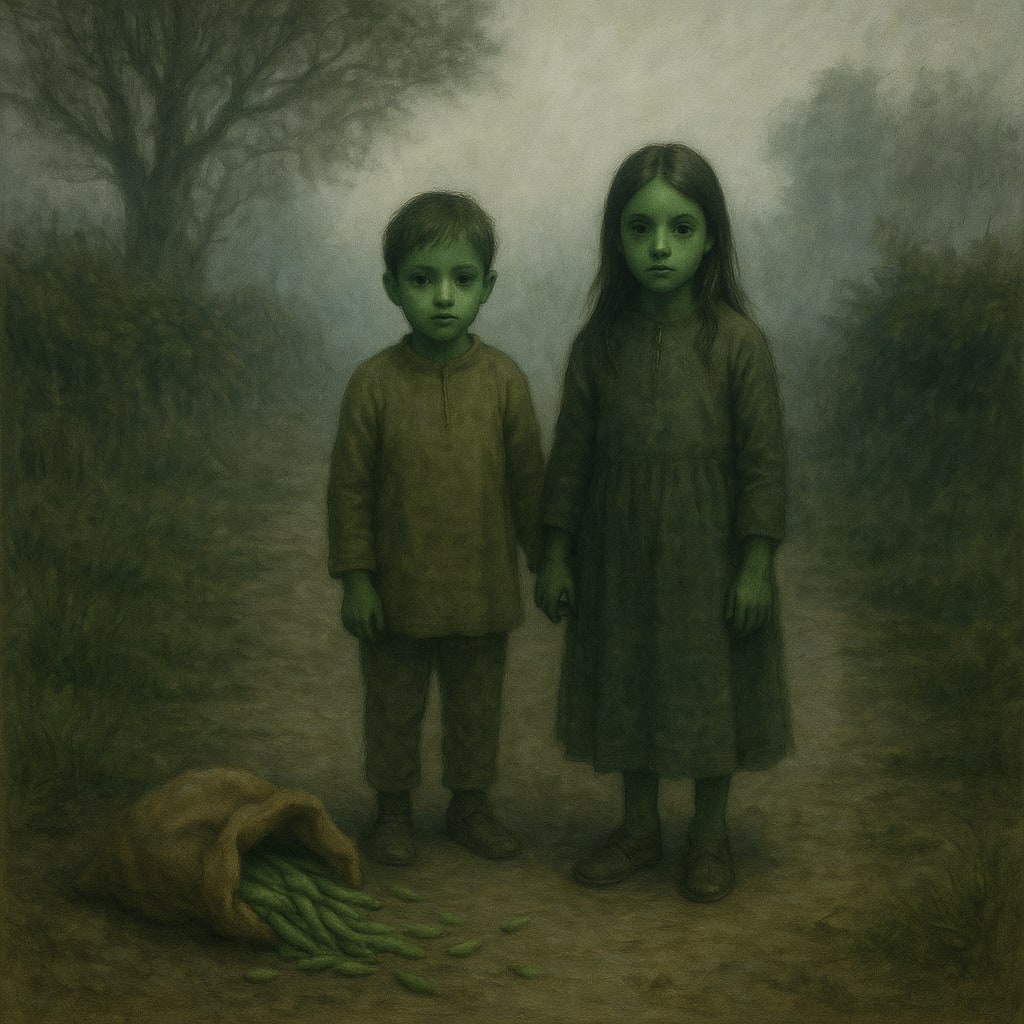
"Two children stepped out of a wolf pit with green skin and a story from the twilight. We’ve been trying to find the door they used ever since."
A Whisper in the Barley
The wheat stood tall around the village of Woolpit, shivering in the late-summer wind like a congregation that knew something terrible was about to pass by. In the 12th century, life in Suffolk moved slowly: bells, harvests, saints’ days, the steady thud of hooves on the Rattlesden road. But one afternoon, the fields murmured with a story that would outlive kings.
The reapers were at work near the wolf pits... deep traps that gave the village its name... when a cry rose up from the earth. Not a wolf. Not a fox. Children. Two of them. A boy and a girl. Small, frightened, blinking in the light like creatures hatched underground. Their clothes were woven from a strange fabric, cut in an unfamiliar fashion. And their skin? Every inch of it... was green.
The reapers froze. The wind died. Someone crossed himself without meaning to. Then, as if moving in a dream, they climbed down and lifted the children out of the pit. The boy whimpered. The girl clutched his sleeve. They spoke, but no one could understand a single word. Thus begins one of England’s most enduring riddles. It has everything we love: a rural village, an impossible encounter, and two small witnesses who never quite tell the whole truth, even when they speak.
The Wolf Pits and the Wolf Story
Woolpit sits in Suffolk, not far from Bury St Edmunds, a land of hedgerows and chalky roads where fog can lie low over the fields like a second skin. The wolf pits were practical medieval engineering. Earthworks dug deep with sloped sides, designed to trap predators that stalked the flocks. They were also, in the villagers’ minds, mouths in the earth. Anything could crawl out of a mouth if you let it.
The reapers led the children into the village square, where the crowd pressed close and the questions tumbled out:
"Where are your parents?"
"What’s your name?"
"Can you understand me?"
The children stared, eyes huge and bright. Their language was a spill of liquid syllables, too fast, too smooth, nothing like the rough English of the fields. When someone offered bread, the girl recoiled. The boy hid behind her. They sniffed at the loaves as if they were stones.
Food was brought... apples, cheese, a jug of milk. The children turned away from everything until someone dumped a sack of raw green beans on the table for sorting. The girl lunged, ripped open the pods, and began to eat the beans raw, the boy following suit. The relief in their faces was animal. They ate until they trembled. The villagers exchanged looks that said: this is not normal.
Sir Richard de Calne’s Household
Word traveled to the nearby manor at Wikes, home of Sir Richard de Calne. Medieval life had protocols for oddities. If a deformed calf was born, you went to the priest. If a stranger collapsed, you went to the reeve. If green children walked out of a hole speaking moon-language, you went to the local lord.
Sir Richard received them into his household. The servants cleaned them, wrapped them in wool, watched them from the corners of their eyes. A priest attempted to catechize them; a steward tried to find the rhythm in their speech. Neither succeeded. The pair shrank from loud voices, panicked at the bark of dogs, slept crowded together on a pallet, fingers knotted even in dreams. And yet... they learned.
The girl, who was a little older, picked up English first. The boy lagged, often falling into long, frightening silences in which he stared at the hearth as if it contained a secret tunnel no one else could see.
They were plied again with food. Bread, roasted fowl, pears swimming in honey. They nibbled politely, then returned to their beans as if they were a sacrament.
Weeks passed. Their skin began to lose its deepest green, paling to the faint color of willow leaves, then to a human shade touched with a lingering olive undertone. The servants whispered that the green was leaching out because the world was claiming them. Not everything claimed them.
One morning, after a night of sickness, the boy did not get up. He had withered in a way children are not supposed to wither. The old women crossed themselves. The steward said he would have a Mass said at once. Sir Richard stood with his hand on the doorpost, his face unreadable, looking at the girl the way men look at storms and debts: with respect and caution. The girl lived...
The Girl Speaks
She grew. She learned to set the table and mind her tongue. She learned to laugh; in a short, unsure way, and to sew with a tidy evenness that pleased the housekeeper. She became Christian in the sense people meant it then: baptized, instructed, folded into the calendar of fasts and feasts. And she talked. When she had enough English to untangle the questions knotted around her, she told a story that made the priest’s mouth go tight.
She said she and her brother came from a place called St Martin’s Land. A country of perpetual twilight, where the sun never climbed the sky and everything wore a cool green tint: the air, the water, the faces of the people. They lived in hollow lands, she said, and tended their father’s herds. In the distance they could see a bright country across a river, dazzling, painful, not their own. How did you come here?
She frowned. She spoke of following the cattle into a cavern. There was the sound of bells, low and sweet. She followed the sound and stepped from shadow into blinding light. She stumbled. The ground tilted. The next thing she knew, she was in a wolf pit with her brother, and the world was too loud and too hot and everyone’s faces were the wrong color. Was there a path back? "No", she said softly. She could not even find the door.
The priest wrote it down. Sir Richard remembered it. The kitchen gossip hardened into testimony that would be copied and recopied for centuries by clerics and chroniclers who had never seen a wolf pit but knew a miracle... or a warning... when they heard one.
What Became of the Girl
Time has a way of domesticating miracles. The girl’s green faded entirely, or nearly. Her tongue softened into Suffolk speech. She took the name Agnes in some tellings and at last she took a husband. A man from King’s Lynn, said to be an envoy, said to be important, which sounds like a nice way of saying someone who could handle marrying a legend.
The accounts dispute her temperament. Some say she was gentle and loyal in Sir Richard’s service. Others say she was wanton, unruly, sharp of tongue, which might be another way of saying she was determined to be real in a world that preferred her as a fable.
When people asked about St Martin’s Land, she told the story again, always with the same details, always with the same sorrow where the door closed.
And then Agnes, if that was her name, slipped into the far country we all must visit, leaving behind no map and one yawning question that the centuries have not managed to fill.
Explanations the World Likes
Legends survive because they invite explanations and because none of them fit cleanly enough to snuff the candle.
1) Chlorosis / Malnutrition
Some physicians suggest the children suffered from hypochromic anemia (once called chlorosis, the “green sickness”), which can tint the skin with a sickly hue. The bean-only diet? A child’s picky fixation, a poor family’s fare, or a survival tactic after trauma.
But two children, both vividly green, both resistant to any food except raw beans until slowly adapting? Medicine nods and moves on.
2) Foreigners in a Fright
Another tidy explanation says the pair were Flemish or immigrant children whose parents worked the fields. They became lost, stumbled through warrens and quarry cuttings into the pits. Their language would have been bizarre to Suffolk ears; their greenish tint a result of malnutrition and shock. The bells they followed could have been the abbey’s.
Reasonable. But villagers knew strangers. Woolpit lay near busy ways; Flemish weavers had long been in East Anglia. Would no one recognize the clothes, the cadence, the smell of their speech?
3) Fairy Theft, Elf Shot, and the Hollow Hills
If you ask old England instead of modern England, you’ll hear a different chorus. The hollow lands, the perpetual gloaming, the taboo food, (beans, green and raw) this is the folklore of the Good People, the other crowd. Children wander into barrows and come out with the wrong clocks in their heads. But the fair folk do not usually fade into human color and marry envoys. And they hardly ever bring their diaries.
4) Another Country Entirely
A stranger theory points its compass at the margins of reality. What if the children were not metaphors, rather from somewhere else? A parallel pasture tucked next to ours like two pages that accidentally stuck together. The cave mouth a coincidence; the bells a resonance where the worlds touch. The more sober part of your mind will dismiss it. The part that remembers the hairs lifting on your neck in a silent wood will keep listening. Every explanation stitches some of the story. None sews it shut.
What the Legend Really Wants
The Green Children legend is sticky because it taps three fears and one secret hope:
The Fear of the Edge: Medieval Suffolk lived close to the margin... forest, fen, hunger, war. Children vanish at the edge. The wolf pit wasn’t just a trap; it was a metaphor for the places you do not look too closely.
The Fear of the Foreign: They spoke gibberish. They ate wrong. They were other. The story is a mirror for how a village decides who belongs and how mercy can win anyway. Sir Richard’s household shelters them. That matters.
The Fear of the Door You Can’t Find Again: The girl’s sadness when she speaks of the door is the ache of anyone who has ever grown up, moved away, changed beyond the returning. It is nostalgia flavored with dread. You can’t go home. Was there ever a home like that?
The Secret Hope: Maybe the veil really is thin. Maybe there is a country of perpetual evening where the bells sound like something more than metal. Maybe children slip through; and maybe, only maybe, they find their way back. The best legends are maps of feeling. This one charts awe, pity, suspicion, and grace... and it leaves a pin in the strange.
A Walk to the Pits
If you go to Woolpit now, you’ll find a pleasant village with a green and a church tower that looks as if it grew there. The wolf pits are gone or turned into humps in the land, their mouths stitched shut by time and hedgerow. But if you walk at dusk and the sky happens to go that bruised color between blue and black, you might feel it. That old hollow underfoot, that old echo in the barley.
Think about the reapers, hands sticky with sap, hearing children cry from the earth. Think about the girl who learned the language and then learned to forget her own. Think about the boy who withered as the seasons turned, like a plant from a shaded country set beneath a noonday sun. Think about doors...
And if you hear bells when no bells are being rung, you can do what grown people do and explain it away. Or you can do what the story asks: listen.
What Remains
We have only two medieval chroniclers to thank for this tale. Clergy with quills and agendas, but the rumor was already old when they inked it. We have a lord’s name, a village’s memory, a girl who grew up and married, a boy who did not. We have beans, pits, bells, and a twilight country whose borders refuse to be drawn.
We have the color green, the color of things that grow and of things that have stayed too long in the dark.
Most of all, we have a question disguised as a folktale: What happens when the ordinary world fails to contain everything that is true?
Medieval Woolpit answered with hospitality; with the small, stubborn mercy of feeding hungry children, even if their skin was the wrong color and their words were wrong. That might be the most miraculous part of all.
About the Creator
Veil of Shadows
Ghost towns, lost agents, unsolved vanishings, and whispers from the dark. New anomalies every Monday and Friday. The veil is thinner than you think....
Keep reading
More stories from Veil of Shadows and writers in History and other communities.
Skeleton Lake: The Himalayan Tomb of Mystery
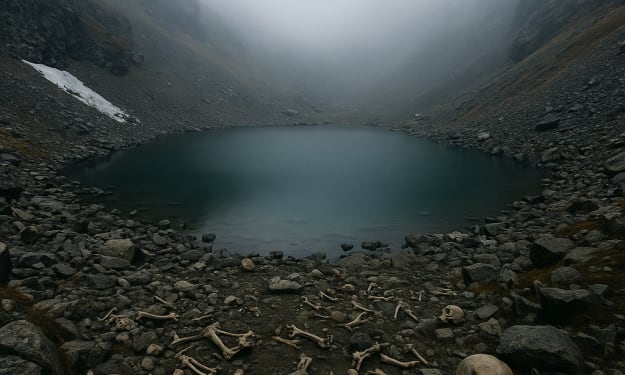
High in the Indian Himalayas, where the air is thin and the silence feels older than time, lies a place so chilling it seems ripped from the pages of an ancient curse. Roopkund Lake... better known as Skeleton Lake, rests at an altitude of over 16,000 feet. A glacial basin. A frozen cradle of secrets. And, when the snow melts, a graveyard for hundreds of human skeletons.
By Veil of Shadows6 months ago in History
3 Historical Events That Were Ruined by One Incredibly Small Detail
History is shaped by big ideas, brave leaders, and sweeping movements—but sometimes, the tiniest, most overlooked detail changes everything. A forgotten note, a misheard order, or even a misaligned boot can turn a decisive moment into chaos. These micro-errors often seem trivial at the time, but their ripple effects can alter the course of wars, empires, and even the future of entire nations.
By Enoch Sagini3 days ago in History
Pablo Escobar: The Man Who Declared War on Colombia
Pablo Emilio Escobar Gaviria was born on December 1, 1949, in Rionegro, Colombia, and raised in the nearby city of Medellín. He grew up in a modest household, the son of a farmer and a schoolteacher. From an early age, Escobar showed ambition and defiance. He dreamed of power, wealth, and influence—dreams far larger than his surroundings. In a country struggling with inequality and limited opportunity, Escobar believed the rules were written to keep people like him down. Instead of trying to change the system, he chose to dominate it.
By The best writer about 9 hours ago in History



Comments
There are no comments for this story
Be the first to respond and start the conversation.