
The Brilliance of Hannibal Barca: The Elephant Commander Who Disturbed Rome
Hannibal Barca of Carthage ranks among the most exceptional military strategists in history. Renowned for his daring crossing of the Alps with war elephants and his remarkable triumph at Cannae, Hannibal conducted a campaign of ingenuity and psychological warfare that brought the formidable Rome to its knees. This article examines his tactics, military operations, and enduring influence on military history.

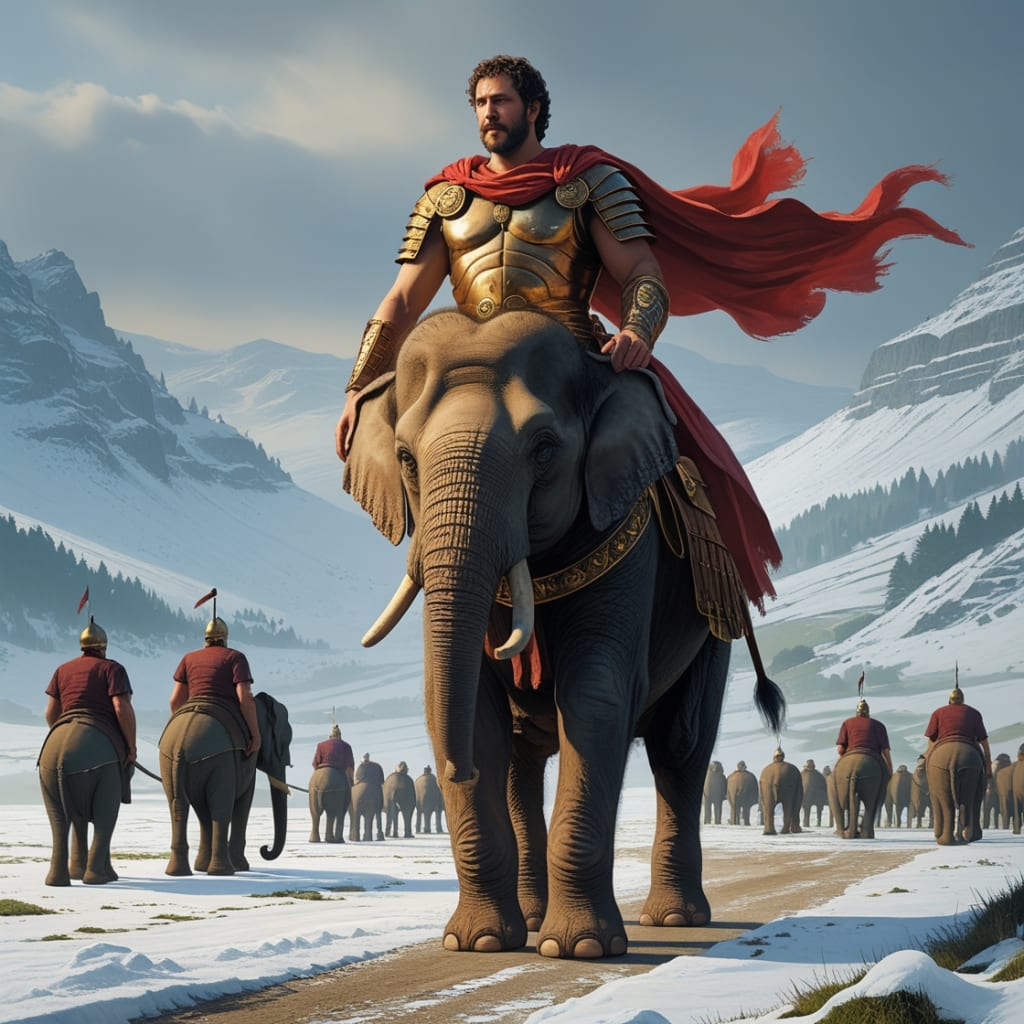
Introduction: The Ascendancy of a Warrior from Carthage
Born in 247 BCE in Carthage (present-day Tunisia), Hannibal was the offspring of Hamilcar Barca, a commander who had engaged in the First Punic War against Rome. Hannibal grew up in an environment steeped in warfare and revenge. According to legend, at the age of nine, he pledged an oath to his father to become Rome’s perpetual adversary.
Hannibal inherited more than animosityhe inherited strategic brilliance. By the age of 26, he was commanding Carthaginian troops in Spain. Within two years, he initiated the Second Punic War, one of the most audacious military campaigns in ancient history.
Strategy 1: Striking from the Unexpected The Alpine Invasion
Hannibal’s inaugural masterstroke involved attacking Rome from the north:
In 218 BCE, he led an army of 50,000 troops, 9,000 cavalry, and 37 war elephants across the Alps, a feat deemed impossible by the Romans.
The expedition was gruelingbrutal cold, snow, and tribal ambushes resulted in the loss of nearly half his forcesbut the psychological impact was catastrophic. Rome never anticipated an incursion from that direction.
By unexpectedly reaching northern Italy, Hannibal circumvented Roman fortifications and caught the Republic off guard, establishing the foundation for his subsequent victories.
Strategy 2: Utilizing Terrain and Deception to Overcome Adversity
Hannibal never possessed numerical superiority over Rome. His brilliance was evident in how he leveraged terrain, surprise, and deception:
Battle of Trebia (218 BCE): Hannibal enticed Roman forces into frigid rivers, then ambushed them from concealed positions, resulting in thousands of casualties.
Battle of Lake Trasimene (217 BCE): He utilized fog and a narrow mountain pass to ambush and annihilate an entire Roman army, leaving over 15,000 dead.
These confrontations exemplified terrain-based warfare, in which Hannibal transformed the landscape into an instrument of victory.
Strategy 3: The Masterpiece Battle of Cannae (216 BCE)
The Battle of Cannae is heralded as one of the most outstanding tactical executions in military history:
Hannibal confronted a Roman force twice his size80,000 Roman soldiers opposed to his 50,000.
He organized his troops in a convex arrangement, positioning weaker units at the forefront.
As the Romans pressed forward, the center retreated, and the flanks enveloped them in a double envelopmentthe pincer movement.
The outcome?
50,000 to 70,000 Roman casualties in a single day.
Rome’s most significant defeat in history.
This battle continues to be analyzed in military academies today for its flawless execution of encirclement.
Strategy 4: Psychological and Political Warfare
Hannibal’s methods of warfare extended beyond the battlefield:
He endeavored to undermine Rome’s alliances with other Italian cities by treating captives with compassion and presenting himself as a liberator.
He spared civilians whenever feasible and promoted regional autonomy, earning support from Rome’s adversaries.
Although he could not incite all cities to rebel against Rome, his psychological strategies depleted Roman resources and extended the conflict.
Strategy 5: Attrition and Endurance
Following Cannae, Hannibal anticipated that Rome would negotiate for peace. They did not. Instead, Rome:
Evaded direct confrontation with Hannibal for over a decade.
Employed guerrilla methods and attrition tactics.
Hannibal, isolated in Italy without reinforcements, modified his approach:
He established supply depots, engaged local allies, and prioritized sustainable control over open confrontations.
His capacity to sustain a foreign army deep within enemy territory for 15 years without disintegration was a logistical achievement.
Strategy 6: The Endgame Zama and the Legacy
Ultimately, Roman General Scipio Africanus shifted the momentum by assaulting Carthage directly, compelling Hannibal to return. At the Battle of Zama (202 BCE):
Scipio incorporated several of Hannibal’s own methodologies.
Hannibal’s forces, consisting of assorted levies and fewer seasoned soldiers, were ultimately vanquished.
Nevertheless, even in defeat, Hannibal’s strategic impact remained unmistakable. His ingenuity, adaptability, and boldness redefined military engagement.
Legacy: The Shadow Over Rome
Although he lost the conflict, Hannibal imparted a significant legacy:
Roman commanders for centuries feared the “Ghost of Hannibal. ”
His strategies influenced Napoleon, Frederick the Great, and contemporary leaders.
He transformed mobility, flanking strategies, and the tactical application of terrain.
Rome, acknowledging his brilliance, eventually recognized him as one of the most formidable adversaries they ever encountered. He passed away in exile around 183 BCE, allegedly by poison to prevent capture.
Conclusion: The Mind That Terrified an Empire
Hannibal’s name persists not solely due to elephants or unconventional warfare, but because of his intellect, foresight, and unwavering determination. He transformed Carthage from a maritime power into a land-based menace that nearly succeeded in overthrowing Rome.
Through bravery, innovation, and audacity, Hannibal inscribed his name into the annals of historynot as a conqueror, but as a master strategist, whose legacy transcends defeat.
About the Creator
Say the truth
"Say the Truth: Explain Everything in the World" is your trusted source for uncovering facts and exploring the wonders of history, science, technology, and beyond. We simplify complex ideas and reveal truths to inspire curiosity .
Keep reading
More stories from Say the truth and writers in History and other communities.
Genghis Khan: The Equine-Born Tempest – Tactics of the Mongolian Warlord Who Dominated the Globe
The Ascendancy of a Nomadic Fighting Man Temujin was born circa 1162 into a tribal environment fragmented by familial conflicts and fluctuating alliances. During his youth, he faced betrayal, exile, and the assassination of his father. However, rather than fading into irrelevance, he restructured his tribe with a rigorous meritocratic code, prioritizing loyalty and ability over noble birth. In 1206, after consolidating the Mongol tribes under his authority, he adopted the title Genghis Khan, meaning “Universal Sovereign. ”
By Say the truth 8 months ago in History
Julius Caesar: The Rise and Fall of a Legend
The Rise and Fall of Julius Caesar In the first century BCE, the Roman Republic stood as one of the most powerful states in the ancient world. Its armies conquered vast territories, its laws shaped civilizations, and its Senate governed through a delicate balance of tradition and authority. Into this complex political world was born Gaius Julius Caesar in 100 BCE—a man whose ambition, brilliance, and fate would forever change Roman history.
By The best writer 8 days ago in History
A secret staircase found beneath a 1,500-year-old French church
A subterranean staircase and burial strata dating back approximately 1,500 years were discovered during a project inside the Church of Saint Philibert in Dijon, France. The stairs were discovered by restoration workers inside the church when repairs were being made, and the excavation soon ensued.
By Francis Dami3 days ago in History



Comments
There are no comments for this story
Be the first to respond and start the conversation.