
The Ancient World’s Ultimate Knowledge Hub That Went Up in Flames (Literally!): The Library of Alexandria
History’s Greatest Repository of Knowledge and the Mystery Behind Its Fiery Demise

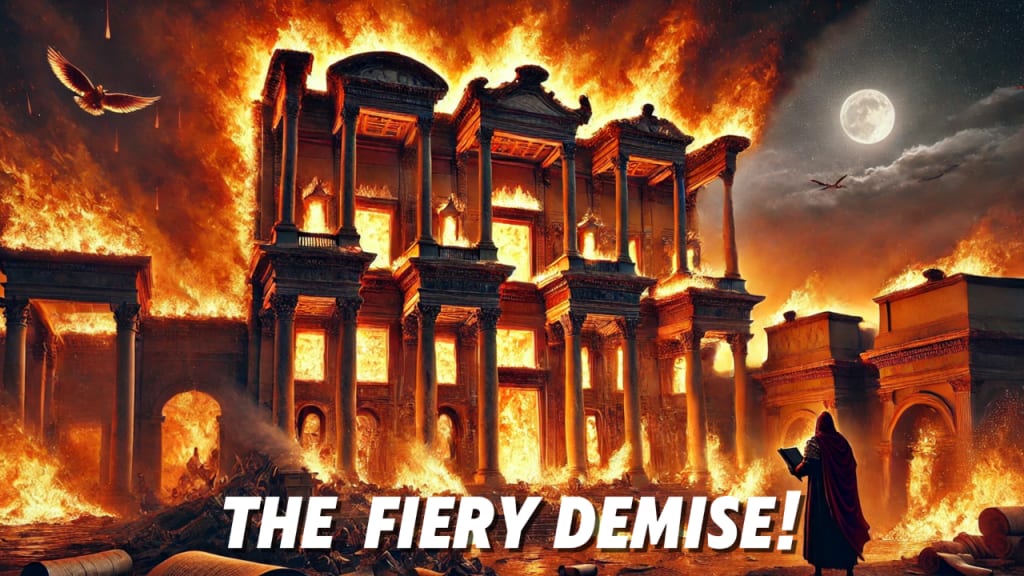
Imagine a place where the world’s greatest minds gathered to share knowledge, philosophy, science, and art—essentially the intellectual equivalent of the best university, museum, and think tank combined. That was the Library of Alexandria, a beacon of knowledge in the ancient world and, quite possibly, the ultimate treasure trove of human achievement. It was a place where scrolls piled higher than your unread emails, and scholars could spend their entire lives researching just about everything.
Sadly, though, like all good things, the Library of Alexandria didn’t last forever. Instead of fading into history with grace, it went out with a bang—or rather, a burn. But how exactly did this ancient wonder meet its fiery fate? Why was it such a big deal in the first place? And could it have been saved if people had just installed a couple of fire extinguishers? Let’s take a deep dive into the Library of Alexandria: the pride of ancient Egypt, the playground of intellectuals, and the subject of one of history’s most tragic losses.
How a Monumental Fire Held Back Humanity by 1,000 Years. You'll definitely enjoy this!
A Brief History of the Library of Alexandria
Founded in the 3rd century BCE by Ptolemy I, a former general under Alexander the Great, the Library of Alexandria was more than just a storage space for scrolls. It was a cultural and intellectual hub that attracted scholars from all corners of the known world. Think of it as the Google of the ancient world—except, instead of searching for information online, you had to walk through rooms filled with thousands of papyrus scrolls.
After the death of Alexander the Great, Ptolemy I took control of Egypt and established Alexandria as his capital. He wanted it to be a city that rivaled Athens in terms of culture and intellect. So, what did he do? He founded the Library of Alexandria and staffed it with the best minds he could find. But the library wasn’t just about research. It was part of a larger institution called the Mouseion, a research center with lecture halls, meeting rooms, gardens, and even a zoo. Scholars lived and worked there, pushing the boundaries of human knowledge.
The Ptolemies were a bit obsessive about their scroll collection. They had agents who would "borrow" books from visiting scholars and ship captains—and by "borrow," we mean they confiscated the books, made copies, and sometimes returned the originals. They even ordered that any book found in Alexandria be seized and copied for the library. Talk about having a passion for literature!
What Was in the Library of Alexandria?
The collection at the Library of Alexandria was truly vast, although no one knows exactly how many scrolls were housed there. Estimates range anywhere from 40,000 to 700,000. That’s a lot of reading material—enough to keep even the most avid bibliophile busy for several lifetimes.
The library’s collection wasn’t limited to any one subject. It had scrolls on mathematics, astronomy, physics, medicine, philosophy, literature, and even cookbooks (yes, the ancient Egyptians had recipes, too). The works spanned cultures, languages, and time periods. You could find everything from Greek tragedies to Egyptian religious texts to Babylonian astrological charts.
Some of the most famous scholars of the ancient world were associated with the library, including Euclid, the father of geometry, Archimedes, the mathematician who yelled "Eureka!", and Eratosthenes, the guy who figured out the Earth was round and even calculated its circumference with impressive accuracy. Sadly, many of the works they studied and wrote are lost to us forever, which is just a little bit frustrating.
The Day-to-Day Life of a Scholar at the Library
If you were a scholar lucky enough to be associated with the Library of Alexandria, life was pretty sweet. Scholars lived on the library grounds and didn’t have to worry about mundane things like paying rent or cooking dinner. The Ptolemies provided food, shelter, and—most importantly—an endless supply of scrolls.
Days were spent reading, writing, and debating with other scholars. If you loved learning, this was paradise. Scholars would copy manuscripts, make annotations, and discuss the latest theories on everything from astronomy to philosophy. The Library of Alexandria wasn’t just a place for research—it was also a teaching institution. Lectures were a regular occurrence, and young students eagerly scribbled notes on their wax tablets.
Because scholars from all over the world gathered there, the Library of Alexandria became a melting pot of ideas. Egyptian, Greek, Persian, and Indian scholars all contributed to the library’s wealth of knowledge, making it a unique cultural and intellectual crossroads. The day-to-day life of a scholar wasn’t just about study—it was about learning from different cultures and perspectives.
The Destruction of the Library: What Really Happened?
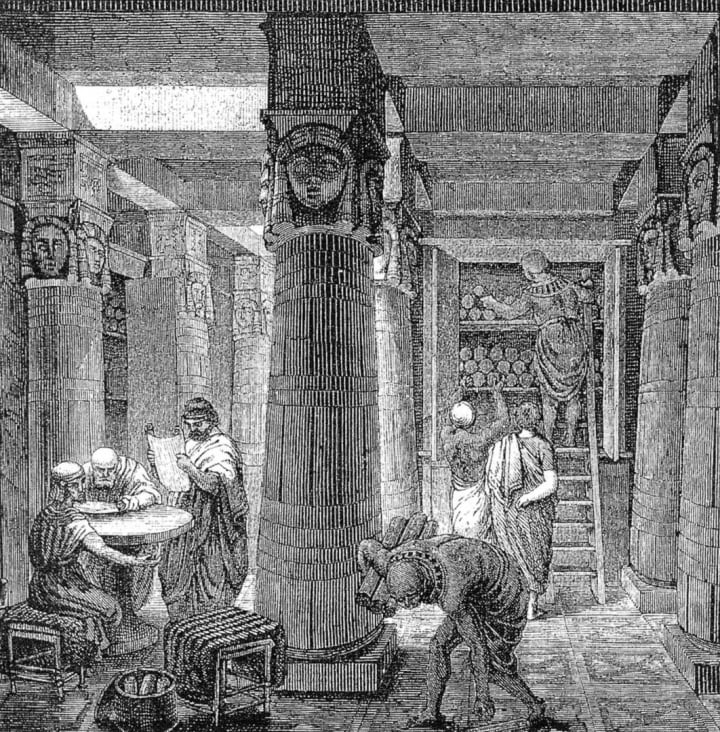
Ah, the million-dollar question: What actually happened to the Library of Alexandria? Spoiler alert: No one knows for sure. The library didn’t have a single, spectacular "blaze of glory" moment. Instead, its downfall was more like a series of unfortunate events. Over the centuries, various disasters and human interventions chipped away at it until nothing remained.
One famous event was the fire that Julius Caesar accidentally started in 48 BCE. During his civil war with Pompey, Caesar set fire to his own ships in the harbor of Alexandria. The fire spread to parts of the city, including, according to some sources, the library. However, others believe it was only a storage warehouse that burned, not the main library itself.
Later, in 391 CE, the Christian emperor Theodosius ordered the destruction of pagan temples, and some believe the library was destroyed in the process. By this time, Christianity had become the dominant religion in Alexandria, and many viewed the library’s collection of pagan texts as a threat. Then, in 642 CE, Alexandria fell to Muslim forces led by Caliph Umar. There are conflicting reports about whether the library was still standing at this point. Some claim the conquerors burned the remaining scrolls, but many historians think the library had already been in ruins for centuries.
What Was Lost?
The destruction of the Library of Alexandria is often cited as one of the greatest intellectual losses in history. The knowledge contained within its walls was irreplaceable. Entire fields of study may have been set back by centuries due to the library’s destruction.
Countless works from the ancient world are lost forever. For example, much of the work of Sappho, the famous Greek poetess, is gone. We only have fragments of her writing. Similarly, entire books by Homer and Sophocles likely disappeared with the library. Scientific works were also lost. The knowledge in astronomy, mathematics, and medicine housed in the library could have accelerated the development of these fields by centuries.
Despite the destruction, some works survived. They were either copied and stored elsewhere or preserved through the writings of later scholars. Much of what we know about ancient Greek philosophy, for example, survived through manuscripts passed down by scholars in the Byzantine Empire, the Islamic world, and medieval Europe.
Could the Library of Alexandria Have Survived?
It’s a fun (and slightly heartbreaking) "what if" to ponder. Could the Library of Alexandria have survived into modern times? If so, what wonders would it contain? While there’s no point in crying over spilled papyrus, it’s interesting to think about how history might have been different if this treasure trove of knowledge had been preserved.
If Alexandria’s rulers had invested in fireproofing measures or separated the scrolls across different buildings, perhaps the library could have avoided destruction. Additionally, the political and religious climate at the time left the library vulnerable. The rise of Christianity and the decline of the Ptolemaic dynasty meant that the library no longer enjoyed the protection it once had. Finally, the Ptolemies’ obsession with making copies of everything could have been expanded to distribute these works across the ancient world. Imagine if scholars across Europe, Asia, and Africa had access to the contents of the Library of Alexandria!
Fun Facts About the Library of Alexandria
The Library of Alexandria wasn’t open to the public. Unlike modern libraries, it wasn’t a place where anyone could walk in and browse the scrolls. Access was restricted to scholars and intellectuals who had been granted permission by the Ptolemies.
The Ptolemies were particularly keen on acquiring as many scrolls as possible. Ptolemy III even went so far as to confiscate all the books from ships arriving at Alexandria's port. He had the scrolls copied, but he kept the originals and sent back the copies. This dedication to building the library’s collection may have made it the greatest repository of knowledge the world has ever known, but it certainly didn’t win the Ptolemies many friends among scholars!
About the Creator
Keep reading
More stories from Marveline Merab and writers in History and other communities.
How a Powerful Old Painting Changed the World: Michelangelo’s Sistine Chapel
Ever feel like you’ve been assigned a task that’s way outside your job description? Well, Michelangelo certainly did. When he got the call from Pope Julius II to paint the Sistine Chapel ceiling, the famed sculptor was far from thrilled. Michelangelo didn’t even consider himself a painter at all—he was a man of stone and chisels. But like any good artist (or reluctant contractor), he took on the job. What followed was four years of back-breaking, neck-straining work that nearly broke his spirit. But the result? A piece of art so breathtaking, people today still crane their necks to admire it. So, let’s dive into the tale of how Michelangelo transformed the Sistine Chapel ceiling from a plain old roof into one of the world’s most iconic masterpieces—while muttering complaints about how he should’ve stuck with sculpting!
By Marveline Merababout a year ago in History
World War I
The morning fog lay thick over the trenches of northern France, clinging to the earth as if it too feared what was about to happen. Private Thomas Hale pulled his coat tighter around himself, though it did little to stop the cold from seeping into his bones. He had been in the trenches for six months, yet the damp smell of mud, smoke, and fear still felt unfamiliar, like a nightmare he could not wake from.
By Maavia tahir6 days ago in History
Chicago Hospital Held Newborn Baby for 8 Months Over an Unpaid Medical Bill
Debts were handled much differently in the 19th and early 20th century. Back then, people who accrued debt had more to fear than letters and calls from collection agencies the same way we do today, especially if they owed a hospital or doctor money.
By Criminal Matters7 days ago in History



Comments (1)
i love history and i am addicted to reading your stories now, wow👌