
The 2002 Godhra train tragedy and the Gujarat riots.
The 2002 Godhra train tragedy and Gujarat riots: Mourning, conspiracy or the outline of political success?

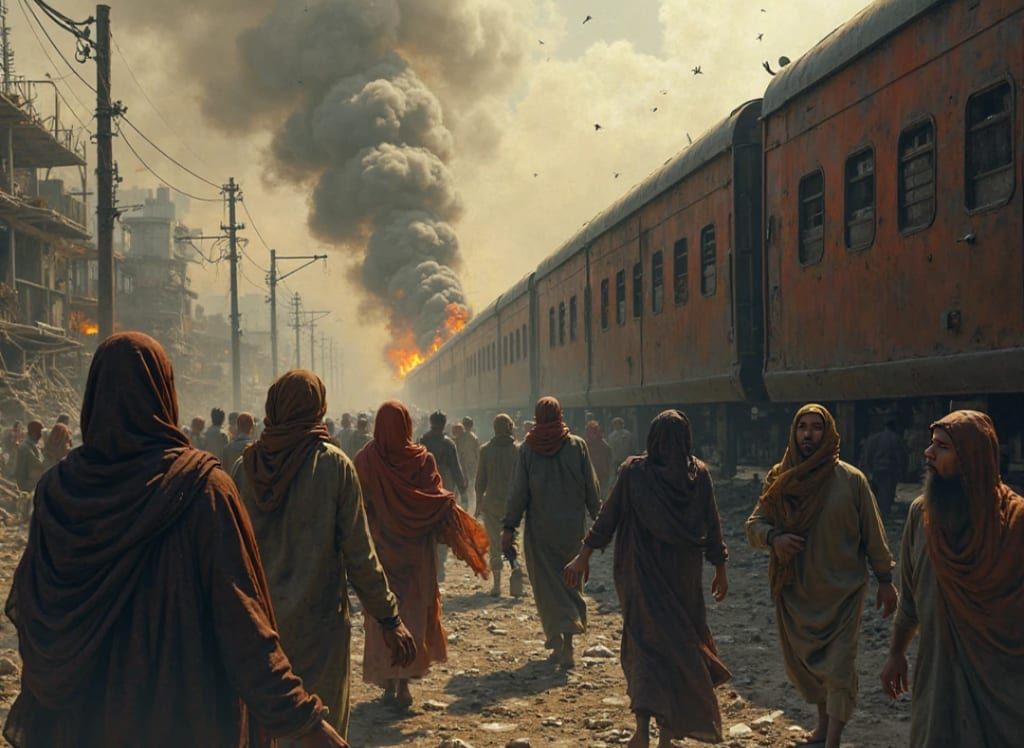
The year 2002 is marked as a bloody and controversial chapter in India's post-independence history. On the morning of February 27 of that year, a terrible incident took place at the Godhra railway station—a fire broke out in the S-6 coach of the Sabarmati Express, killing 59 Kar Sevaks who were returning from Ayodhya. Immediately after this incident, terrible riots spread across the state of Gujarat, in which about 2,000 Muslims were killed, thousands of Muslim women were raped, mosques were destroyed, businesses were ruined, and millions of people were displaced. This riot was not just a communal outrage—behind it was a dazzling political tableau, state silence, and purposeful administrative inaction. The Godhra incident and the subsequent riots are still controversial, questionable, and symbolize the darkest chapter in politics.
First, there are two main views in the interpretation of the Godhra incident—one by the government, the other by independent observers. Government investigations, particularly the Nanavati Commission set up by the Gujarat government, claimed that the burning of the Kar Sevaks was a pre-planned and organised conspiracy by a Muslim mob. It is said that a group of around 1,000 people planned to open the train doors from the Muslim slum of Singhi Phala, pour petrol and set it on fire. But the veracity of this explanation was called into question when the Unni Krishnan Commission and other independent observation teams in 2011 showed that the fire had started from inside the train, making it unlikely that it had been started from outside.
The wave of riots that followed Godhra was ‘pre-planned’ – violence spread in various parts of Gujarat, especially in Muslim-dominated areas. Narendra Modi was the Chief Minister of Gujarat at the time of the riots. The question has repeatedly been raised: Was the administration deliberately inert? Many human rights organizations and investigative reports say that the police were kept as ‘silent spectators’, and in some places they even helped the rioters.
The rise of ‘Teja Bhai’ (Modi) became visible only after this riot. He became popular with a section of the Hindu majority as a ‘tough anti-Muslim administrator’. The rise of nationalist Hindu identity in Indian politics gained new momentum through this riot. Despite the intense criticism of the Modi government in domestic and international circles, the BJP’s public support in Gujarat immediately strengthened, and Modi was re-elected in the next elections.
A terrible aspect was the creation of public opinion through the media. Regional media outlets called ‘Sandesh’ or ‘Gujarat Sangbad’ unilaterally incited hatred against Muslims. In the villages of Gujarat, these newspapers promoted Muslims as ‘traitors’ and ‘jihadis’, as a result of which the common people also burned with the fire of revenge.
Another terrifying aspect is the level of violence against women. Thousands of Muslim women were gang-raped, and children were not spared either. Several reports, including those by the National Human Rights Commission (NHRC), have proven that this rape and violence were not just a spur-of-the-moment incident, but rather ‘planned gendered violence’—where women’s bodies were used as a ‘battlefield’ to destroy Muslim identity.
The question has arisen—is this riot a ‘communal reaction’ or a state-sponsored ‘pogrom’ (extrajudicial mass killing)? Human Rights Watch and India’s ‘Citizens’ Tribunal’ have termed this incident a ‘pogrom’. Because not only the public, but also the indifference of the administration and the failure of the judiciary gave a kind of government sanction to this massacre.
Many members of the Metropolitan Development Authority and the police department have said that they received orders from above ‘not to intervene’. Even during the riots, requests for deployment of the army were rejected in many places, which raises serious doubts about the role of the Modi administration.
Some real events occurred after 2002 that further question Modi’s responsibility. For example, IPS officer Sanjiv Bhatt, who testified in court that Modi himself told the police in a high-level meeting: “Let the Hindus express their reactions.” Bhatt was later dismissed and later sent to prison. His allegations were never accepted by the government.
The political consequences of these riots were a blessing in disguise for Modi. While the whole of India was blaming him internationally, his popularity in Gujarat skyrocketed. He won the elections after 2002, building his image as the protector of Hindu nationalism. Gradually, this image spread to national politics and in the 2014 Lok Sabha elections, Modi led the BJP to a historic victory.
In this context, many researchers believe that the Godhra incident and the Gujarat riots were not just a sudden incident—rather, they were state-sponsored clashes as a political strategy. Although the Indian courts did not convict Modi for the riots, and the Supreme Court gave him a ‘clean chit’ in 2022, many international human rights organizations, journalists, and investigative reports still say—“The blood of the riots was not just on the hands of the mobs, but on the silence of the state.”
These riots have created a hole in the political, social, and religious world of India. The Gujarat riots are a blatant example of how an incident can turn into a massacre through state silence and political opportunism.
About the Creator
Keep reading
More stories from Abdul Barik and writers in History and other communities.
Caste system in Hinduism
Caste system in Hinduism and the history of oppression of lower castes for millennia The caste system has survived for centuries as one of the most complex and tragic realities in the ancient religious, social and political structures of India. It is not only a social structure, but is embedded in the scriptures, rituals and philosophy of Hinduism in such a way that its influence has not weakened even after centuries, but rather it is still present in new forms. The caste system is basically based on the Varnashrama system, the origins of which can be found in Hindu scriptures such as the Rigveda and the Manusamhita. It states that the four main castes—Brahmin, Kshatriya, Vaishya and Shudra—determine the social duties of a person, and the Shudras are the lowest in society, whose purpose in life is to serve the upper classes.
By Abdul Barik8 months ago in History
Can the United States Leave NATO?
Can the United States Leave NATO? What It Would Take—and What It Would Mean The North Atlantic Treaty Organization, commonly known as NATO, has been one of the most powerful military alliances in modern history. Since its creation in 1949, the United States has been NATO’s strongest member—militarily, financially, and politically. But in recent years, debates have grown louder about whether the U.S. should remain in the alliance. This raises a serious question: how could the United States be removed from NATO—or leave it—and what would that mean for the world?
By Wings of Time 7 days ago in History
3 Ordinary Places That Hid Something Truly Disturbing for Years
Most of us take comfort in ordinary places. Schools feel safe. Homes feel familiar. Workplaces feel predictable. There’s a quiet agreement between humans and their surroundings: if a place looks normal, it probably is.
By Enoch Saginiabout 4 hours ago in History


Comments
There are no comments for this story
Be the first to respond and start the conversation.