
Caste system in Hinduism
Caste system in Hinduism and the history of oppression of lower castes for millennia.

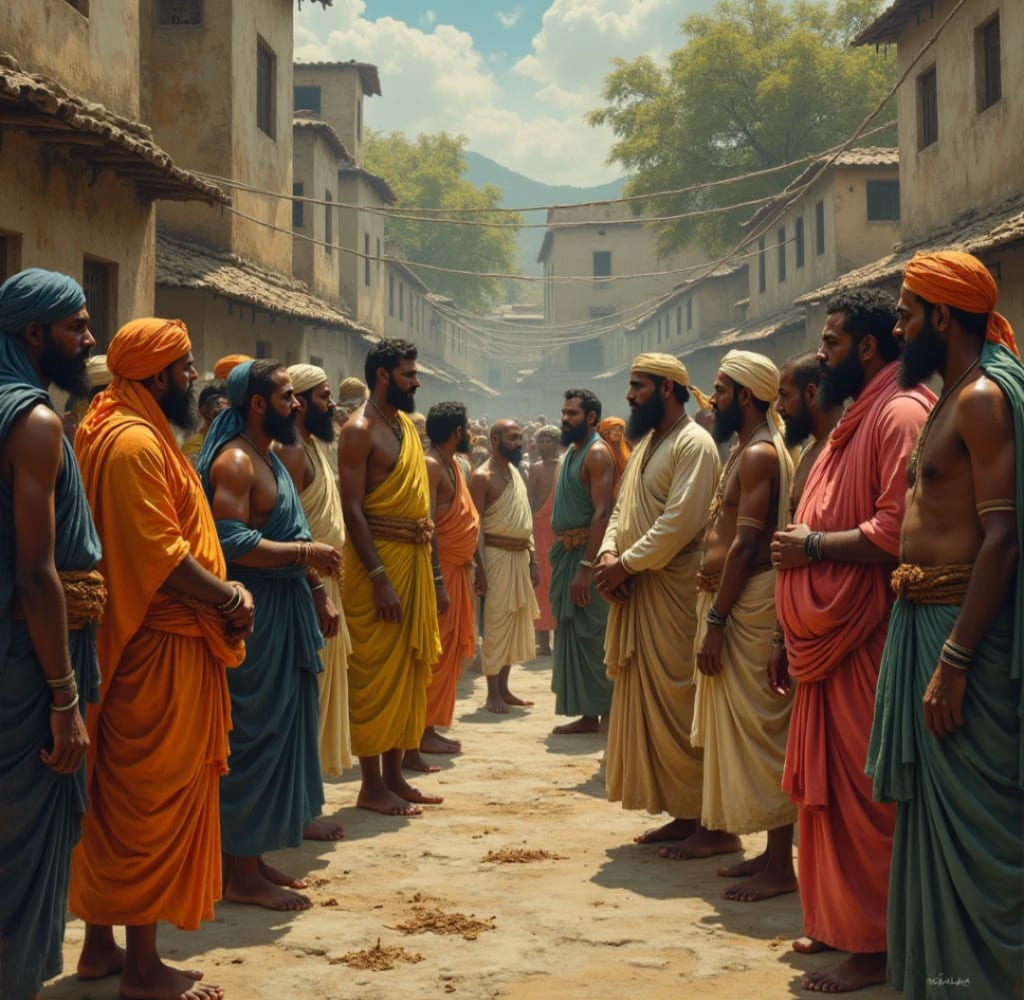
Caste system in Hinduism and the history of oppression of lower castes for millennia
The caste system has survived for centuries as one of the most complex and tragic realities in the ancient religious, social and political structures of India. It is not only a social structure, but is embedded in the scriptures, rituals and philosophy of Hinduism in such a way that its influence has not weakened even after centuries, but rather it is still present in new forms. The caste system is basically based on the Varnashrama system, the origins of which can be found in Hindu scriptures such as the Rigveda and the Manusamhita. It states that the four main castes—Brahmin, Kshatriya, Vaishya and Shudra—determine the social duties of a person, and the Shudras are the lowest in society, whose purpose in life is to serve the upper classes.
The most terrible aspect of this system was the creation of the ‘untouchable’ or ‘untouchable’ caste. This class was considered so low that if a higher caste even touched or touched them, there was a fear of losing its purity. For centuries, millions of people in India were considered “unfit”, “unclean”, “impure” simply by birth, who were forbidden to enter temples, had no right to education, and whose jobs were to collect bones, clean filth, skin, tear dead animals apart or light fires in crematoriums. This inhuman system was not an optional custom; rather, society, religion, law and culture together made it natural and legitimate.
The Manusamhita—one of the main religious texts of Hindu society—not only gave religious legitimacy to this caste distinction, but also sought to perpetuate it by prescribing punishments. It states that if a Shudra listens to the religious teachings of a Brahmin, molten lead should be poured into his ears. If he speaks to someone from a higher caste, his tongue should be cut out. These terrible principles were not limited to writing, but were in effect in real society for many generations.
Although the caste system underwent some changes in the Middle Ages, after the arrival of Islam and later the British, the basic structure of this system remained intact. Although the Muslim rulers tried to create a relatively just social system, it was not possible to get rid of caste discrimination in many Hindu societies. Although the British rulers brought some educational and legal reforms, they themselves used the caste system in the policy of 'Divide and Rule'. As a result, the caste system was not completely destroyed in post-independence India, but rather it merged with the modern system.
Although the Constitution of independent India prohibits the caste system, the reality is that even today in many areas, especially in rural areas, people from Dalit or lower castes are subjected to deprivation, oppression, rape, mob lynching, social boycott and physical attacks. They cannot enter temples, they are forbidden to enter ponds, and in many places even upper caste people do not sit with them for meals. In some areas, the ‘two glass system’ is still in effect—a separate tea cup is kept for Dalits.
The biggest protest against this terrible social discrimination came under the leadership of B. R. Ambedkar. He himself was a Dalit and as the author of the Indian Constitution, he fought against the caste system all his life. He declared—“I was born a Hindu, but I will not die a Hindu.” Ultimately, he abandoned Hinduism and converted to Buddhism. His move created a revolutionary spirit in Indian society and many Dalits abandoned Hinduism following his example.
In today’s India, Dalits number more than 200 million, or about 16-17% of the total population. Yet, higher education, government jobs or political representation among this large population is very limited. Although the reservation policy provided some benefits, it could not bring about any radical change in social status in real terms. Moreover, today's Indian politics uses Dalits as a vote bank, but does not take any serious action for their real liberation.
Brahmanism—that is, the hegemonic philosophy of Brahmins—is rooted in the caste system. This philosophy not only establishes itself as the sacred and highest class, but also defines others as inherently inferior and servants. It creates a psychological slavery, where a Shudra is forced to believe that he is inherently inferior and that the Brahmin is worthy of respect. This psychological oppression is more terrible than slavery, because in it the person himself accepts his own chain with pleasure.
However, the hope is that the struggle against this system does not stop. Many intellectuals, social movements, literati, Dalit writers, and even some conscientious Hindu activists are taking up the pen and taking to the field against this injustice. The justice-based social philosophies of Islam, Christianity, Buddhism, and Sikhism have given new shelter to many Dalits. The Indian Constitution, the courts and some modern institutions have taken a stand against this practice, although it is still not enough.
If India wants to become a truly secular, humane and egalitarian state, then this poison of casteism must be uprooted. It is not enough to ban it only in legal terms, a major human revolution is needed in the socio-cultural sphere. People must be taught that not birth, but deeds are the identity of a person. Not caste, but humanity is the criterion of excellence.
About the Creator
Keep reading
More stories from Abdul Barik and writers in History and other communities.
The Fall of the Caliphate: The History of the Division of the Muslim Ummah and the Brutal Reality of Western Geopolitics.
No moment in history is ever isolated or isolated. Behind every political catastrophe, every collapse lies the combined shadow of centuries of preparation, internal breakdown and external intrigue. The fall of the Caliphate was such a historical catastrophe—not just the end of a regime, but also the extinction of an ideal, a worldview and a collective ummah.
By Abdul Barik9 months ago in History
Chinese Water Torture
Since the dawn of history, human beings have inflicted unimaginable suffering upon one another. Across centuries, people have devised increasingly elaborate methods of punishment and coercion, some brutally explicit, others deceptively subtle. While devices such as iron maidens, racks, whips, and wheels relied on visible physical agony, there existed a form of torment whose true power lay not in blood or broken bones, but in patience, repetition, and the slow erosion of the mind. This method came to be known as Chinese water torture.
By Pure child3 days ago in History
Saddam Hussein: Rise, Rule, and Fall
Saddam Hussein was born on April 28, 1937, in a small village near Tikrit, Iraq. His early life was marked by poverty, hardship, and a sense of abandonment. His father died before he was born, and his mother remarried soon after. Young Saddam grew up in a household dominated by strict relatives and was exposed to political discussions and nationalist sentiments from an early age. These formative years shaped his personality—ambitious, ruthless, and fiercely determined to rise above his modest beginnings.
By The best writer 3 days ago in History



Comments
There are no comments for this story
Be the first to respond and start the conversation.